![]()
1
Introduction
Thou O Spirit, that dost prefer
Before all Temples th’ upright heart and pure,
Instruct me, for Thou know’st
John Milton
The study in which I write is a small upper room in the east wing of a large Georgian building that once served as the county lunatic asylum. The now tranquil grounds continue beyond the nearby road where they transform into an extensive graveyard arrayed with damp, stone-shrouded Victorian ornament, plain military headstones, marble and flowers. And everywhere yew trees – those age-old symbols of renewal and immortality. Time pervades this place. One cannot help but be reminded of the fleeting nature of existence – and this heightened sense of transience gives the present a vital beauty tinged with a melancholy hue.
Close behind the town rises the high moorland hill of Clougha Pike. If the early residents of the asylum ever made this climb and looked to the southeast they would have seen on the distant plain before them the smoke-billowing mills and factories of the Industrial Revolution. Here was industry writ large – rationalized production, commerce, unimagined wealth, exploitation and urban squalor. Here was the world of James Brindley, who reshaped goods transportation through the canal system, and Richard Arkwright and Samuel Crompton, who pioneered large-scale cotton manufacturing. Here was technology, instrumental reason and progress.
If those same early residents had turned around and looked to the northwest, a very different scene would have met them. In the distance, across the sands of the broad bay, rise the spectacular fells of the English Lake District – the home of British Romanticism. This was a world of art, poetry and literature, of human imagination and aesthetic experience and was, in many ways, a reaction to the rise of industry and trade to the south. Here Wordsworth and Coleridge roamed and wrote of daffodils and the up-springing lark, and Turner and Constable captured the soul of nature.
While the great poets and painters of Cumbria are long dead and the ‘dark satanic mills’1 of Lancashire are now but silent sentinels of a triumphant past, the sensibilities they each brought into sharpened focus remain. In this place, reason, objectivity, advancement and pragmatism rubbed shoulders with aesthetic sensitivity, intuition and imaginative experiences that lie beyond the realm of intellectual understanding. If there can ever be a geographic spot that epitomizes the spirit of design, it is surely the top of this windswept hill where these two vistas meet.
Design as a form of inquiry
A particularly prominent feature of today’s society is the emphasis placed on monetary concerns. Even in our universities cost-effectiveness, competitive funding and ‘real world’ economic benefits have become dominating themes. This has grown to such an extent that the very notion of exploring ideas for their own sake is regarded by some as almost quixotic.
Despite the current of the times and the short-term agendas of government and market, it remains crucial to explore areas of interest, irrespective of their immediate usefulness or prospects of turning a profit. This is the nature of academic inquiry. However, in my own experience, having lectured and given conference talks all over the world, the questions I have been asked time and time again centre on how my propositional designs might be produced and sold, whether they are feasible as commercial products, and whether I collaborate with companies to put them into production. Such concerns have no place in this type of creative investigation.
After a century or more of product design for mass-production, we have developed the means for making a plethora of ever-changing goods readily accessible to many. We are well aware that, in doing so, we have also contributed to unprecedented environmental devastation and unconscionable social exploitation and inequity. Ironically, however, there is little evidence to suggest that all these developments in design, production and acquisition have made us any happier. On the contrary, the unremitting messages of product advertising combine to create a pervading sense of discontent.
It becomes important, therefore, to reflect upon the implications of product design and how its undesirable effects are embedded in the very nature of how we conceive of and produce functional objects. And we must explore alternative forms that manifest quite different sensibilities and values. Eventually, some of these explorations might be developed into a material culture that is not only in closer accord with environmental and social responsibilities but also with more meaningful understandings of human happiness. Such aims tend to be ignored or severely distorted within our present system. International fanfare surrounding minor ‘improvements’ to small electronic gadgets, product launches that promote endless variations on a theme, and the media spotlight placed firmly on the putative benefits rather than the devastating costs are merely some of the indications that product design, as well as the system of which it is a part, is ripe for fundamental change.
A new direction
If change is needed, we require at least some indication of a new direction. This is where design can make a contribution – by imagining and visualizing new forms of functional objects that are not only less damaging to the natural environment but also are in accord with more meaningful understandings of human well-being.
Such forms are explored here through a series of discussions and propositional objects. Environmental considerations are part of this, but the main focus is on the development of functional objects that are consistent with substantive values and profound notions of human meaning. It is surely self-evident that the former cannot be pursued without due account of the latter.
The following chapters combine reasoned argument and the development of theory with speculative design explorations. These tangible propositions both inform and embody the theoretical concepts. Taken together, the discussions and objects constitute a form of creative academic design practice.
A particular challenge today is the design of functional objects that rely on rapidly advancing, and therefore highly transient, digital technologies. Current approaches favour product replacement when technologies become outmoded, which results in a destructive legacy of electronic waste. However, digital technologies enable functionality via software applications and, as such, the physical form of the object becomes far less relevant to the achievement of everyday tasks than was the case with mechanical devices. Effectively, this liberates much product design from the constrictions of function, allowing it to explore areas of significance that lie outside the virtual realm and giving it a new, much needed stimulus to reconsider its purpose and contribution.
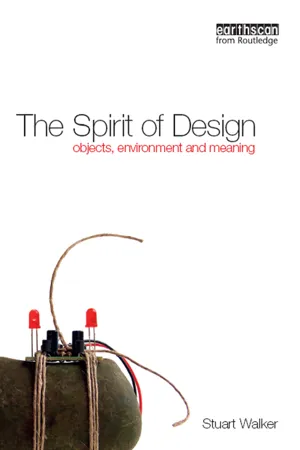
The propositional objects presented here include explorations of design and place, electronic artefacts that incorporate unmodified or ‘raw’ natural materials, and product concepts that encourage considered use. In addition, hybrid objects combine technologies with archetypal forms to reach beyond prosaic functionality and allude to deeper, enduring notions of human meaning and spiritual understanding.
Together these explorations yield a robust basis for a fresh approach to product design. The early 20th century’s influential principle of ‘form follows function’ is superseded not by the black boxes of late 20th century product design, the whimsical forms of postmodern experimentation or fashionable variations whose justification is merely change for its own sake, but by a rationale for form beyond function anchored in enduring understandings of human realization. Such a direction, which we might summarize as ‘form follows meaning’, takes design beyond the instrumental logic of production efficiencies, in which the product too often becomes simply a means to economic growth and shareholder profit. Here, design embraces not only substantive values but also matters of ultimate concern; those facets of our humanity that encompass but transcend reason. These, at least, are the aims – the fact that they are never fully achievable, makes their pursuit no less worthy.
The results of such practice can serve as a catalyst for discussion and the advancement and maturation of product design as a discipline. The work draws on a heritage of human values and understandings of meaning to take design beyond the often superficial and damaging characteristics it has developed over past decades; characteristics that successfully stimulate consumerism but with insufficient regard for consequences.
![]()
2
Sambo’s Stones
sustainability and meaningful objects
it is impossible for you to take up the most insignificant pebble at your feet, without being able to read, if you like, this curious lesson in it. You look upon it first as if it were earth only. Nay, it answers, ‘I am not earth – I am earth and air in one; part of that blue heaven which you love, and long for, is already in me; it is all my life – without it I should be nothing, and able for nothing; I could not minister to you, nor nourish you – I should be a cruel and helpless thing; but, because there is, according to my need and place in creation, a kind of soul in me, I have become capable of good, and helpful in the circles of vitality.
John Ruskin
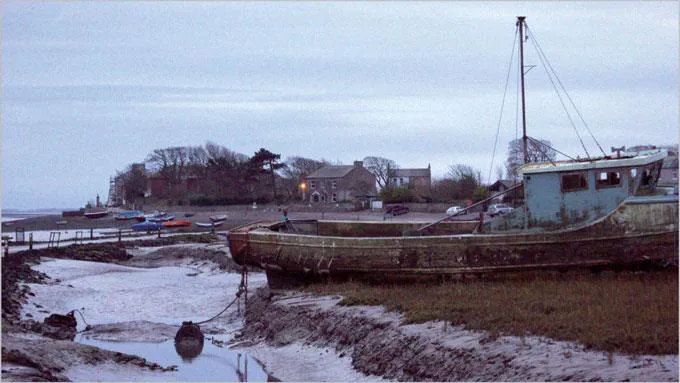
On the northwest coast of England, a narrow, poorly maintained road leads out across marshy tidal flats. The withdrawing tide sucks at the mud, scouring deep channels. At high water, the way becomes impassable, cutting off the old, weather-beaten houses huddled on the higher ground at the far end of the spit. It is a wild, wind-blown place – a constantly shifting landscape of tidal pools, quicksands and coarse salt-grasses – home to lapwings and curlews and rotting hulks that are slowly being claimed by the sea (Figure 2.1). Cows, their haunches and bellies caked black, wade through the sodden earth at the edge of the track, seeking clumps of moist, green growth.
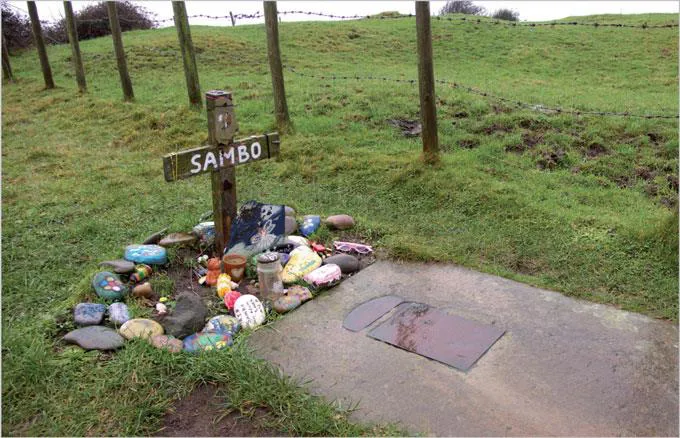
At the end of the surfaced road, a footpath leads up to the houses. Some are inscribed with dates – bearing witness that in the 18th century this remote, cloud-laden place was once a thriving seaport that sent ships to Virginia and the Indies. Among the houses, a narrow lane leads to the windward side of the point and here, in unconsecrated ground at the edge of a blustery field, lies a solitary little grave (Figure 2.2). It is a poignant reminder of a shameful history. The name inscribed on the brass plaque of the gravestone is Samboo, itself an offensive slur – not so much a name as a label. It marks the last resting place of a young black boy buried here in a period when England profited well from exploiting other human beings.1,2
Sambo, which is the name more commonly used, arrived at this spot in 1736. It is thought that he was the servant boy of a ship’s captain; and he most likely died from cold and fever.3
Memorial stones
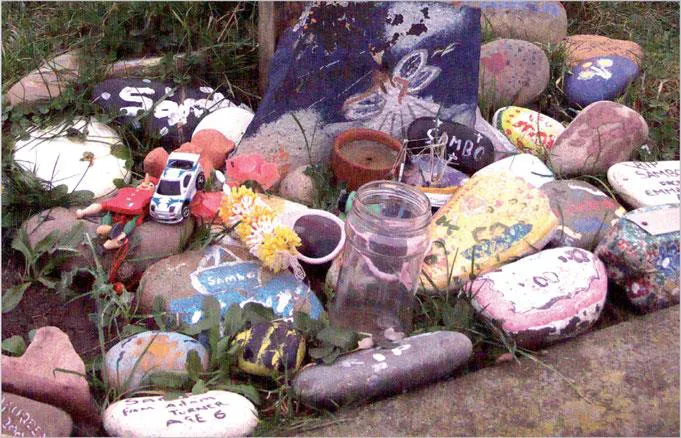
Visiting Sambo’s Grave today, one usually finds painted pebbles placed around the simple wooden cross (Figure 2.3). These are the work of children; school-trip gifts to a long-dead fellow innocent. The local poet, Edward Calais, in his poem ‘Samboo’s Grave’, calls these decorated stones ‘mawkish’4 – perhaps they are, but this seems a harsh judgement. These stones can tell us much about the nature of objects and how we find, express and ascribe meaning. They can also contribute to our understandings of sustainability, and the environmental and social responsibilities this term invokes.
These painted stones are the result of a teacher’s class about history, with simplified stories about events that today we regard as reprehensible and dishonourable. Children express their own interpretations of regret and sadness in these sentimental pebbles; but the process is not complete until the trek is made to the gravesite, which is especially moving because of its bleak isolation.
The meaning and significance of these stones can be interpreted from several angles. Firstly, there is the relationship of these artefacts to our own history and sense of identity – a history of empire and expansionism, trade and the economic development of the Americas, together with the inhumanity of the slave trade, which wrought such devastating and enduring effects. So these stones, an outcome of children learning something of this history, are linked to our own cultural identity. Reflecting on this history and identity, these memorial stones inevitably raise thoughts about morality – that ever-changing system of ideas by which a society judges good and virtuous conduct. In hindsight, we judge our predecessors who took part in or were supportive of the slave trade, as having a lower or inadequate sense of morality. Yet, at the time, people whom society judged to be upright citizens were open supporters and politicians spoke out in the Houses of Parliament, decrying any attempts to abolish it.5 Are these simply the actions of a less enlightened age? Or are we, today, also pursuing activities that will leave lasting scars and which future generations will also judge immoral and reprehensible?
Secondly, there is the intention behind their creation. Far more poignant than generalities about empire and slavery, these stones are created for one particular person. Each is a commemorative act from one child to another; a gift that connects across time and demonstrates a fundamental notion of empathy between two human beings. In effect, the intention behind the act of gift making imaginatively ascribes to the object feelings present in oneself and, through the act of gift giving, whereby the stones are placed on the grave, passes these feelings on to the dead child. It matters not that the recipient is deceased and therefore unable to appreciat...