Protecting the Brand
eBook - ePub

Protecting the Brand

Busting the Bootlegs

  1. 416 pages
  2. English
  3. ePUB (mobile friendly)
  4. Available on iOS & Android
eBook - ePub

Protecting the Brand

Busting the Bootlegs

About this book

Protecting the Brand, Volume II: Busting the Bootlegs follows Volume I which provides a unique combination of legal and business best practices related to intellectual property protection.

This second volume showcases U.S. states specific legal statues and examples related to legal approach to counterfeiting and grey market issues. The primary emphasis is to prove advice to U.S. companies navigating the complex domestic legislation and provide a single source of reference for both law practitioners and those tasked with intellectual property rights enforcement and compliance who need to understand the applicable state legislation.

Both volumes of this book are focused on leveraging trademark enforcement while also commenting on copyright and patent enforcement, establishing a framework for successful brand protection in the future.

Frequently asked questions

Yes, you can cancel anytime from the Subscription tab in your account settings on the Perlego website. Your subscription will stay active until the end of your current billing period. Learn how to cancel your subscription.
No, books cannot be downloaded as external files, such as PDFs, for use outside of Perlego. However, you can download books within the Perlego app for offline reading on mobile or tablet. Learn more here.
Perlego offers two plans: Essential and Complete
  • Essential is ideal for learners and professionals who enjoy exploring a wide range of subjects. Access the Essential Library with 800,000+ trusted titles and best-sellers across business, personal growth, and the humanities. Includes unlimited reading time and Standard Read Aloud voice.
  • Complete: Perfect for advanced learners and researchers needing full, unrestricted access. Unlock 1.4M+ books across hundreds of subjects, including academic and specialized titles. The Complete Plan also includes advanced features like Premium Read Aloud and Research Assistant.
Both plans are available with monthly, semester, or annual billing cycles.
We are an online textbook subscription service, where you can get access to an entire online library for less than the price of a single book per month. With over 1 million books across 1000+ topics, we’ve got you covered! Learn more here.
Look out for the read-aloud symbol on your next book to see if you can listen to it. The read-aloud tool reads text aloud for you, highlighting the text as it is being read. You can pause it, speed it up and slow it down. Learn more here.
Yes! You can use the Perlego app on both iOS or Android devices to read anytime, anywhere — even offline. Perfect for commutes or when you’re on the go.
Please note we cannot support devices running on iOS 13 and Android 7 or earlier. Learn more about using the app.
Yes, you can access Protecting the Brand by Peter Hlavnicka,Anthony Keats in PDF and/or ePUB format, as well as other popular books in Business & Business Law. We have over one million books available in our catalogue for you to explore.

Information

CHAPTER 1
State Civil and Criminal Anti-Counterfeiting Statutes
A Parallel System of Trademark Anti-Counterfeiting Statutes
Although the Founding Fathers of the United States considered the need to encourage innovation and protect creativity for limited periods of time through patents and copyrights, they did not give trademarks similar consideration. In fact, although counterfeiting had been taking place in various forms for centuries, trademark counterfeiting has grown exponentially in the modern industrial age. While federal and state governments have recognized the need to protect the consumer from confusion with regard to the source of a product or service, there has also been a significant surge in the value of trademark assets through commercial advertising and sales of branded goods. This has created portfolios of valuable assets for the brand owners as well. The confluence of these two interests has brought about the passage and implementation of state, as well as federal, civil, and criminal anti-counterfeiting statutes.
In the United States, unlike the exclusive federal laws pertaining to patents and later to copyrights, a parallel system of state and federal law developed to protect trademarks. Commercial issues relating to false labeling, forgery, and the like led to the development of various unfair trade practice laws among the states. Almost every state had these types of consumer protection statutes. For example, in 1881, New York’s legislature enacted Penal Code Section 364, which made trademark counterfeiting a misdemeanor.1 However, as commerce became national in scope and products and services were available throughout the country, consumers needed the same protection everywhere. Unfortunately, many states treated the same harm to the consumer differently.2
Congress enacted the Lanham Act in 1946 in order to provide national protection for trademarks used in interstate and foreign commerce. S. Rep. No. 1333, 79th Cong., 2d Sess., 5 (1946). Previous federal legislation, such as the Federal Trademark Act of 1905, 33 Stat. 724, reflected the view that protection of trademarks was a matter of state concern and that the right to a mark depended solely on the common law. S. Rep. No. 1333, at 5. Consequently, rights to trademarks were uncertain and subject to variation in different parts of the country. Because trademarks desirably promote competition and the maintenance of product quality, Congress determined that “a sound public policy requires that trademarks should receive nationally the greatest protection that can be given them.”3
Congress passed the Lanham Act in 1946 to bring a single unified statutory scheme to the treatment of trademarks, similar to that accorded to patents and copyrights before.
Why Is the Parallel System of Trademarks Important or of Value?
Unlike patent and copyright protection, state laws relating to trademarks may be broader than the Lanham Act.4 The Lanham Act does not preempt state law.5 Both federal and state courts have ...
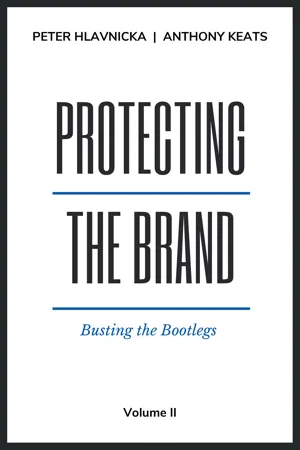
Table of contents

  1. Cover
  2. Half-Title Page
  3. Title Page
  4. Copyright
  5. Description
  6. Contents
  7. Foreword
  8. Preface
  9. Acknowledgments
  10. Chapter 1 State Civil and Criminal Anti-Counterfeiting Statutes
  11. Chapter 2 Federal Criminal Law
  12. Chapter 3 The Legal Framework for Protection from Copyright Piracy
  13. Chapter 4 Using the Lanham Act to Combat Grey and Counterfeit Goods
  14. Chapter 5 The Material Difference: Sections 32, 43(A), and 42 of the Lanham Act and Section 526 of the Tariff Act
  15. About the Authors
  16. Index
  17. Backcover