eBook - ePub
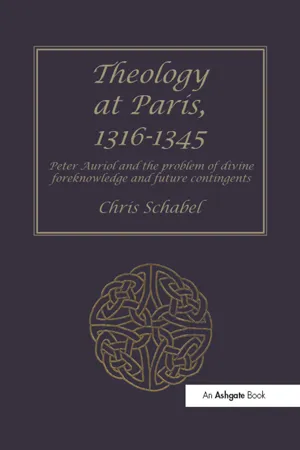
Theology at Paris, 1316–1345
Peter Auriol and the Problem of Divine Foreknowledge and Future Contingents
- 382 pages
- English
- ePUB (mobile friendly)
- Available on iOS & Android
eBook - ePub
Theology at Paris, 1316–1345
Peter Auriol and the Problem of Divine Foreknowledge and Future Contingents
About this book
Chris Schabel presents a detailed analysis of the radical solution given by the Franciscan Peter Auriol to the problem of reconciling divine foreknowledge with the contingency of the future, and of contemporary reactions to it. Auriol's solution appeared to many of his contemporaries to deny God's knowledge of the future altogether, and so it provoked intense and long-lasting controversy; Schabel is the first to examine in detail the philosophical and theological background to Auriol's discussion, and to provide a full analysis of Auriol's own writings on the question and the immediate reactions to them. This book sheds new light both on one of the central philosophical debates of the Middle Ages, and on theology and philosophy at the University of Paris in the first half of the 14th century, a period of Parisian intellectual life which has been largely neglected until now.
Information
PART ONE
The Background
Chapter 1
The Roots of the Debate
The Antiqui
Later-medieval solutions to the problem of divine foreknowledge and future contingents were the culmination of the development of ideas surrounding issues that philosophers and theologians had been debating for many centuries. Peter Auriol and other early fourteenth-century scholastics cited with frequency the pertinent texts of these venerable ancients or antiqui: Aristotle worried about what would happen if future-tensed propositions had to be either true or false; Augustine and Boethius helped develop and popularize a view of God in eternity that allowed for His immutable knowledge, yet preserved contingency and human free choice; and Boethius and Anselm articulated a modal theory that distinguished between what they considered benign and malignant senses of the necessity that one could tie to God’s knowledge of the future. Finally, Peter Lombard influenced later thinkers with the organization of and the doctrine in his Sentences, which became the theological textbook of the universities: all theologians in the period of concern in this book had to deal with foreknowledge in distinctions 38 and 39 of book I of their Sentences commentaries. The writings of Aristotle, Augustine, Boethius, Anselm and Lombard not only stimulated the basic theories of divine foreknowledge developed in the thirteenth and fourteenth centuries, but they also created a technical theological and philosophical vocabulary that later theologians used to express those theories. For these reasons, some familiarity with their contributions is required.1
Aristotle and the Truth of Propositions
Medieval theologians cited various works of Aristotle, the ‘Philosopher’, in the context of foreknowledge, but chapter nine of De Interpretatione, known to scholastics by its Greek name, Peri Hermeneias, overshadowed all others.2 In book I, distinction 38 of innumerable Sentences commentaries of the fourteenth century, where scholastics asked something along the lines of “Does God know future contingents?” they first responded rhetorically: “No: there is no determinate truth in future contingents, according to the Philosopher in Peri Hermeneias; but God knows only what is true; thus God does not know future contingents.”
In chapter four of Peri Hermeneias, Aristotle defines ‘proposition’ as the type of sentence that has truth or falsity, and he thus establishes the Principle of Bivalence — that is, every proposition can and must have one of two ‘truth values’: it must either be true or false. In the context of their statements on propositional logic, medieval theologians often derived this principle on the basis of a slightly different parallel rule from Metaphysics IV, chapter three: “Concerning anything whatever either the affirmation or negation is true,” a logical principle so fundamental that they called it the ‘First Principle’ (primum principium). Aristotle sets up a corollary in chapter six of Peri Hermeneias, that for every positive proposition there exists its opposite, contradictory, negative proposition and vice-versa. In the Middle Ages this was called the ‘Law of Contradictories’ (lex contradictoriarum), that for each pair of contradictory propositions, for example ‘Paris is in France’, ‘Paris is not in France’, exactly one is true and the other false. In the beginning of the famous chapter nine, Aristotle summarizes this rule by saying, in a passage which medieval thinkers often quote directly:
In the case of that which is or which has taken place, propositions, whether positive or negative, must be true or false. Again, in the case of a pair of contradictories, either when the subject is universal and the propositions are of a universal character, or when it is individual, as has been said, one of the two must be true and the other false.3
As the passage makes clear, Aristotle mentions only propositions about the present and past.
Most fourteenth-century theologians held that Aristotle made an exception for propositions with individual subjects and about the future. Aristotle suggests that if those propositional laws applied to future contingent propositions, then everything would take place of necessity, and nothing by our free choice. If the proposition ‘Ninevah will fall’ were true now, then it appears that Ninevah would necessarily fall. Conversely, if it were false now, then it would be impossible for Ninevah to fall in the future, otherwise the proposition would have been true in the first place. One or the other of a pair of contradictory propositions about the future will be ‘verified’ by the facts, for Ninevah will either fall or not fall, but if it had been true beforehand to say ‘Ninevah will fall’, then Ninevah’s fall was unavoidable. Thus if the Principle of Bivalence is applied to future-tensed propositions of this sort, then there is no real alternative to what comes about. If all things happened of necessity, in a phrase often repeated in the Middle Ages, “There would be no need to deliberate or take trouble” about the future.4
Aristotle says these are “awkward results,” and the conclusion is impossible, because people know that taking steps and deliberating about the future does indeed affect events, and that those events can either happen or not happen. While most medieval theologians held along with Aristotle that there was no point in deliberating about or denying the existence of something while it exists, and that “everything which is, when it is, necessarily is” (omne quod est, quando est, necesse est esse), they also agreed, however, that before things happen, one does not deliberate about them in vain, since not all things happen or will happen of necessity.5
What then is the truth-value of statements about future events, such as Aristotle’s famous example of the sea battle, which can and can not come about? Scholars have debated this for a long time, and medieval theologians certainly did not agree about the Philosopher’s view.6 Many took him to mean that such propositions are neither true nor false. Of course Aristotle does say that “everything must either be or not be,” but many understood that this statement must be taken as a whole, with disjunction ‘or’ intact. This is why Aristotle continues: “It is not always possible to distinguish and state determinately which of these alternatives must necessarily come about.”7 The key word for many medieval theologians is ‘determinately’, and Aristotle seems to mean that it is not already determined that something will come about, or that something will not come about, and thus the truth or falsity of a proposition about the future has not been determined yet either. A few scholastics held that Aristotle meant to say that propositions about future contingents may be true or false, but not determinately true or false — they are ‘indeterminately’ true or false. Others claimed that he was only talking about future contingents understood in themselves, not as they are in God’s intellect, where such determination obtained. Still others maintained that Aristotle was simply denying that all such propositions have any truth or falsity at all. Instead, they are completely indeterminate with respect to truth and falsity.
Aristotle goes on to say:
Since propositions correspond with facts, it is evident that when in future events there is a real alternative, and a potentiality in contrary directions, the corresponding affirmation and denial have the same character… it is therefore plain that it is not necessary that of an affirmation and a denial one should be true and the other false. For in the case of that which exists potentially, but not actually, the rule which applies to that which exists actually does not hold good.8
Aristotle left the matter at that and did not clarify his position further. In his concern with the necessity or contingency of future events, Aristotle did not consider what foreknowledge, especially divine foreknowledge, would have meant as an additional factor. Augustine had no choice.
Augustine, Boethius, and God's Eternity
The influence of Augustine (354–430), Bishop of Hippo, on the theology of the Middle Ages is ubiquitous. In the fourteenth century especially, with theologians’ growing interest in historical accuracy, scholars cited the works of Augustine with ever-increasing frequency, more than those of any other Christian theologian.9 The slight ambiguity of his statements concerning free will and divine foreknowledge provided fuel for several different positions in the later-medieval discussion.10 As an opening argument against Aristotle, and indeed as a major means of support, later scholastics cited Augustine’s remarks against Cicero in City of God. Cicero had tried to refute the notions of certain pagan philosophers, some of them Stoics, that humans had a fate or destiny which was already set up in advance. In doing so, Cicero rejected foreknowledge, and he included in his attack astrology, oracles, and any sort of divination. Augustine thought that denying foreknowledge was tantamount to denying God’s existence, “for one who is not prescient of all future things is not God.”11 In a pun on Cicero’s name, Marcus Tullius Cicero, Augustine claimed that astrology was more “tolerable” (tollerabilis in some medieval spellings) than the complete denial of any foreknowledge.12
Medieval theologians also used his statements about the causal relationship between God’s foreknowledge and human action in their principal arguments. Augustine understood that a human ‘must’ do as God foreknew, but he was not able to explain clearly why this ‘having’ to do something was compatible with free will. Sometimes he seems merely to say that it is enough that God foreknows we will do something by our free will. Some scholastics accepted this explanation. For Augustine, the connection between foreknowledge and free will is difficult to describe:
… a man does not therefore sin because God foreknew that he would sin. Nay, it cannot be doubted but that it is the man himself who sins when he does sin, because He, whose foreknowledge is infallible, foreknew not that fate, or fortune, or something else would sin, but that the man himself would sin, who, if he wills not, sins not. But if he shall not will to sin, even this did God foreknow.13
Later theologians disagreed on how to interpret this type of auctoritas, or authoritative passage. Since God’s knowledge does not change, because God is immutable and perfect, Augustine is compelled to say in The Trinity, “He does not, therefore, know all His creatures, both spiritual and corporal, because they are, but they, therefore, are because He knows them.”14 The word ‘therefore’, coupled with the stress on immutability, seemed to say that foreknowledge causes future things. To this and other like auctoritates of Augustine, later theologians opposed an equally enigmatic phrase from Origen appearing on the face of it to say that future things cause foreknowledge.
Of course, later-medieval theologians understood why these passages in Augustine were so ambiguous. Augustine developed a notion of a God outside of time, unchanging, far from the imperfect, ever-changing world of creation, a notion that was difficult to put into words that humans, trapped in time, could understand. Everywhere in fourteenth-century writings one finds quotations from several of Augustine’s works where he tries to explain that God does not experience past or future, but everything all at once, simultaneously, in “one eternal, changeless, and ineffable vision.”15 For example, in De diversis quaestionibus 83: “For God, nothing is absent, neither the past nor the future, but everything is present to God.” Events do not go past God’s view; God does not see one thing now, another later, but all at once.
In addition, God’s knowledge is as changeless as His essence and substance, and in fact it is the same thing. So in The Trinity, Augustine remarks:16 “God does not know things differently after they happen from before they come about,” and: “The foreknowledge that God has of every creature is none other than the divine essence.” This notion of God’s ‘eternal present’, for Augustine, preserved simultaneously the idea of a perfect, unchanging, omniscient God, and human free will. Regardless of its po...
Table of contents
- Cover
- Half Title
- Title Page
- Copyright Page
- Table of Contents
- Preface
- List of Abbreviations
- Introduction
- Part I: The Background
- Part II: Peter Auriol’s Theory
- Part III: The Reaction to Auriol’s Theory at Paris
- Part IV: The Reaction in England and in the Late Middle Ages
- Epilogue: The Quarrel at Louvain
- Bibliography
- Index of Manuscripts
- Index of Medieval Names
- Index of Modern Authors
- Index of Topics and Places
Trusted by 375,005 students
Access to over 1.5 million titles for a fair monthly price.
Study more efficiently using our study tools.
Frequently asked questions
Yes, you can cancel anytime from the Subscription tab in your account settings on the Perlego website. Your subscription will stay active until the end of your current billing period. Learn how to cancel your subscription
No, books cannot be downloaded as external files, such as PDFs, for use outside of Perlego. However, you can download books within the Perlego app for offline reading on mobile or tablet. Learn how to download books offline
Perlego offers two plans: Essential and Complete
- Essential is ideal for learners and professionals who enjoy exploring a wide range of subjects. Access the Essential Library with 800,000+ trusted titles and best-sellers across business, personal growth, and the humanities. Includes unlimited reading time and Standard Read Aloud voice.
- Complete: Perfect for advanced learners and researchers needing full, unrestricted access. Unlock 1.5M+ books across hundreds of subjects, including academic and specialized titles. The Complete Plan also includes advanced features like Premium Read Aloud and Research Assistant.
We are an online textbook subscription service, where you can get access to an entire online library for less than the price of a single book per month. With over 1.5 million books across 990+ topics, we’ve got you covered! Learn about our mission
Look out for the read-aloud symbol on your next book to see if you can listen to it. The read-aloud tool reads text aloud for you, highlighting the text as it is being read. You can pause it, speed it up and slow it down. Learn more about Read Aloud
Yes! You can use the Perlego app on both iOS and Android devices to read anytime, anywhere — even offline. Perfect for commutes or when you’re on the go.
Please note we cannot support devices running on iOS 13 and Android 7 or earlier. Learn more about using the app
Please note we cannot support devices running on iOS 13 and Android 7 or earlier. Learn more about using the app
Yes, you can access Theology at Paris, 1316–1345 by Chris Schabel in PDF and/or ePUB format, as well as other popular books in Philosophy & Philosophy History & Theory. We have over 1.5 million books available in our catalogue for you to explore.