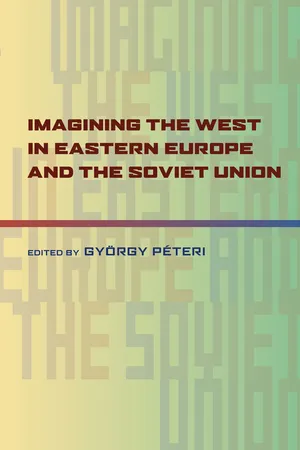
This volume presents work from an international group of writers who explore conceptualizations of what defined "East" and "West" in Eastern Europe, imperial Russia, and the Soviet Union. The contributors analyze the effects of transnational interactions on ideology, politics, and cultural production. They reveal that the roots of an East/West cultural divide were present many years prior to the rise of socialism and the Cold War.
The chapters offer insights into the complex stages of adoption and rejection of Western ideals in areas such as architecture, travel writings, film, music, health care, consumer products, political propaganda, and human rights. They describe a process of mental mapping whereby individuals "captured and possessed" Western identity through cultural encounters and developed their own interpretations from these experiences. Despite these imaginaries, political and intellectual elites devised responses of resistance, defiance, and counterattack to defy Western impositions.
Socialists believed that their cultural forms and collectivist strategies offered morally and materially better lives for the masses and the true path to a modern society. Their sentiments toward the West, however, fluctuated between superiority and inferiority. But in material terms, Western products, industry, and technology, became the ever-present yardstick by which progress was measured. The contributors conclude that the commodification of the necessities of modern life and the rise of consumerism in the twentieth century made it impossible for communist states to meet the demands of their citizens. The West eventually won the battle of supply and demand, and thus the battle for cultural influence.
- 337 pages
- English
- PDF
- Available on iOS & Android
eBook - PDF
Imagining the West in Eastern Europe and the Soviet Union
About this book
Information
Subtopic
Eastern European HistoryIndex
HistoryTable of contents
- Contents
- Chapter 1. Introduction: The Oblique Coordinate Systems of Modern Identity, György Péteri
- Chapter 2. Were the Czechs More Western Than Slavic? Nineteenth-Century Travel Literature from Russia by Disillusioned Czechs, Karen Gammelgaard
- Chapter 3. Privileged Origins: “National Models” and Reforms of Public Health in Interwar Hungary, Erik Ingebrigtsen
- Chapter 4. Defending Children’s Rights, “In Defense of Peace”: Children and Soviet Cultural Diplomacy, Catriona Kelly
- Chapter 5. East as True West: Redeeming Bourgeois Culture, from Socialist Realism to Ostalgie, Greg Castillo
- Chapter 6. Paris or Moscow? Warsaw Architects and the Image of the Modern City in the 1950s, David Crowley
- Chapter 7. Imagining Richard Wagner: The Janus Head of a Divided Nation, Elaine Kelly
- Contributors
Trusted by 375,005 students
Access to over 1.5 million titles for a fair monthly price.
Study more efficiently using our study tools.
Frequently asked questions
Yes, you can cancel anytime from the Subscription tab in your account settings on the Perlego website. Your subscription will stay active until the end of your current billing period. Learn how to cancel your subscription
No, books cannot be downloaded as external files, such as PDFs, for use outside of Perlego. However, you can download books within the Perlego app for offline reading on mobile or tablet. Learn how to download books offline
Perlego offers two plans: Essential and Complete
- Essential is ideal for learners and professionals who enjoy exploring a wide range of subjects. Access the Essential Library with 800,000+ trusted titles and best-sellers across business, personal growth, and the humanities. Includes unlimited reading time and Standard Read Aloud voice.
- Complete: Perfect for advanced learners and researchers needing full, unrestricted access. Unlock 1.5M+ books across hundreds of subjects, including academic and specialized titles. The Complete Plan also includes advanced features like Premium Read Aloud and Research Assistant.
We are an online textbook subscription service, where you can get access to an entire online library for less than the price of a single book per month. With over 1.5 million books across 990+ topics, we’ve got you covered! Learn about our mission
Look out for the read-aloud symbol on your next book to see if you can listen to it. The read-aloud tool reads text aloud for you, highlighting the text as it is being read. You can pause it, speed it up and slow it down. Learn more about Read Aloud
Yes! You can use the Perlego app on both iOS and Android devices to read anytime, anywhere — even offline. Perfect for commutes or when you’re on the go.
Please note we cannot support devices running on iOS 13 and Android 7 or earlier. Learn more about using the app
Please note we cannot support devices running on iOS 13 and Android 7 or earlier. Learn more about using the app
Yes, you can access Imagining the West in Eastern Europe and the Soviet Union by Gyorgy Peteri in PDF and/or ePUB format, as well as other popular books in History & Eastern European History. We have over 1.5 million books available in our catalogue for you to explore.