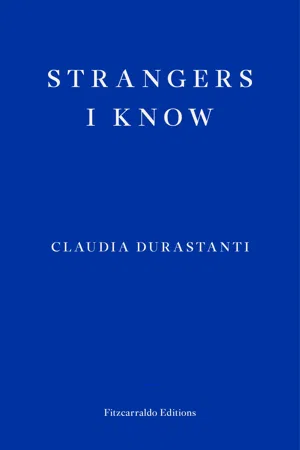
Every family has its own mythology, but in this family none of the myths match up. Claudia's mother says she met her husband when she stopped him from jumping off a bridge. Her father says it happened when he saved her from an attempted robbery. Both parents are deaf but couldn't be more different; they can't even agree on how they met, much less who needed saving. Into this unlikely yet somehow inevitable union, our narrator is born. She comes of age with her brother in this strange, and increasingly estranged, household split between a small village in southern Italy and New York City. Without even sign language in common – their parents have not bothered to teach them – family communications are chaotic and rife with misinterpretations. An outsider in every way, she longs for a freedom she's not even sure exists. Only books and punk rock – and a tumultuous relationship – begin to show her the way to create her own mythology, to construct her own version of the story of her life. Kinetic, formally daring, and strikingly original, Strangers I Know is a funny and profound portrait of an unconventional family that makes us look anew at how language shapes our understanding of ourselves.
- 272 pages
- English
- ePUB (mobile friendly)
- Available on iOS & Android
eBook - ePub
Strangers I Know
About this book
Information
II. TRAVELS
‘But it is one thing to read about dragons and another to meet them.’
— Ursula K. Le Guin
AMERICA
WOMEN NIGHT WARRIORS
When I was little, I pretty much knew how I’d die: kryptonite poisoning, toxic fumes from a nuclear power plant, forced starvation holed up in some bunker under Russian chemical attack. In my conspiracy fantasies, it was always the Russians: I was five and this was 1989 in New York. Not exactly the best year for the USSR and the Cold War, but the Soviets had done something worse than threaten the United States with their aerospace program or their fearsome Olympic gymnasts: they’d moved into my neighborhood. What’s more, my mother was close friends with some of them. Strangers in leather bomber jackets, quartz-colored eyeglass frames; one of her girlfriends with an unpronounceable name who came to dinner and would suddenly grow animated, with her hacking laugh and bad lungs from that hostile, science-fictional country.
The Russians weren’t the only foreigners in the neighborhood. There were the daughters of the bricklayers who worked for my uncle Arthur, doing repairs for him in the condominium complex he managed; my uncle wore cowboy boots and a mariachi mustache and had been engaged at least once to every woman in the building. The bricklayers’ daughters spoke Spanish and would sometimes go with me to the top floor to find a resident named Jenny, who was forever ninety-nine and fast disappearing under her lilac robe tangled up in her walker.
My grandpa Vincenzo charged her a reduced rent in his four-story, redbrick building with a bottle-green door near Fifteenth and Ovington Avenue, a nondescript outpost between Bensonhurst and Dyker Heights, a place of senior centers, video stores, and butcher shops. He’d bought the building for his children to live in, before they declared their independence. Jenny was a widow with no relatives to care for her – they all lived in Eastern Europe. I’d bring the bricklayers’ daughters up to see her because she always handed out chocolate mints and pennies. I’d save up my coins, and my grandfather would help me make penny rolls to bring to the bank and we’d come home with a bunch of dollar bills, so I could buy what I wanted at the local department stores full of flowered muumuus and Barbie videos.
I sometimes distracted myself with stealing. I’d pinch bracelets, plastic earrings for unpierced ears, and slimy goo I’d slap on the wall. Nothing cost more than a dollar, but I was scared all the same. Not about stealing – about not getting caught. At night, I’d sleep with my grandparents in their bedroom smelling of polished wood, with a statue of Saint Francis in one corner, and I’d stay awake, waiting for the flashing red and blue lights to rouse my family, or for the police to pound on the front door, but no storekeeper ever reported me, and God knows what awful things would happen to me in the future, if the grown-ups couldn’t be bothered about my correction and redemption.
My mother never worked. On those days she lay around sleeping in her robe, I’d scramble onto the bed and get her to dance or play-suffocate her with the sheets or just wear her down until she said I didn’t have to go to preschool. So, instead of learning how to socialize or color, I’d walk with my mother in the oranges and burnt reds of autumn, peeking past pumpkins into windows. My brother had told me that our parents were both stage actors pretending to be deaf to get into their parts, a sort of Stanislavski method. They only stopped this practice late at night, when I was sleeping: if I set the alarm for just the right time, I’d find them chatting away in the kitchen, praising each other on their technique. But I didn’t have the patience to catch them in the act; once I raced over to my mother and kicked her, screaming, ‘Speak, speak,’ until both of us were crying. By the time my brother also told me I was adopted and our parents were secretly aliens planning to sabotage the planet, I didn’t believe him anymore.
While my mother didn’t work, she wasn’t with me a whole lot either, so I spent part of my childhood in my grandparents’ garden with its tubs of dirt and the vine hanging loosely over the pergola that got the neighbors asking how they could do this, too, though those bunches of grapes only produced a heavy, sour wine. My mother and I didn’t see each other much, but we dressed alike, in cutoffs and white Reebok high-tops, hers always scuffed. As soon as my grandfather noticed mine were starting to wear out, he’d take me to Payless Shoes on Eighteenth and buy me a new pair. He concerned himself with my clothes and teeth, was the first to notice I was nearsighted, and whenever my hair was messy, he’d pull a comb out of his cotton cropped pants, the kind boys wear now at contemporary art museums, that field hands wore.
His first day in America not spent in a flophouse but as a free man, Grandpa Vincenzo lay by a window overlooking the elevated trains that kept passing all night long. He cursed the noise and swore he’d be better off back home. But the truth was that apartment was a leg up from where he’d just been, a moldy basement shared with some other relatives. It belonged to a fellow townsman from San Martino d’Agri who ran a bìsniss of bringing people over from Basilicata to work in his construction company and in the kitchens of Midtown, taking a chunk of their pay for himself. My grandmother’s brother had been the first to escape and bring his family back above ground; my grandfather, weakened by his amphibious misery, only managed this later.
He found work as a laborer, spreading tar on rooftops, that black pitch smelling of burnt sugar and turning to Plasticine beneath your feet in the summer. His first day, he climbed up on a building along with the other workers while my grandma Maria watched him from the street. But soon he started feeling dizzy and had to come down off the roof. She wrapped her head in a scarf and went up and took his place and started spreading tar among all those men, while he winked at the girls going by.
My grandfather would convince me to hide down in the basement with him and bottle homemade wine that he’d sell on the side; he’d make me laugh by singing Little Richard – ‘tutti frutti, bimbabbambaloulabimbabbamboo’ – and say bottoms up to my little glass of mosto and Gingerella. Later I’d sit on the long table for twenty-four where we’d have our Sunday noon meal and I’d open his suitcase full of Neapolitan videocassettes. When the others were asleep, we sat on the couch and watched videos with Mario Merola or Nino D’Angelo popping up during some religious celebration or wedding that was destined to end badly, or they’d be following a couple who had broken up but then changed their minds and were chasing each other through an airport. I’d watch these overblown scenes just to make him happy: shoot-outs and communions. And while I didn’t like the tarantella, he loved playing the accordion and so his friends would come over and me and my cousins would form a line and dance in the basement, bouncing off each other and the plaster walls, to a frenzy of clapping.
Men in striped polos, moccasins without socks, tinted glasses; men in chauffeur jackets, who never trimmed their hair even if they were balding, who smelled of cigars and grape must and crumpled money, all these men blurring into one mass, with the same face from the day they married to the day they retired, and always making me break out laughing.
Like my grandfather, these men will resurface whenever I hear a song from Southern Italy, vivid apparitions in spite of these songs’ implausible claims: I often fly but no one chases me through airports to prevent me from walking up a plane’s steps like in the old Neapolitan tunes, no one screams for me not to go because otherwise he’ll be departing this life himself, and so I think of all the lies they told me about love: it wasn’t true that by walking down the aisle in a white dress and wearing a shiny crucifix around my neck I’d meet the best boy in school, a future entrepreneur or restaurateur willing to commit any crime to have me; it wasn’t true that by staying a virgin and doing well in school I’d have a more lavish wedding than all the other girls, a ballroom with crystal chandeliers and drunken uncles moved to tears at just the right moment.
Not to mention that crystal chandeliers were bad luck: the day one of our neighbors – thin, blond Anna Banana – was married, a chandelier fell on top of her and her husband during their first dance; they divorced soon after. All the boys liked Anna as a girl, but when my uncles went to check her out on Facebook, they immediately closed the browser window, embarrassed they’d kissed her. And also, according to my aunts, I shouldn’t fall in love with a restaurant owner and must ‘never marry a pizza guy’: these men worked too hard, they cheated as soon as they could, and they’d hit you if they weren’t turning a profit.
My grandma Maria never talked about men, unlike her sister Giuseppina, who arrived in Bensonhurst after escaping a Basilicata village as a minor – she was just sixteen when she landed at JFK.
The men of the family teased my aunt Giuseppina when she showed up for our Sunday dinners. She had two daughters and though she was chunky, she insisted on wearing leather miniskirts; she had her hair bleached and wore gold costume jewelry. My aunt – Josephine now – looked like she’d had some work done, though she hadn’t: she was born with those swollen lips, and those breasts bulging out of her too-tight bras were her own. My grandparents had tried to keep an eye on her when she moved in with them as a girl, but she quickly staked out her independence, working as a butcher by day and a dancer by night. She frequented clubs where a member of the Gambino family hung out; she sometimes came home with bruises. Eventually, she stopped speaking Italian, pretending she didn’t remember the words. It was her fault I thought my real name was Gloria for quite a while; at Christmas she’d hold out my gifts, shouting, ‘Clooooria,’ always emphasizing the vowels. (A mystery hovers over my name: my father insisted it was a tribute to Claudia Cardinale, my grandma Rufina was sure it was for Claudia Mori – ‘Claudia Cardinale was too beautiful, your father would never have given you that’ – while my mother remembered reading somewhere that it was a Roman name meaning ‘strength.’ To my American cousins, it was too close to cloudy in English, so whenever the weather was bad, they’d tell me, ‘Look how claudia it is today, ha ha.’ In one of the first translations of Latin I did in high school, I discovered that ‘claudicante’ meant ‘lame,’ and maybe it was no accident that my mother took a physical lacuna for an asset.)
Once my aunt Jo stopped with the nightclubs, she got herself hired at a luxury boutique on Eighty-Sixth in Brooklyn, but she still kept working as a butcher, to scrape some money together: for years I imagined that under her bloodied butcher jacket, she wore a sequined dress.
During those colossal noonday meals at my grandparents’, she was the only one who’d get up from the table and go meet the neighborhood bag lady who returned recyclables on Sundays. My grandfather didn’t understand how this exchange worked with the supermarket – what interest could ShopRite possibly have in recycling used plastic bottles? – so he’d fill her shopping cart with unopened bottles of Pepsi and 7 Up, certain she must be thirsty.
The woman wore mud-colored clothes and the lenses were chipped in her glasses; over time, she started talking to herself; when I asked around, people said her son had died in Vietnam, but Vietnam was too easy, it couldn’t explain everything. I wasn’t afraid of her, but every time I threw empty bottles into her cart, I ran off again without looking back, chased by the sound of those wheels dragging along the road, exposed to traffic.
I was used to wandering around by myself; if I went far enough, I’d stop smelling that perennial odor from the nearby apartments: spaghetti sauce, vinegar, and marshmallows. I’d go by the video store that was always closed, the Chinese takeout places my grandmother asked me to order chicken and broccoli from on the rare times she decided not to cook, and I’d stand and watch the metro trains rumbling overhead near the Sixty-Second Street stop, where the N line headed straight to the city.
No one took me there, to the city. For my family Manhattan was irrelevant. But I longed for it the way Dorothy did the Emerald City: all the grown-ups around me spoke of how it seduced them, ruined them, and how alone they felt there, how small beside those glass buildings, the toxic smoke rising off the manhole covers, the heavy pushcarts nearly crashing into them, all the useless wares for sale, the girls with their strange hair and their begging dogs, the headwinds over the river, the stagnant, wet garbage; but I couldn’t wait to lose myself along those sidewalks glittering under the streetlights.
The biggest attraction in our area was the car wash and its enormous brushes. My father would let me stay in the car and we’d go back and forth between the bristles circling his Jeep in a deluge of water and soap. To me it was more entertaining than going to Coney Island, with its faded rides, its Cyclone that made me sick – in 1977 a man rode this shabby rollercoaster for 104 hours straight (my brother could have beaten that record).
Coney Island’s entire boardwalk of carcinogenic sugar was a land of foolish records and marriage proposals made on park benches, out of a lack of imagination. Along the pier there’s still a ride that a friend of the family operated for over fifty years, the human slingshot, firing the public through the air. When this friend died a few years back, they buried his ashes at the base of the ride in a ceremony under a milky, cold sun. He wasn’t an easy man to cry for, or to miss really; he’d spent his retirement years listening over and over to the Normandy landing on his portable radio and harassing his wife with anonymous phone calls to the retirement home where she’d fled from him, this German emigrant obsessed with Burt Lancaster, for whom marrying an Italian woman was a terrible mistake.
My brother wasn’t afraid to ride that rusty rollercoaster and I followed him as far as I could, before I lost sight of him beyond the metal turnstiles like those to the trains, the ones he jumped when he went out with his friends, the same friends who had a gun. To me they were only boys, their dirty socks spilling from laundry bins and their divorced fathers dating young redheads with teased hair and short skirts; other friends of his were Jewish, though not Orthodox, so they were allowed to play expensive video games and they invited my brother over to join them even if they weren’t popular at school and my brother was, and how could he not be, with his Johnson & Johnson hair, his chipped teeth, and his perfect battle scars.
One day he was going way too fast on his BMX and we found him on his back on the sidewalk in a large puddle of bright blood. I was afraid he’d be disfigured and burst out crying: his beauty was our one hope for escaping our sad, broken parents.
He was just finishing elementary school and was already lying down on the train tracks and skipping class.
Once, the police came to our door because my mother had reported him missing; he didn’t show up until dinnertime. My uncles told him to knock it off – it was time to become the man of the family. I was intimidated by this secret life he led without me, I was confused, jealous, but in spite of the tricks he played on me, his breaking of the rules was also for me. One day he stuck gum in my hair and my mother had to cut my bangs too short with the kitchen shears; at age four I looked like one of those pale, chicken-boned punk rockers that I’d see years later on flyers at Astor Place.
In the movies I watched with my parents, the girls were always sweaty and rebellious, and as Grease or The Warriors showed, shy girls also had to be cunning to survive. I’d see them out in front of the high school after class, or on the streets at night, while my mother and I were coming back from the drugstore and they were lit up by the streetlamps: these girls would be stretched out on the hoods of cars, petroleum-blue or rust-colored Lincolns, metal caving slightly under their weight, posing like models, braless, immigrants, less and less religious. I’d keep watching them from my bedroom window while they set their beer or Coke cans in the hollow of their throat to swipe at mosquitoes, and then I’d go to sleep thinking I was destined to fall in love and become a nice Republican girl.
My grandmother started sending me out for deliveries around the neighborhood when I was five; she had me take her black bag, the kind doctors carried in New Yorker cartoons, which she filled with nice shredded mozzarella for the pizza she smuggled out of the restaurant where she worked, on Fifty-Fourth Street.
She didn’t understand Italian very well anymore and she spoke in a dialect that was deliberately strange: she said ‘Bruklì’ instead of Brooklyn, ‘aranò’ rather than I don’t know, ‘la bega’ for bag, ‘porchecciapp’ for pork chops; ‘a diec pezz’ was ten dollars and ‘u’bridge’ the tollbooth between New Jersey and New York. The truth is she knew perfectly well how to pronounce these words in English, but she refused – she liked being teased, it was her means of staking out a personality.
She was a cook along with some Puerto Rican guys who occasionally joined us on Sundays; they were tall and thin and would pull a silver coin from my ear to make me laugh. The language they spoke was gentle and strange, and they laughed at things I didn’t understand. I think they really came to those meals to find a girlfriend, but the women in my family were already married or too young, and basically unhappy.
All those Italian girls, killing their fathers with their bad behavior, thinking studying was a disadvantage, even if this was the eighties. My mother couldn’t change her life, not yet, but to spite her father, at least she could change blocks and move.
My grandmother’s older sister, Aunt Rosa, wound up in a mental institution and immediately had a hyst...
Table of contents
- PRAISE
- TITLE PAGE
- DEDICATION
- CONTENTS
- I. FAMILY
- II. TRAVELS
- III. HEALTH
- IV. WORK & MONEY
- V. LOVE
- VI. WHAT’S YOUR SIGN
- AFTERWORD
- ACKNOWLEDGEMENTS
- ABOUT THIS BOOK
- ABOUT THE AUTHORS
- COPYRIGHT
Trusted by 375,005 students
Access to over 1.5 million titles for a fair monthly price.
Study more efficiently using our study tools.
Frequently asked questions
Yes, you can cancel anytime from the Subscription tab in your account settings on the Perlego website. Your subscription will stay active until the end of your current billing period. Learn how to cancel your subscription
No, books cannot be downloaded as external files, such as PDFs, for use outside of Perlego. However, you can download books within the Perlego app for offline reading on mobile or tablet. Learn how to download books offline
Perlego offers two plans: Essential and Complete
- Essential is ideal for learners and professionals who enjoy exploring a wide range of subjects. Access the Essential Library with 800,000+ trusted titles and best-sellers across business, personal growth, and the humanities. Includes unlimited reading time and Standard Read Aloud voice.
- Complete: Perfect for advanced learners and researchers needing full, unrestricted access. Unlock 1.5M+ books across hundreds of subjects, including academic and specialized titles. The Complete Plan also includes advanced features like Premium Read Aloud and Research Assistant.
We are an online textbook subscription service, where you can get access to an entire online library for less than the price of a single book per month. With over 1.5 million books across 990+ topics, we’ve got you covered! Learn about our mission
Look out for the read-aloud symbol on your next book to see if you can listen to it. The read-aloud tool reads text aloud for you, highlighting the text as it is being read. You can pause it, speed it up and slow it down. Learn more about Read Aloud
Yes! You can use the Perlego app on both iOS and Android devices to read anytime, anywhere — even offline. Perfect for commutes or when you’re on the go.
Please note we cannot support devices running on iOS 13 and Android 7 or earlier. Learn more about using the app
Please note we cannot support devices running on iOS 13 and Android 7 or earlier. Learn more about using the app
Yes, you can access Strangers I Know by Claudia Durastanti, Elizabeth Harris in PDF and/or ePUB format, as well as other popular books in Literature & Social Science Biographies. We have over 1.5 million books available in our catalogue for you to explore.