eBook - ePub
Available until 23 Dec |Learn more
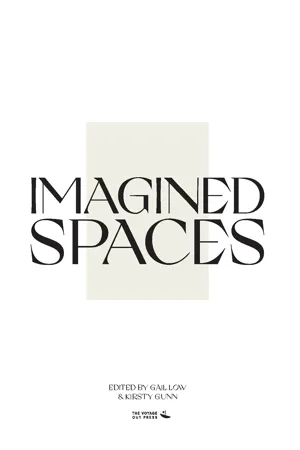
Imagined Spaces
This book is available to read until 23rd December, 2025
- 224 pages
- English
- ePUB (mobile friendly)
- Available on iOS & Android
eBook - ePub
Available until 23 Dec |Learn more
Imagined Spaces
About this book
Exciting and provocative essays in a collection that is fun, entertaining, and deeply serious. In words and images that explore our environment, culture and architecture, that reflect on literary and artistic creation, mortality, mental health, depression, the North (as a place both real and imagined) and education, Imagined Spaces returns the essay to its original activity of having a go, trying and weighing something out, taking a risk.
Frequently asked questions
Yes, you can cancel anytime from the Subscription tab in your account settings on the Perlego website. Your subscription will stay active until the end of your current billing period. Learn how to cancel your subscription.
No, books cannot be downloaded as external files, such as PDFs, for use outside of Perlego. However, you can download books within the Perlego app for offline reading on mobile or tablet. Learn more here.
Perlego offers two plans: Essential and Complete
- Essential is ideal for learners and professionals who enjoy exploring a wide range of subjects. Access the Essential Library with 800,000+ trusted titles and best-sellers across business, personal growth, and the humanities. Includes unlimited reading time and Standard Read Aloud voice.
- Complete: Perfect for advanced learners and researchers needing full, unrestricted access. Unlock 1.4M+ books across hundreds of subjects, including academic and specialized titles. The Complete Plan also includes advanced features like Premium Read Aloud and Research Assistant.
We are an online textbook subscription service, where you can get access to an entire online library for less than the price of a single book per month. With over 1 million books across 1000+ topics, we’ve got you covered! Learn more here.
Look out for the read-aloud symbol on your next book to see if you can listen to it. The read-aloud tool reads text aloud for you, highlighting the text as it is being read. You can pause it, speed it up and slow it down. Learn more here.
Yes! You can use the Perlego app on both iOS or Android devices to read anytime, anywhere — even offline. Perfect for commutes or when you’re on the go.
Please note we cannot support devices running on iOS 13 and Android 7 or earlier. Learn more about using the app.
Please note we cannot support devices running on iOS 13 and Android 7 or earlier. Learn more about using the app.
Yes, you can access Imagined Spaces by Kirsty Gun, Gail Low, Kirsty Gunn,Gail Low, Kirsty Gunn, Gail Low in PDF and/or ePUB format, as well as other popular books in Art & Art General. We have over one million books available in our catalogue for you to explore.
Information
Songs I Can’t Play
This is where you are now, my teacher said, as she passed me a piece of paper. I give this to the children, she told me, to help them understand. But a better comparison for you might be the second stage of labour, when you think I just can’t go on.
On the piece of paper was a picture of a boy pick-axing his way through an underground tunnel. The walls were made of rock—the boy was clearly exhausted, sweating, hunched over. He must have been digging for a long time and could not see what we see: that less than half a meter away is the open air. It was an image of endurance: only a few more heaves and the boy will break free. I told her that I couldn’t actually remember the second stage of labour, that by that point I was too far gone. She acknowledged this as a challenge in itself—the thinking back—and told me that at the same point she decided she was just going to walk home, thank you very much, and someone pointed out to her that there was still the baby to come.
For three months I had been trying to play open D, then open A on the cello, but just open D would have done. I couldn’t hold the bow properly. I couldn’t find the weight. My palms sweated and my thumb muscle spasmed. You’re so close, my teacher said. It might just be two more sessions, and then you’ll have it. I felt myself near to tears, which seemed ridiculous. A three-year old could play this. If it was a matter of brute force, pick-axing my way to the sound, I might manage it. But this was a foible that my teacher had already spotted and cautioned me against. You hit a block and you just try to ram through it, she said some weeks back. We have to find a way of you not pushing and shoving against the problem.
I tried again, scooting over the strings. Where was the traction? The gravity? Where is your neutral? She asked me then, and I looked at her in complete confusion. Neutral? I said. I generally don’t have a neutral. Or maybe my neutral is seasonal.
But nor do I drive, so I maybe I don’t really know what you mean by neutral? She looked at me with some concern.
I am wary of horses and dogs and sometimes even cats because it always seems they can sense something deep inside me that is not admirable, that is perhaps hard and scroogelike, that is too hurried, and that is therefore feeble, not soft enough, not malleable, too determined. While I play I feel my teacher’s gaze similarly: how does she deduce this corner of my character simply from the way I failed to bow? Or, more precisely, from the way I did bow? Let’s try again, she said, and I repositioned the instrument.
That morning we had started the lesson with me lying on the floor, on my back, with the cello on top of me. From this position I had played my open strings. Now she stood over me and repositioned the bow on the string whenever it was necessary. We play, she had said at one point, in the way that we live. Can you feel that now? she asked. For months we had been trying to find the sensation of weight in my shoulder blade and arm, a weight that would let the bow rest on the string, that would let the cello carry the bow, a feeling that would circumvent my instinct to hold the bow on behalf of the cello. Yes, I said, I can feel that—my shoulder blade working against the carpet, low pile and stained with black ink from where a child broke a pen. Then I stood up and played the cello as if it were a double bass, then sat down and tried again from a seated position. The feeling of weight was there for a moment, and then gone. Where did it go? There was sensation, and then just as suddenly, no sensation. Watch for this, she said. Sometimes I seemed to not be able to feel my arm in space at all. There was a flicker of feeling: a kind of muscular fluttering, a corner of my body felt pixilated, and then, at a certain point in the bow stroke, something hardened and all subtle sensation disappeared.
Ten years earlier I was playing Bach, maybe badly, maybe much worse than I thought, but the enthusiasm was vivid. Then I suffered an injury, and for years after this couldn’t open a jar or turn a door handle, I could hardly use the breaks on my bike. Simply to pick up the cello bow caused a terrible shooting pain through my right arm. I had no choice but to lock the instrument up in its case. At a certain point my husband suggested we get rid of it. And while there was nothing to indicate I would ever be able to play again, I couldn’t give the instrument away.
For Christmas some time later I was given a clarinet. I had reasoned to myself that another instrument would have to do, and that something in me needed music in a way I didn’t need to understand but had to honour. I unwrapped the gift, put it all together, then huffed and puffed to make a tiny squeak of sound. It looked beautiful and shiny, but it felt entirely wrong: too small, too narrow, no strings attached. It went back in its box never to come out again. But what it made me realise was that there was only one instrument for me: this was not actually a general desire for music, but a specific one for a particular object, and a particular sound. I could not look back and think I had missed this. There must be a way, I decided.
A friend gave me the number of a Suzuki teacher. She wrote it down on a yellow post-it-note, and I stuck it to my fridge. I knew enough about my old way of playing to know that I had to subvert it, that I couldn’t place any physical pressure on myself to work through repertoire, or think about scales and theory, that I didn’t even want to play in that way but had no idea of what the alternative was. Still, every day, for a whole year, I glanced at the phone number and wondered if I would call. I had excuses: I couldn’t really afford the lessons. I didn’t really have the time, it was possible that I wouldn’t be able to do it anyway. But when the following summer came around, a year after my one and only attempt on the clarinet, the faded post-it-note started to feel like an affront. I tapped in the numbers on my phone, palms sweating, and left a message.
It took more than four months before I could play Twinkle Twinkle Little Star. I proclaimed this achievement to other adults, and was crestfallen when they didn’t grasp the significance, the joy. They looked at me askance, a little bewildered. Now, at last, two years later, I am muddling my way through a nearly grown-up piece. I call it a song, but technically it is perhaps not a song, more like a long exercise, but I like to think of it as a song. Although this thinking in itself, the assumption of a completed set of sounds, draws me into a thicket of new troubles: I aim for the endpoint and as a result the bowing comes undone: I play a down bow when I should do an up bow, lose the thread, skim over the crossings and stop halfway through, unsure of where I’ve come, what path I’ve taken, how the music ended me here. My hand hurts. My shoulder hurts. In the lesson we try to break this down. Where does this incomprehension start? In the limbs of the body? In the ear?
Before I arrive at this point where I can even come close to playing the piece, I have already been listening to it for years, months, weeks until it is memorized in a strangely deep way. I listen to it in a state of distraction, I listen to it closely, on repeat, and eventually I dream of it, or can’t sleep because certain sections run endlessly through my head in the dark. Then, when I sit down to play I suddenly seem to have forgotten it. I can’t find the exact sound or note with which to begin, but sense instead the pulse of the song, the rhythm or not even that but a dim sense of a rhythm, yet to crystalise or accumulate sound. There is always an element of here of near-improvisation, of winging it, of trusting that my ear will recollect the sound just in time for my body to catch it. It is less a song that is being played, than a journey made through a childhood landscape: once known so well, so intimately, many decades ago and now being revisited at night. I am struck by points of intense familiarity—the particular roll of stones under the soles of the shoe, the rise of the mountain; shadowy, unseen, sensed, out to the west. The rhythm, the shape of the landscape, is the last part of the song to remain as memory failures occurs: it is the bones, the residue, the pulse, underlying and invisible, undecorated. On the wave of this sounds reaccumulate.
The song is not a snake, you cannot learn it that way, my teacher reminds me. But you will hear it that way before you can break it down into playable parts, whereupon it becomes complete once again.
Put your bow in your mouth, she tells, me.
What? I ask. And she shows me.
Like this, she says through tightened lips, the bow between her teeth as a dog might hold a stick. I try but am laughing so much I can’t keep my mouth closed around the bow. I try again, without laughing.
Now lift your hands above you head. And sway. Can you feel that?
Yes, I say.
We try again. And once more it breaks apart.
Put your bow in your mouth, she tells, me.
What? I ask. And she shows me.
Like this, she says through tightened lips, the bow between her teeth as a dog might hold a stick. I try but am laughing so much I can’t keep my mouth closed around the bow. I try again, without laughing.
Now lift your hands above you head. And sway. Can you feel that?
Yes, I say.
We try again. And once more it breaks apart.
The piece, my teacher tells me, is like a landscape in fog for you right now. There are some trees, some mounds of grass, but you cannot see the details, you can’t see the path. I tell her it feels comparable to the disorientation of starting out on a new book, where I move over the territory roughly, in some disoriented bewilderment, shading in, finding the obvious dynamics, before going over and over the marked-out ground, working into the details. Yes, she replies. I can see the comparison, but the difference is that this piece is here, and that book, when you are starting out, doesn’t actually exist. Here, you don’t need to work over the whole in order to find it, because it has already been made. The chipping away and chipping away comes as you break down the parts that have been composed, as you figure out how to play them.
I agree with her, then come away uncertain, because a book feels, at least to me, like it already exists, only in some region or realm slightly ahead of me, or slightly above me, just beyond reach. To reverse this idea: when I close my eyes, and play from ear, from memory, the music seems to arrive from the left and the right—as if it were hiding in the wings of a stage, in the dark corners just out of conscious thought and what I must do in playing is to find a way to articulate an intuited form, to interpret my sense of its form. To my body, the song seems not to exist until I have played it, or am playing it, as if it exists only in the playing and in the listening but really not as a preserved, material, pre-existing artefact. The challenge is to find the song in the air and run it though my body, or to find the aural memory of the song that lies in wait in my body, that has developed over time like sediment and give it shape, set it free.
But improvement is slow, and I chafe against this. You are trying to do too many things at once, she says. You are trying too hard. Have you been looking at the score? she asks, a note of disapproval in her voice. There is no point in not confessing, the fault is obvious. Don’t, she tells me. The score is a guide only. And particularly unhelpful for you.
I must learn not to expect to ‘learn’ a piece: dot learning, my teacher calls this old method. Following the rules. Some of her students are ‘good’ students, she tells me, and they think they have to play what the score tells them. She does not need to explain the task of errancy because she already knows that trying to follow the rules only terrifies me, even if I think I should follow them when I’d be better off not.
Instead, I am asked to arrive at the song from the inside. It is a process that involves an uncanny practice of anticipatory listening—the body following the lead of the inner ear that recollects the song, the timing always double and just out, close to syncopated—as I enact a melody that has already occurred, a fraction earlier, in my head. If I do not anticipate the sound, if I do not listen outside of my own lived time, my body will not play, or rather the sound will be off, awkward, discontinuous, unfelt. This sensation of listening is almost identical, I come to realise, to the kind of attention experienced in the act of writing. The attunement to a vague internal melody, occurring still some bars away, in the distance—muted but discernable, felt. The attunement of the ear in playing—the matching up of inner to outer ear, this too feels like a refinement of the listening that precedes any putting down of words onto the page, as one moves from feeling to hearing, to sounding out. The moment that the melody is lost, the moment one is distracted, the moment the internal listening drops out—then the thread of musical thinking slackens, and the ear seems to lose all surface tension. Writing or playing, I attend to a bodily intuition of a prosody that is gradually cloaked in some more ornate, and increasingly dense aural experience, sometimes words.
Indirectly and by association, because the activities are often undertaken back to back, and because I have a habit of hearing things in my head, and because the unedited, incomplete version is always of more interest to me, for all of these reasons experiencing sound in this way compels me to radically rethink the feeling and therefore the act of fictional thinking—no longer as a development of any complex scaffolding in which characters live and move, but rather as something that acquires meaning only in the practicing of it, as a listening forwards into the dark. It is a musical thinking, or perhaps musical thinking is a fictional thinking. Increasingly they feel one and the same.
But if I had to say what the difference is between the two practices, between writing and playing, what would it be? Only that they occur at the far ends of the same spectrum: while one moves through vibration towards words, the other passes back in the opposite direction, away from words. They each pick up the vibration, run the texture of this through the body and shape it differently. There is no chronology, no hierarchy, just an affinity. It is the meeting points that interest me most, the co-dependence that I slip in and out of: the writing mind relies on a principle of musicality, of variation, of rhythm. The musical mind, or the musical body, relies on the emotive foundation of sounds that will often come together to form a narrative design, or else plunge us into the bewildering absence of this. The ear always listens for the sound of the story: the pitch of beginning, the silence before the start. The body waits, eager, to be drawn into the music of the tale. The writing self and the musical self each depend upon, and emerge from, or start with a state of deeper and very wordless feeling which, in its earliest form is that niggling quiver in the gut, the lilt, rise, and quaver of the heart. The beginning of a vibration that one is compelled to follow, or follow through on, enlarge, maximise, make manifest, sound out, realise.
Maybe there is, as someone pointed out, meaning here in the relationship between the cello and the voice. The range of the cello is akin to that of the human voice, to the human voice singing in particular. And although the cello can obviously surpass the reaches of the human voice there is a meeting point, where the human voice and the cello might stand in for one another. The writing voice, freed from the physical constraints of the speaking voice, can seek to match the sonorous dexterity of the cello, can be extended by the knowledge of what it is to embody those sounds. When I play, the underlying pulse of the writing—the emotional core that is felt as a vibration leading to rhythm before arriving at words—is strengthened, repeated, rehearsed, re-encountered from new angles. I once listened to a teacher of mine, a poet, read out a poem, many years ago. It was strangely moving although I couldn’t say why and didn’t understand what the poem was about, what it was saying. What did you hear then? he asked us. There was a long silence. Then he read a section again. Vowels, I said. Open vowels. The feeling is never just about the words.
Why don’t you call these pieces you play tunes? a friend asked. Why songs? They are perhaps too simple to be called songs, too brief, my friend said. I call them songs because a song is given the privilege of belonging to the voice and the body, a song that emerges through and in relation to the body. A tune is what you whistle on your walk, a half-remembered ditty that you might hum before remembering the song proper—something deeply internalised, a somatic memory anticipated and which only belatedly emerges.
Have we talked about the different movements of the joints? My teacher asks. All your joints are trying to take the lead at the same time. What happens if you just let the shoulder own that movement. And at what point does the shoulder need to give way to the movement of the elbow? I close my eyes and bow slowly. Halfway into the bow stroke there is a flurry of confusion in my arm as if it isn’t sure in what direction it should be heading. The bodily panic is very quiet but also very clear: like a flurry of dove wings in a small dark space. Dusty. Disoriented. That’s the moment, my teacher says, when the exchange between occurs. Maybe you just need to sit in that for a while.
Meanwhile, my left arm is going rogue. A strange and sudden pain breaks across my shoulder blade. It is as if, in the process of attending to the residual habits and difficulties of my right shoulder and the bowing arm, my bodily quirks have simply migrated and transferred themselves to the other side. We start over, making no sound and just trampolining my fingers on the strings. My proprioception is all out. To regain this we map my body in relation to the instrument: with my left hand I touch my nose then the fingerboard, then my nose, then my left shoulder, then the fingerboard again, then my nose. Once more, we start over. The repetition of this—the endless recommencement—has become itself a source of comfort, a pleasure and a release from the vortex in which one is expected to claim more and yet more territory, to accumulate and display. Instead, we just go further in to the same place.
I think of a post that I saw on Instagram, one that shows a handwritten note which reads: ‘Everyone has something they wish they could talk about with someone who is not in a hurry’. I realise that in the act of playing I must be that person for myself. To listen without haste or irritation, and to listen not just to the sounds, but also, and perhaps first, to my body, and then to play without feeling hurried because I know I am listening. The listening comes first: an attitude or bearing that precedes any sounded note, that is just ready, for whatever comes. I listen doubly: for what is there, for what arises—and for what lies just up ahead. Like any good friend, I am attentive to the developments of the story no matter how small or seemingly insignificant. Although in this act of listening I cannot treat the completed song as the aim or destination, the thing I am listening for. To do this would be to create a response in my body that is the experience of expectation—a tightening and straining around suspense, the demand to get it right and finish on time, and in the midst of this I forget to pay attention to the landscape that I am surrounded by, the resonant sound, the texture of this, even the fog. More especially, this is how I used to play, it is how we are generally taught to play, how we are taught to think, to argue, to live. I can reach the end of a piece in this manner, but know that my body will be broken by it. What is the alternative route? Check yourself, my teacher reminds me. Each note, each phrase, each bow, each transition, must feel to come from, and be, a movement of complete ease. Slow it down, and each time the body tenses, experiences strain or roughness, displeasure in the playing, then stop, and in that moment of stopping treat it just as a pause in the playing where you rest the tension, drop it back, settle, find your neutral, and make the transition you need to make—preparing the string crossing, shifting position—and then and only...
Table of contents
- Title Page
- Dedication
- Contents
- Tracing lines … Essaying For Our Times - GAIL LOW & KIRSTY GUNN
- 1: Songs I Can’t Play - STEPHANIE BISHOP
- 2: Line Drawing - CHRIS ARTHUR & GRAHAM JOHNSTON
- 3: On Being Hit on the Head by a Poem - GABRIEL JOSIPOVICI
- 4: Politics of Small Places - LORENS HOLM & PAUL NOBLE
- 5: Mind the Gap - SUSAN NICKALLS
- 6: Life in the Bardo: Dying, Death and the Imagination - MEAGHAN DELAHUNT
- 7: You by Me: Writing Depression - STEPHEN CARRUTHERS & FIONA STIRLING
- 8: A Voyage Out in Education - JANE MACRAE
- 9: The Flicker of North - DUNCAN MCLEAN & KENNY TAYLOR
- 10: The Strange Performance of Ink on Paper - WHITNEY MCVEIGH
- 11: Home Ile Ghar Hame - TOMIWA FOLORUNSO & HAMZAH HUSSAIN
- 12: Between the Lines - DAI JOHN
- 13: My Love Affair with the Essay - PHILLIP LOPATE
- 14: The Fiction of the Essay: of Abstraction, Texts, Communication, and Loss - EMMA BOLLAND & ELIZABETH CHAKRABARTY
- 15: A Leaf Out of Someone’s Book - GRAHAM DOMKE
- 16: The Art of the Intransitive Essay - LINDA E. CHOWN
- Notes & Bibliography
- Contributors
- Acknowledgments
- Also by The Voyage Out Press
- About the Authors
- Copyright