Emily Brontë Reappraised
eBook - ePub
Available until 23 Dec |Learn more

Emily Brontë Reappraised

  1. 208 pages
  2. English
  3. ePUB (mobile friendly)
  4. Available on iOS & Android
eBook - ePub
Available until 23 Dec |Learn more

Emily Brontë Reappraised

About this book

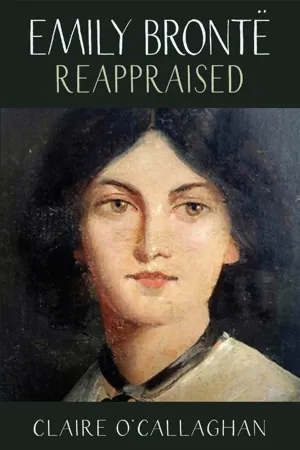
This biography with a twist unravels myths and delves into the work of the great author for answers to the question:  Who was the real Emily Brontë?

Emily Brontë occupies a special place in the English literary canon. And rightly so: the incomparable  Wuthering Heights  is a novel that has bewitched us for almost 200 years, and the character of Heathcliff is seen by some as the ultimate romantic hero—and villain. But Emily herself remains an enigmatic figure, often portrayed as awkward, volatile, as a misanthrope, as “no normal being.” That’s the conventional wisdom on Emily as a person, but is it accurate, is it fair?

In this biography with a twist, Claire O’Callaghan conjures a new image of Emily and rehabilitates her reputation by exploring the themes of her life and work—her feminism, her passion for the natural world—as well as the art she has inspired, and even the “fake news” stories about her. What do we really know about her romantic life, for example, or about who and what inspired her characters and stories?

What we discover is that Emily was, in fact, a thoroughly modern woman. So now, two centuries on, it’s time for the real Emily Brontë to step forward.

Frequently asked questions

Yes, you can cancel anytime from the Subscription tab in your account settings on the Perlego website. Your subscription will stay active until the end of your current billing period. Learn how to cancel your subscription.
No, books cannot be downloaded as external files, such as PDFs, for use outside of Perlego. However, you can download books within the Perlego app for offline reading on mobile or tablet. Learn more here.
Perlego offers two plans: Essential and Complete
  • Essential is ideal for learners and professionals who enjoy exploring a wide range of subjects. Access the Essential Library with 800,000+ trusted titles and best-sellers across business, personal growth, and the humanities. Includes unlimited reading time and Standard Read Aloud voice.
  • Complete: Perfect for advanced learners and researchers needing full, unrestricted access. Unlock 1.4M+ books across hundreds of subjects, including academic and specialized titles. The Complete Plan also includes advanced features like Premium Read Aloud and Research Assistant.
Both plans are available with monthly, semester, or annual billing cycles.
We are an online textbook subscription service, where you can get access to an entire online library for less than the price of a single book per month. With over 1 million books across 1000+ topics, we’ve got you covered! Learn more here.
Look out for the read-aloud symbol on your next book to see if you can listen to it. The read-aloud tool reads text aloud for you, highlighting the text as it is being read. You can pause it, speed it up and slow it down. Learn more here.
Yes! You can use the Perlego app on both iOS or Android devices to read anytime, anywhere — even offline. Perfect for commutes or when you’re on the go.
Please note we cannot support devices running on iOS 13 and Android 7 or earlier. Learn more about using the app.
Yes, you can access Emily Brontë Reappraised by Claire O'Callaghan in PDF and/or ePUB format, as well as other popular books in Literature & Literary Criticism for Women Authors. We have over one million books available in our catalogue for you to explore.
Four
Emily in Nature
Emily had an affinity with the natural world. As one biographer suggested, nowhere was she ‘so much herself, nowhere else so free; nowhere else had she so many friends, wild animals living their own lives with whom she was in intense sympathetic communication’.134 So it’s apt that today the land surrounding her home on the moors (and the south Pennine hills, more broadly) is known as ‘Brontë Country’. Emily was familiar with every inch of this area; she knew and loved the contours of the landscape, the hills, trees, streams, ravines, flora and fauna. Helpfully, we have eyewitness accounts of Emily’s natural gaiety on the moors, as Ellen Nussey recalled how, whether she was ‘on the top of the moor or in a deep glen, Emily was a child in spirit for glee and enjoyment’. 135 Ellen also reminisced of how Emily ‘threw aside her reserve, and talked with freedom and vigour’ during walks over the moors.136 The Yorkshire landscape, then, was a place where Emily felt happy and independent, she gained confidence from being outside, and felt free.
It was also a realm that made her daring. There’s a story that, in childhood, during one of the children’s Angrian theatricals, an eleven-year-old Emily sneaked out of a second-story window at the parsonage and climbed into the branches of tree outside. But the branch gave way under her, and Emily fell to the ground. She was unhurt, but she knew her father would be displeased by the garden mischief, so the children tried to cover the damaged tree. They did a bad job, though, because Patrick noticed the damage immediately on his return home. In another tale, Ellen told how, during her walks on the moors with the sisters (which would often happen when she visited the family), Emily would sometimes lead Charlotte ‘where she would not dare to go of her own free-will’.137 Charlotte, Ellen reported, ‘had a mortal dread of unknown animals, and it was Emily’s pleasure to lead her into close vicinity, and then to tell her of how and of what she had done, laughing at her horror with great amusement’.138 Poor Charlotte! Thanks to Emily’s child’s play she must have found herself in several uncomfortable predicaments.
With such an indelible connection with nature, it is hardly a surprise that writers and scholars over the years have also recognised how Emily’s passion for the natural world formed a motif in her writing. In the early 20th century, Virginia Woolf speculated that Emily (and Charlotte) invoked ‘the help of nature’ because they felt ‘the need of some more powerful symbol of the vast and slumbering passions in human nature than words or actions can convey’.139 Woolf’s comment helps us understand the influence of the Romantic poets on Emily, a group of writers for whom the natural world was both a setting and a mechanism to comment on humanity. Among this group are authors that we know the Brontës read and loved, including Byron, Robert Southey (to whom Charlotte wrote and received that condescending reply), and Wordsworth and Coleridge (to whom Branwell wrote with mixed results). Nature works in different ways across the work of these writers. In Wordsworth’s poems, nature is revered and idealised; in Byron’s verse, nature complements human emotion and helps him to make sense of civilisation; and in Keats’ work, the natural world is a haven away from the grim squalor of urban living.
Like the Romantics, Emily also found that the natural world was a helpful key to understand both human nature and herself. Across her wor...

Table of contents

  1. INTRODUCTION
  2. The Life and Works of Emily
  3. Emily – The Biographers’ Tales
  4. Ellis Bell
  5. Emily in Nature
  6. Emily and Feminism
  7. Emily’s Afterlives
  8. Emily – Real and Fake News
  9. Selected Bibliography
  10. Aknowledgements
  11. About the Author