Smart polymers react sharply to small changes in physical or chemical conditions and present an intelligent response to chemical stimuli (i.e., chemical species -including biomolecules-, pH, solvents, redox, stimuli that trigger controlled depolymerization) and physical stimuli (i.e., temperature, light, mechanical stress and electrical stimuli). For these reasons, the interest in smart polymers has recently increased exponentially, especially in biological stimuli (i.e., application of polymer-based biosensors, drug delivery, tissue engineering, precision medicine and cell therapy). This book offers a unique opportunity to review the physical-chemical fundamentals of smart polymers, and their behaviour. It also provides an excellent review of the main applications of smart polymers.
eBook - ePub
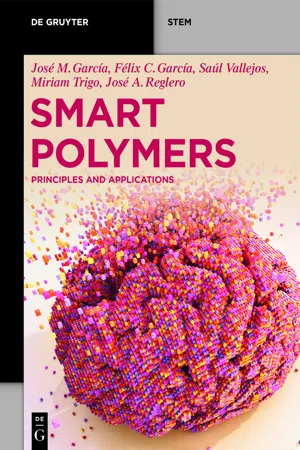
Smart Polymers
Principles and Applications
- 153 pages
- English
- ePUB (mobile friendly)
- Available on iOS & Android
eBook - ePub
Smart Polymers
Principles and Applications
About this book
Information
1 General introduction and preface
Nature is full of examples of stimuli-responsive (or smart) materials. Leaves of the Dionaea muscipula (venus flytrap) close capturing insects, leaflets of Codariocalyx motorius (telegraph plant) and Helianthus annuus (sunflower) rotate under exposure to sunlight, the former at a speed that can be visually perceived, leaves of Mimosa pudica (sensitive plant) can collapse when shaken or touched and Chamaeleonidae (chameleon) or Octopoda (octopus) change their colour depending on the environmental condition or situation. These natural phenomena have attracted the interest of researchers for a long time, and many different efforts have been carried out to mimic this behaviour using synthetic materials. In this sense, the synthesis, characterization and applicability of stimuli-responsive polymers have become one of the most important research lines of the polymer science.
Smart polymers present the ability to respond to different stimuli by changing their physicochemical properties. The type of response varies from dimensional variation (shape-memory polymers), to changes in colour, electrical conductivity, luminescence and many others. Concerning the stimuli, we can have, for example, temperature variations (thermo-responsive), pH (pH-responsive), magnetic and electric fields (magneto-responsive or electrical-responsive polymers), humidity or light (light-responsive polymers). Furthermore, when the external stimulus is the chemical or physical interaction between the polymer and an external substance itself, smart polymers can be employed as sensory materials due to their ability to detect and quantify the target substance by analysing their responsive properties. Here, the term “smart” indicates that the polymer exhibits a specific response for a given stimulus; thus, the control, triggering and analysis of the stimuli-response relation in smart polymers is the key factor in which researchers put their efforts.
This book describes the fundamentals and main applications of smart polymers. Chapter 2 will be devoted to resume the fundamentals of smart polymers, listing the main families of responsive polymers in terms of external stimuli, such as in pH, temperature, light and mechanical stimuli. In Chapter 3, we will describe the use of smart polymers as key components of sensory systems. Due to their intrinsic nature, stimuli-responsive polymers can be designed to respond to a wide variety of different stimuli, resulting in changes in shape, solubility, surface properties, colour or fluorescence, including also a section dedicated to the immobilization of biomolecules, which is especially interesting for the recent developments in the recognition and immobilization of several proteins which are directly related to several diseases (e.g. the immobilization of the human angiotensin-converting enzyme 2 allows the recognition and detection of the SARS-Cov-2 pathogen). Additionally, the easy processability of polymers allows them to be manufactured into different forms such as films, beads, coatings and fibres, making them promising materials for sensors fabrication. For these reasons, the use of smart polymers as sensory materials was one of the earliest developments in this research field. However, the exponential interest in biomedical and biological-related applications over the last decade focus the attention of Chapter 4, becoming an essential part of the book. With the obtention of new biocompatible and biodegradable smart polymers, and the designing and fabrication of hydrogels, that can be easily implemented in biological media with minimal risks, the use of smart polymers in these applications have significantly increased. We will analyse four different research lines in which these materials play a key role: drug delivery, tissue engineering and precision medicine or cell therapy. The use of smart polymers in precise drug delivery implies the use of pH-responsive polymers that can retain a specific drug when entering the stomach, where it could irritate or inflame the stomach lining, but then rapidly release it when it reaches the intestines where the pH rises to physiologic pH levels. Tissue engineering employs regenerative polymers that present similar properties to human skin or tissues, taking advantage of their biocompatibility and/or biodegradability. Finally, precision medicine uses pH-responsive polymers that can interact directly with a specific cell or a group of cells to treat directly diseases such as Alzheimer or brain tumours, due to the different pH that these cells present with respect to healthy ones. Our final chapter will include some perspectives and reflections about the evolution of smart polymers, that will have undoubtedly to turn their main efforts to study their role in the biomedical and biological fields, broadening their applicability and leading the materials science in the future years, driven by the aim to provide solutions to societal challenges. In this sense, polymer science is continuously evolving, and there are still numerous polymer structures that remain not investigated, methods to be developed for their synthesis and new properties to be discovered.
In short, we present here a critical review of the state of the art of this outstanding research field, including both the chemico-physical fundamentals and main applications of smart polymers. However, this text comes from our experience as researchers and authors in sensory polymers, so our personal view has been relevant for writing the book, and this must be considered by the reader. In this way, the classification in responsive and sensory polymers, commented in the next chapter, is affected by the mentioned research experience. We believe that this book can be used as a teaching manual in an advanced polymer science course, but also it can be very useful to the polymer science researchers, as a reference guide for novel researchers that takes their firsts steps in the polymer science, and to the experienced scientist working in a specific polymer science area.
2 Fundamentals of smart polymers
2.1 Introduction
The term polymer, and more specifically polymeric, was coined in 1832 by Berzelius [1]. Parallel to the development of chemistry as a science, and in complete analogy to its evolution, the industrial importance of polymer science and technology began long before establishing the scientific foundations of science itself. Although cellulose was isolated and chemically modified throughout the nineteenth century as a substitute for silk and ivory, the real breakthrough in industrial production of modified natural polymers came in 1839 with the vulcanization of natural rubber by Goodyear, and concerning fully synthetic polymers in 1908, by Baekeland, with the development of phenolic resins known as Bakelites.
However, despite the commercial success of polymers or macromolecules, at the beginning of the 1920s, their structure was completely unknown since the colloidal theory was in force, which stated that polymers were simple associations of molecules of relatively small molecular mass. Thus, in 1920, Staudinger, professor of organic chemistry at the ETH in Zurich, published an article entitled “Über Polymerisation” [2], which describes various polymer formation reactions called polymerization, in which discrete molecules react with each other, giving rise to structural units that are repeated by formation of conventional covalent bonds. This radically new concept of polymers, referred to by Staudinger as “Makromoleküle” in 1922 [3], coining the term macromolecules, covered both synthetic and natural or modified polymers, reinforcing his proposition of polymers as long polymer chains, thus laying the foundations of polymerization and polymer science and technology.
The development and description of the structure of macromolecules paved the way to the precisely designed architecture of synthetic polymers to meet the technological needs of today’s highly technical society. Thus, the buildout of conventional random chain or step-growth polymerization and copolymerization techniques based on radically initiated polymerization or on well-known organic reactions afforded an impressive number of structures leading to polymers designed to have target properties. However, recent polymerization techniques allowed for the easy preparation of precise structures, in terms of blocks and chain size and distribution that are basic for fine-tuning the properties of responsive polymers. Among these techniques are the evolution of anionic polymerization, that is, controlled/living radical polymerization (e.g. atom transfer radical polymerization, reversible addition-fragmentation chain transfer polymerization and nitroxide-mediated polymerization [4], and chain growth polycondensation [5]. Also, highly efficient techniques for modifying polymers, in terms of yield, lack of side reactions, smooth conditions and tolerance to functional groups, such as “click chemistry”, have fostered the evolution of smart polymers from the viewpoint of design of the polymer and the response mechanism [6].
Thus, the science and technology of polymers is directed today towards obtaining and studying special polymers, prepared directly by synthesizing new monomers or through chemical and physical modifications of pre-existing polymers, and it has become a cutting-edge science, eminently interdisciplinary, which is on the frontiers of chemistry, physics, engineering and biology, and which also requires knowledge about synthesis, characterization, structure, processing, properties and behaviour of materials. The main objectives of this branch of scientific research focus on the preparation of materials with high modulus, high thermal and oxidative resistance, non-flammable, electroactive, photosensitive, biopolymers, polymers with non-linear optical properties, nanomaterials, multicomponent systems with special properties, selective materials for separation or analysis techniques, for medical applications, with biodegradable structures, support for heterogeneous catalysis or for the automatic synthesis of proteins or nucleic acids and so on.
In this way, polymers are currently part of a wide range of structural, functional and special application materials, which find application in the construction, aeronautical, automotive, container and packaging industries, electronics, in medical applications and so on, acquiring great importance in the economy and social welfare. The diversity of applications that polymeric materials find is due to the variety of physical and chemical properties that they can present, which are intrinsically related to their structure, which derives from the nature of the monomer and the bonds they form throughout the polymer chain, in addition to the length and functionality of the side groups that they may incorporate. This extraordinary development has notably boosted research in this field, one of the most active from a scientific and technological point of view today. The general advances in science and technology made in recent decades are mainly due to the rapid evolution of polymer science and technology, which has become a key instrument in humans’ development, safety, and quality of life.
The inherent macromolecular structure of polymers turns these materials sensitive to each macromolecular chain’s microenvironment, regardless of the state, solid or solution. Thus, several variables, such as temperature, humidity and mechanical stress, change the way each structural unit of each chain interacts intra- and intermolecularly with others and with solvents, absorbed species and so on. And this leads to changes that can be used to sense this microenvironment. The question is if we have a technique with the sensitivity to correlate these changes with a useful output or signal, thus entering into the field of smart polymers. This challenge is faced by chemically designing sensory monomers to get sensory polymers with easily measurable responses to specific targets, where these targets can be a physical stimulus (temperature, light, electrical and magnetic, mechanical, etc.), a chemical stimulus (pH, solvent, redox reaction, chemical species, etc.) or a biomolecule in biological media (enzymes, proteins, glucose, etc.).
The ability to respond to changes in environmental conditions is the key factor of the functionality of biomacromolecules, such as proteins, DNA and RNA, and the milestone of life itself, intimately related to sensing mechanisms of complex nature. And the goal in the design of advanced intelligent materials is intimately related to mimicking nature in selective and sensitive recognition, structural accommodation and response [7].
This book will show the potential of smart- or stimuli-responsive polymers as sensory materials concerning their ability to respond to different physical or chemical stimuli, such as temperature, electromagnetic pulses, pH, chemical species or biological molecules, changing different physicochemical properties (e.g. solubility, colour, fluorescence, electric conductivity or shape) [8]. The smart behaviour of these materials is boosted by the shapes that can be obtained by simple transformation of polymers, such as coatings, films, fibres or wires, coupled with the easy tuning of key properties, such as their hydrophilicity, porosity and mechanical properties. Also, the relevance of smart polymeric materials in biological and biomedical applications will be reported, for example, in the diagnosis of numerous diseases, selective release of drugs at cellular level, tissue engineering and regenerative medicine, biosensors for detection and immobilization of biomolecules and cell therapy and precision medicine.
There are multiple ways of classifying this kind of polymers a...
Table of contents
- Title Page
- Copyright
- Contents
- 1 General introduction and preface
- 2 Fundamentals of smart polymers
- 3 Sensory polymers
- 4 Emerging applications of smart polymers in biomedicine
- 5 Conclusions, challenges and perspectives
- Index
Trusted by 375,005 students
Access to over 1.5 million titles for a fair monthly price.
Study more efficiently using our study tools.
Frequently asked questions
Yes, you can cancel anytime from the Subscription tab in your account settings on the Perlego website. Your subscription will stay active until the end of your current billing period. Learn how to cancel your subscription
No, books cannot be downloaded as external files, such as PDFs, for use outside of Perlego. However, you can download books within the Perlego app for offline reading on mobile or tablet. Learn how to download books offline
Perlego offers two plans: Essential and Complete
- Essential is ideal for learners and professionals who enjoy exploring a wide range of subjects. Access the Essential Library with 800,000+ trusted titles and best-sellers across business, personal growth, and the humanities. Includes unlimited reading time and Standard Read Aloud voice.
- Complete: Perfect for advanced learners and researchers needing full, unrestricted access. Unlock 1.5M+ books across hundreds of subjects, including academic and specialized titles. The Complete Plan also includes advanced features like Premium Read Aloud and Research Assistant.
We are an online textbook subscription service, where you can get access to an entire online library for less than the price of a single book per month. With over 1.5 million books across 990+ topics, we’ve got you covered! Learn about our mission
Look out for the read-aloud symbol on your next book to see if you can listen to it. The read-aloud tool reads text aloud for you, highlighting the text as it is being read. You can pause it, speed it up and slow it down. Learn more about Read Aloud
Yes! You can use the Perlego app on both iOS and Android devices to read anytime, anywhere — even offline. Perfect for commutes or when you’re on the go.
Please note we cannot support devices running on iOS 13 and Android 7 or earlier. Learn more about using the app
Please note we cannot support devices running on iOS 13 and Android 7 or earlier. Learn more about using the app
Yes, you can access Smart Polymers by José Miguel García,Félix Clemente García,José Antonio Reglero Ruiz,Saúl Vallejos,Miriam Trigo-López in PDF and/or ePUB format, as well as other popular books in Technology & Engineering & Chemistry. We have over 1.5 million books available in our catalogue for you to explore.