Exposes the intimate relationship between big finance and higher education inequality in America.
Elite colleges have long played a crucial role in maintaining social and class status in America, while public universities have offered a major stepping stone to new economic opportunities. However, as Charlie Eaton reveals in Bankers in the Ivory Tower, finance has played a central role in the widening inequality in recent decades, both in American higher education and in American society at large.
With federal and state funding falling short, the US higher education system has become increasingly dependent on financial markets and the financiers that mediate them. Beginning in the 1980s, the government, colleges, students, and their families took on multiple new roles as financial investors, borrowers, and brokers. The turn to finance, however, has yielded wildly unequal results. At the top, ties to Wall Street help the most elite private schools achieve the greatest endowment growth through hedge fund investments and the support of wealthy donors. At the bottom, takeovers by private equity transform for-profit colleges into predatory organizations that leave disadvantaged students with massive loan debt and few educational benefits. And in the middle, public universities are squeezed between incentives to increase tuition and pressures to maintain access and affordability. Eaton chronicles these transformations, making clear for the first time just how tight the links are between powerful financiers and America's unequal system of higher education.
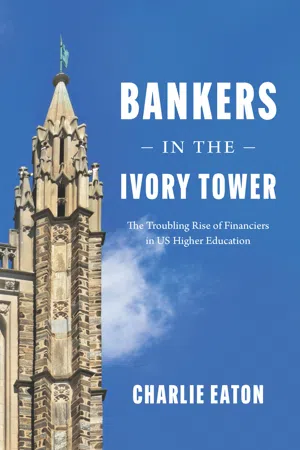
eBook - ePub
Bankers in the Ivory Tower
The Troubling Rise of Financiers in US Higher Education
- English
- ePUB (mobile friendly)
- Available on iOS & Android
eBook - ePub
About this book
Information
Publisher
University of Chicago PressYear
2022Print ISBN
9780226854397
9780226720425
eBook ISBN
9780226720562
Topic
EducationSubtopic
Education General1.
Universities and the Social Circuitry of Finance
Every fall as students return to college, the United States observes two relatively new rituals. First, higher education watchers and the media gawk at whether Harvard, Yale, or some other elite school added the most cash to its multibillion-dollar endowment in the previous year.1 Around the same time, and without a trace of irony, commentators debate the potential social consequences of the latest record-breaking growth in student debt.2
The rise of wealthy college endowments and student debt have together contributed to increasingly obscene inequality in US higher education and in American society at large. While the most elite private universities typically have grown their endowments tenfold, they also have hoarded this expanding wealth by maintaining undergraduate enrollments close to 1970s levels. As a result, spending on education-related costs by the top ten schools in the US News & World Report rankings grew from an already high $50,000 per student in 1988 to more than $100,000 per student since 2010.3 This spending has primarily benefited students from privileged backgrounds who dominate admissions to the most elite private universities.4
Beyond the Ivy League’s islands of wealth, the majority of students now leave college with the burden of student debt. This has not always been the case. In 1975, just one in eight students used student loans to pay for college.5 Scholars have only begun to unpack the social consequences of these debts. We do know, however, that student debt leaves borrowers at an economic disadvantage relative to wealthier students. This is because most wealthy students, including a supermajority of all students at elite private institutions, leave college debt-free.6 At Harvard, only 2 percent of undergraduates today take out any federal student loans at all.7
Although researchers have begun to study the consequences of rising student debt, few have investigated what caused it.8 We have even less research to explain the growth of concentrated endowment wealth and its overwhelming use for the benefit of a privileged few. Observers also rarely recognize that these trends are connected. In Bankers in the Ivory Tower, I ask why and how these interwoven changes occurred.
The rise of student debt and bulging endowments is not just a story of inequality in higher education. As organizations that confer social rank, social connections, and claims to moral superiority, colleges have become ever more important as sites where people vie for status and resources. Consequently, colleges are microcosms for observing the causes and consequences of rising inequality in America and how they are inextricably tied to the resurgent power of financiers.
Intimate University Ties and the Power of Financiers
Even in comparison to other elites, financiers derive unusual power and profits from colleges and universities. As a result, colleges and financiers have played outsized roles in each other’s recent transformations. To explain how the two are linked, I start by tracing who financiers are and what financiers do.
Critically, financiers hold powerful economic roles as middlemen. (They remain overwhelmingly men, especially in high finance.) In myriad varieties of these middleman roles, financiers broker resource transfers between every corner of the economy, including universities and their students. Some key financier roles in higher education include those of commercial bankers who lend to students, hedge fund managers who oversee endowment investments, private equity partners who buy and manage for-profit colleges, and investment bankers who sell university bonds.
Both economists and popular critics have characterized financiers as unusually individualistic, cold, and calculating.9 As with all good lies, there is some truth in this contention. But financiers also collectively secure their wealth through an unparalleled web of intimate social ties to other elites. Sociologist Viviana Zelizer defines intimate ties as those that convey private information—from feelings we share with only an inner circle to a hedge fund’s internal investment plan. In contrast, impersonal ties share only public information, such as the interest rate for a student loan or the price of a stock in a for-profit college.
Scholars of elites have shown that prestigious universities have long been central nodes for financiers’ intimate ties. Financiers gain credentials, connections, and social status from their elite university educations more than any other group of US economic elites. Among the four hundred wealthiest billionaires in America, 65 percent of private equity and hedge fund managers have bachelor’s degrees from the nation’s top thirty private universities.10 But among technology billionaires, the group with the second most elite degrees, only 36 percent are alumni of the top thirty private schools. This nexus between the Ivy League and high finance has helped maintain the sector’s top echelons as the nearly exclusive providence of the well pedigreed.11
Compared to other elites, financiers derive more economic benefits from their university ties because financiers of all varieties trade formally and informally in private information. Financiers use private information to assess credit risks, evaluate potential investments, and solicit capital from investors.12 For example, hedge fund investor Tom Steyer learned from a friend at the 1988 Yale homecoming football game that Yale’s endowment manager David Swensen was beginning to make hedge fund investments. Steyer parlayed the tip into raising $300 million, a third of his initial capital, from Yale’s endowment.13 Tales like Steyer’s pepper the histories of America’s largest private equity and hedge funds.
Financial deregulation since the late 1970s and 1980s gave financiers more freedom to leverage intimate ties and private information for profit. This simultaneously made collegiate ties more valuable and opened new lines of business in the financing of higher education itself. Deregulation let financiers borrow, lend, invest, and trade with fewer restrictions and lower taxes on their profits. As a result, investors could borrow more to make bigger financial bets based on private knowledge. These financiers surpassed in prestige and influence the leaders of other dominant institutions, including government, industrial corporations, and universities. Scholars have referred to this growing power and centrality of financial markets as the financialization of society.14 As the US economy financialized, growing dependence on financiers induced even the leaders of nonfinancial institutions to adopt a financial logic: that money should always be allocated where it will yield the highest rate of return. University leaders have been no exception.
These far-reaching financial ideas and financial institutions can be thought of as a social circuitry of finance that connects every member of society, with financiers positioned as the transistors. Imagining a social circuitry helps us see the actions and choices of people that are missing from many abstract accounts of financialization. The circuitry is social because its connective financial ideas and institutions are neither natural nor robotic. In fact, Zelizer and sociologist Frederick Wherry show that the ideas and institutions of social circuits are “incessantly negotiated” through the interactions of people.15
Just as transistors connect the varied segments of electronic circuits, financiers and their organizations connect the varied financial relations of billions of people around the world. For example, finance’s social circuitry wires the subordinate relationships of student loan borrowers to the investment fund managers that own for-profit colleges. But the circuitry also fuses more equitable interactions between university endowment officers and those same fund managers who invest in for-profit colleges. These complex connections often escape the comprehension of the people involved, including financiers. For proof of this incomprehension, consider that nearly all financiers and financial regulators failed to anticipate the collapse of the mortgage-backed derivative markets that connected homeowners to bond investors.16
Financial Deregulation and Higher Education Inequality
In the context of financial deregulation and declining government support for universities, a variety of financiers expanded the social circuitry of finance via three critical interventions in US higher education. First, commercial bankers mobilized to promote radical changes to federal student loan policies. Second, former investment bankers enlisted the endowment managers of their wealthy alma maters to provide some of the earliest and most important capital for their upstart private equity and hedge funds. Third, private equity managers acquired hundreds of for-profit colleges that used federal student loan expansion to prey on millions of working-class and racially marginalized students. Together these interventions drove new and widening inequalities in US higher education.
Financiers’ three interventions played out differently across three organizational strata of US universities: elite private colleges at the top, for-profit colleges at the bottom, and less-selective public and private colleges in the middle. At the top, elite private universities hoarded their booming endowments for the benefit of small and mostly well-off student bodies. At the bottom, financial investors’ profit model saddled students with greater debt in order to increase tuition revenue. In the middle, public institutions were squeezed by the diversion of government funding to tax cuts and subsidies for financiers and their clients. The diversion of government funding included tens of billions of dollars in annual tax exemptions for university endowments and for public subsidies to for-profit colleges. In response, public universities used student loans to increase tuition revenue. Over the course of this book, I will unpack how these transformations unfolded within each of the three strata.
The results of these transformations are higher education inequalities that both mirror and contribute to expanding wealth and income disparities in America. While the United States was once a leader among wealthy countries in college attainment, growth in US bachelor’s degree completion slowed after the 1970s. While the United States continues to compete internationally in rates of college attendance, the nation lags in the share of students who ultimately receive a four-year degree. Just 40 percent of those aged twenty-five to thirty-four held bachelor’s degrees in 2019. With this slow growth, the United States fell to eighteenth among the thirty-seven nations tracked by the Organisation for Economic Co-operation and Development (OECD).17
The United States has fallen even further when it comes to educational mobility. Americans from the baby boomer generation attained higher degrees than their parents about as often as baby boomers in the median OECD nation. But the US gap in bachelor’s degree attainment between young people in the top and bottom quartiles for parental income actually widened from 40 percentage points to 44 percentage points between 1970 and 2015.18 As a result, the United States now ranks just twenty-fourth among OECD countries for the share of people aged twenty-five to thirty-four who have received higher degrees than their parents.19
We can draw relatively straight lines from the financial transformations of US colleges to their persistent roles in social and economic inequality. Behind a veil of meritocracy, finance steers increasing resources to elite private schools where students continue to hail most often from America’s white upper class. As of 2017, thirty-eight of the most well-endowed colleges enrolled more students from the top 1 percent of the income spectrum than from the bottom 60 percent combined.20 Sociologists have shown that this upper-class educational advantage intergenerationally transmits income and wealth, particularly by providing a pathway to the elite MBA, law, and medical degree programs that offer the most valuable intimate ties and credentials.21
For-profit colleges also play an outsized role in low educational and income mobility among those whose parents did not complete college. The United States is unique among OECD countries for its large for-profit college system that overwhelmingly enrolls low-income and racially subordinated students. These colleges enrolled 12 percent of all US undergraduates at their peak and have been definitively shown to have provided almost no discernible educational or economic benefit to students.22
But financiers’ impact on higher education inequalities and economic disparities is most glaring in the highly unequal explosion of student debt. The United States is again unique among wealthy nations for the amount of nondischargeable student debt that it foists on middle-class and lower-income students.23 Educational debt places these students at further economic disadvantage compared to wealthy students, who overwhelmingly leave college debt-free.
The leg up that wealthy students receive by leaving college debt-free is substantial. Because graduation rates have been suppressed by inadequate instructional funding, a majority of students leaving public institutions with debt do not enjoy the substantial earnings boost that typically comes with a bachelor’s degree. Average income boosts from degrees are also far from universal. As a result, 46 percent of all borrowers have missed payments on federal student loans even since the 2008 recession subsided.24 More than one million federal student loan borrowers have defaulted annually since the 2008 financial crisis, including 47 percent of borrowers at for-profits, 38 percent of borrowers at community colleges, and 27 percent of students at nonselective four-y...
Table of contents
- Cover
- Title Page
- Copyright Page
- Dedication
- Contents
- Acknowledgments
- 1. Universities and the Social Circuitry of Finance
- 2. Our New Financial Oligarchy
- 3. Bankers to the Rescue: The Political Turn to Student Debt
- 4. The Top: How Universities Became Hedge Funds
- 5. The Bottom: A Wall Street Takeover of For-Profit Colleges
- 6. The Middle: A Hidden Squeeze on Public Universities
- 7. Reimagining (Higher Education) Finance from Below
- Methodological Appendix: A Comparative, Qualitative, and Quantitative Study of Elites
- Notes
- References
- Index
Trusted by 375,005 students
Access to over 1.5 million titles for a fair monthly price.
Study more efficiently using our study tools.
Frequently asked questions
Yes, you can cancel anytime from the Subscription tab in your account settings on the Perlego website. Your subscription will stay active until the end of your current billing period. Learn how to cancel your subscription
No, books cannot be downloaded as external files, such as PDFs, for use outside of Perlego. However, you can download books within the Perlego app for offline reading on mobile or tablet. Learn how to download books offline
Perlego offers two plans: Essential and Complete
- Essential is ideal for learners and professionals who enjoy exploring a wide range of subjects. Access the Essential Library with 800,000+ trusted titles and best-sellers across business, personal growth, and the humanities. Includes unlimited reading time and Standard Read Aloud voice.
- Complete: Perfect for advanced learners and researchers needing full, unrestricted access. Unlock 1.5M+ books across hundreds of subjects, including academic and specialized titles. The Complete Plan also includes advanced features like Premium Read Aloud and Research Assistant.
We are an online textbook subscription service, where you can get access to an entire online library for less than the price of a single book per month. With over 1.5 million books across 990+ topics, we’ve got you covered! Learn about our mission
Look out for the read-aloud symbol on your next book to see if you can listen to it. The read-aloud tool reads text aloud for you, highlighting the text as it is being read. You can pause it, speed it up and slow it down. Learn more about Read Aloud
Yes! You can use the Perlego app on both iOS and Android devices to read anytime, anywhere — even offline. Perfect for commutes or when you’re on the go.
Please note we cannot support devices running on iOS 13 and Android 7 or earlier. Learn more about using the app
Please note we cannot support devices running on iOS 13 and Android 7 or earlier. Learn more about using the app
Yes, you can access Bankers in the Ivory Tower by Charlie Eaton in PDF and/or ePUB format, as well as other popular books in Education & Education General. We have over 1.5 million books available in our catalogue for you to explore.