The New Female Antihero examines the hard-edged spies, ruthless queens, and entitled slackers of twenty-first-century television.
The last ten years have seen a shift in television storytelling toward increasingly complex storylines and characters. In this study, Sarah Hagelin and Gillian Silverman zoom in on a key figure in this transformation: the archetype of the female antihero. Far from the sunny, sincere, plucky persona once demanded of female characters, the new female antihero is often selfish and deeply unlikeable.
In this entertaining and insightful study, Hagelin and Silverman explore the meanings of this profound change in the role of women characters. In the dramas of the new millennium, they show, the female antihero is ambitious, conniving, even murderous; in comedies, she is self-centered, self-sabotaging, and anti-aspirational. Across genres, these female protagonists eschew the part of good girl or role model. In their rejection of social responsibility, female antiheroes thus represent a more profound threat to the status quo than do their male counterparts. From the devious schemers of Game of Thrones, The Americans, Scandal, and Homeland, to the joyful failures of Girls, Broad City, Insecure, and SMILF, female antiheroes register a deep ambivalence about the promises of liberal feminism. They push back against the myth of the modern-day super-woman—she who "has it all"—and in so doing, they give us new ways of imagining women's lives in contemporary America.
eBook - ePub
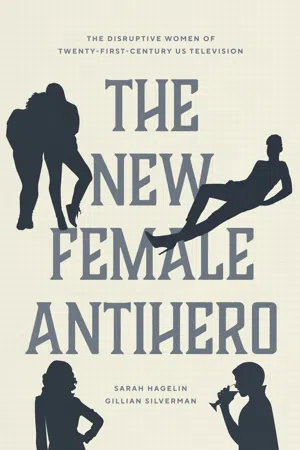
The New Female Antihero
The Disruptive Women of Twenty-First-Century US Television
- English
- ePUB (mobile friendly)
- Available on iOS & Android
eBook - ePub
The New Female Antihero
The Disruptive Women of Twenty-First-Century US Television
About this book
Information
Publisher
University of Chicago PressYear
2022Print ISBN
9780226816401
9780226816357
eBook ISBN
9780226816364
Subtopic
Performing ArtsPART ONE
Ambition TV
1
The Limits of the Female Antihero in Game of Thrones
HBO’s hit show Game of Thrones (2011–2019) provides some tantalizing possibilities for the role of female antihero. It features a slew of possible contenders—lady knights, girl assassins, and ruthless queens who upend conventions with barbarous glee. The series, based on George R. R. Martin’s Song of Ice and Fire novels, is a sprawling fantasy epic with scores of interlocking plots and at least a dozen central characters. Since the show lacks a single protagonist, its approach differs from dramas like Breaking Bad and The Sopranos, which operate as elaborate character studies of individual antiheroes. Yet, for our purposes, the show’s epic scale and plethora of strong women allow questions of heroism, villainy, and audience response to emerge in especially stark terms. Moreover, since the show has as its primary focus the future of civilization—what society should look like, who should hold power, and by what means—it is particularly suited for our analysis since, as we have been arguing, the figure of the antihero pivots around sociality and its destruction. This chapter analyzes two central female characters, Cersei Lannister (Lena Headey) and Daenerys Targaryen (Emilia Clarke), mirrored figures whom the show (up until the penultimate episode of the final season) codes as villain and hero, respectively.1 Recognizing the parallels between them while keeping in mind the disparate reaction of fans—who love Daenerys and love to hate Cersei—allows us to parse what acceptable female transgression looks like and where audiences draw the line.
Cersei and Daenerys differ from fan-pleasing tomboy characters like Arya Stark (Maisie Williams) and Brienne of Tarth (Gwendoline Christie) because they must find ways to assert influence from positions traditionally coded as female. Arya and Brienne observe a world that values masculinity and physical force, and both decide they’ll play by its rules. They turn themselves into an assassin and a knight, respectively, casting off any associations with conventional femininity to guard against a world that views all things female with disdain.2 They both spend entire seasons out on the road, apart from the societies that establish them as women. Cersei and Daenerys, meanwhile, are always enmeshed in a social and political context. They must find a way to crack the code of culture without abandoning it completely—to be taken seriously while remaining associated with the feminine. They thus establish the primary objective of the female antihero in television drama: not to opt out of civilization but to fundamentally alter its modes of conduct. Cersei and Daenerys set the terms for understanding the other female antiheroes examined in part 1 of this book—Elizabeth Jennings of The Americans, Olivia Pope of Scandal, and Carrie Mathison of Homeland—all women who occupy positions associated with state power but whose gender performance undermines the usual operations of the state. In this way they endanger the status quo more effectively than do outliers like Brienne and Arya, threatening to undo establishment hierarchies from the inside out and occupying leadership positions that might allow them to codify these rebellions.
Of course, Game of Thrones has long been appreciated for the way it upends convention. Indeed, the show is often understood in one of two ways: as a political allegory or as a critique of the fantasy genre’s traditional conservatism and nativism. In the former, Daenerys’s dragons are nuclear weapons, and the danger posed by the Night King and his band of ice zombies is the threat of climate change, dismissed by arrogant kings who play the “game of thrones” while ignoring the long winter coming for them all.3 In the latter, the show replaces the genre’s usual swashbuckling male heroes with “cripples, bastards, and broken things” (the title of season 1, episode 4), situating characters like Tyrion Lannister (Peter Dinklage), Jon Snow (Kit Harington), and Bran Stark (Isaac Hempstead Wright) at the center of stories that usually marginalize these figures.4 In this reading, the show’s interest in female characters stands as an important corrective to fantasy’s masculinist worldview. It is part of a larger attempt to give voice to the voiceless and thereby stoke audience identification. As Brent Hartinger has written in his investigation of “freaks and outcasts” in Game of Thrones: “As humans, most of us seem to be instinctively drawn to outsiders, to the excluded. At least on some level, most of us sympathize with those who are denied even the opportunity to prove their full worth.”5
Yet Game of Thrones reveals that we’re drawn to outcast figures not at the moment when they’re denied the opportunity to show their worth but at the precise moment that they’re invited to prove it. That is, downtrodden characters appeal only when they flip the script, turning victimhood into an unabashed show of triumph. Otherwise they merely frustrate or disgust, as the example of Theon Greyjoy (Alfie Allen) under the control of Ramsay Bolton (Iwan Rheon) demonstrates. This dynamic partly explains the audience’s contrasting reactions to Cersei and Daenerys, whom we come upon at different moments in their shared story arc. When Daenerys is introduced to us, she’s young and defenseless, and her onscreen trajectory involves the development of self-respect and agency. We delight in Daenerys’s discovery that she has the blood of the dragon inside her, portending her glorious insurgence. We come upon Cersei, instead, at the moment her authority begins to wane—as she ages, her children grow out of her control, and her sexual indiscretions threaten her status. Daenerys’s story is the lure, a pleasurable fantasy about a scared girl sold into marriage who has the potential to take over the Seven Kingdoms. But Cersei is the fierce, sinking counterweight: the knowledge that female ascendency is impossible to retain and will cost a woman all that she holds dear. If Daenerys’s arc showcases a woman’s rise to power, Cersei’s highlights her inevitable decline—into loss, menopause, and isolation.
But wait, the savvy reader objects, you’ve got it all wrong! We don’t love Daenerys for her upward trajectory; we love her because she’s good! Because as the “breaker of chains,” she plans to free the slaves and better the world. And Cersei, well of course she’s despised; but not because she’s past her prime. Rather, she is, in common parlance, a bitch—cruel, rapacious, and self-aggrandizing. She needs to get her just deserts no less than Tywin Lannister (Charles Dance), Walder Frey (David Bradley), and the show’s other savage autocrats.
Perhaps. Certainly, the show provides Daenerys the classic hero’s cut, gracing her with fist-pumping action sequences and showering her with onscreen adoration. Cersei, meanwhile, is stuck in dimly lit castles, swilling wine and delivering barbed insults. The show telegraphs from its beginning that viewers are meant to read her as hopelessly depraved—in the first episode she beds her brother, and in the second she orders the execution of a little girl’s direwolf puppy.
But a closer look reveals that Cersei and Daenerys, who for much of the show are positioned as opposites—nefarious queen and benevolent Khaleesi, ironfisted matriarch and waifish ingénue—are startlingly similar. Both are blond, beautiful daughters of royal households; both are sold into marriage to secure political alliances; both are fiercely determined to protect their children—each has three (and a firstborn that dies in infancy), and each has been told by a witch that she can bear no more.6 Incest, too, haunts the storylines of both, although Daenerys responds ambivalently to her brother Viserys’s (Harry Lloyd) creepy advances and is, at least at first, an unknowing participant in her affair with nephew Jon Snow.7 Perhaps, most importantly, the ruthlessness with which both women persecute their enemies and pursue world domination is remarkably alike. Indeed, even before Daenerys brutally murders the citizens of King’s Landing at the series conclusion, she seemed to be adopting the rules of a fascist playbook, making her potentially a greater villain than Cersei. That Daenerys remained (almost to the end) a fan favorite while Cersei—whose motivations, we argue, can be read in more feminist terms—was “officially the most hated character on Game of Thrones”8 tells us a thing or two about the limits of the female antihero’s appeal. Specifically, it suggests that viewers may be more comfortable with savage imperial violence than they are with unabashed female pleasure, especially when the first is dressed up in plunging necklines and flowing hair and the second is articulated by an aging, barren, and increasingly unfeminine woman.
“Tears Aren’t a Woman’s Only Weapon. The Best One’s between Your Legs”
Both Cersei and Daenerys are introduced to us in season 1 as victims, albeit uneven, of their family’s will and their husband’s abuse. Daenerys has been bartered by her brother Viserys to Khal Drogo (Jason Momoa), warlord of the Dothraki, in the region that stands in for the Middle East in the show’s spatial imaginary. The first episode presents her as powerless and humiliated, first violated by her brother and then raped so painfully by Drogo on their wedding night that she has trouble walking the next day. Meanwhile, across the Narrow Sea in King’s Landing, Cersei has been forced by her father to marry “the usurper,” Robert Baratheon (Mark Addy), a man who brazenly proclaims his love for another woman (Ned Stark’s deceased sister, Lyanna) and who takes every opportunity he can to whore it up with the locals in Cersei’s (and her family’s) presence. (“He likes to do this while I’m on duty,” a seething Jaime Lannister [Nikolaj Coster-Waldau] remarks. “He makes me listen as he insults my sister.”)9 While Cersei, unlike Daenerys, comes off as vicious and scheming, her backstory and framing encourage audiences, at least at first, to view her with some sympathy. Indeed, even when she is shown in what appears to be a consensual sexual liaison with her brother, Cersei’s physical stance—taken with considerable force from behind—echoes Daenerys’s stance with Drogo, reinforcing their parallels as sexual supplicants. Sex coach Doreah’s (Roxanne McKee) advice to Daenerys in episode 2 might apply to Cersei as well: “Dothraki take slaves like a hound takes a bitch. Are you a slave, Khaleesi? Then don’t make love like a slave.”10
At the same time that they are subordinated, however, both Cersei and Daenerys wield a certain amount of influence, a consequence of their beauty and fertility. As Daenerys learns from Doreah how to pleasure Khal Drogo, she improves both her treatment at his hands and her standing in the Dothraki community. And once she becomes pregnant, her new status as “mother” drives every important moment in Daenerys’s growing agency over the course of season 1. She rids herself of her feckless brother Viserys after he threatens her unborn child, and she saves a group of captured women from being raped by Drogo’s army by claiming them as her children. When Drogo’s lieutenant, Mago (Ivailo Dimitrov), complains that Daenerys has thwarted his “right” to “mount” the conquered women, Daenerys insists, “I have claimed many daughters this day, so they cannot be mounted.” Mago challenges her authority, but Drogo responds with admiration: “See how fierce she grows? That is my son inside her, the stallion that will mount the world, filling her with his fire.”11 Motherhood is here figured both as the protection with which Daenerys would cloak the women and as the “fire” that gives Daenerys ascendency. “I am Khaleesi. I do command you,” she declares to Mago. This particular lesson on the power of queenly motherhood is not specific to the Dothraki. Back in King’s Landing, Robert Baratheon suggests killing Daenerys precisely because he recognizes that despite her young age, the Khaleesi’s fertility poses a threat. As he tells Ned Stark (Sean Bean), “Soon enough, that child will spread her legs and start breeding.”12
A similar dynamic can be observed with Cersei, who wields power principally through her status as mother. Indeed, the mystery that structures the first season pivots on the problem of Cersei’s rogue sexuality and the questionable legitimacy of her children. Patriarchy is built on precisely this issue, as the phrase that Hortense Spillers popularized—“Mama’s baby, Papa’s maybe”—makes clear.13 Because men can never be assured of their paternity, they must put into place all manner of restrictions to guarantee that their wives remain subjugated and sequestered. That Cersei has managed to skirt these by carrying on a clandestine affair that results in two sons who become heir to the throne is impressive indeed; it indicates that she, no less than Daenerys, understands how women, largely dispossessed, may wield power. In a moment, perhaps, of would-be feminist solidarity, she attempts to impart this lesson to young Sansa Stark (Sophie Turner) while the two are holed up awaiting Stannis Baratheon’s (Stephen Dillane) invading army in season 2. Inexperienced and romantic, Sansa is fond of declaring that “courtesy is a lady’s armor,” but Cersei explains that a woman’s virtue provides no shield against the soldiers that would sack the city. Lamenting that Stannis (labeled “Westeros’s Al Gore” on fan websites for his humorless adherence to rules14) would reject her seduction attempts should his army prevail, Cersei then taunts Sansa: “Have I shocked you, little dove? Tears aren’t a woman’s only weapon. The best one’s between your legs. Learn how to use it.”15 While Sansa appears mortified, her canny manipulation of Lord Baelish (Aidan Gillen) in subsequent seasons indicates that Cersei’s advice does not fall on deaf ears. “I learned a great deal from her,” Sansa tells a surprised Jon Snow years later.16
It bears repeating that the ability of noblewomen to weaponize their sexuality (and their consequent status as mother) is precisely the thing that Arya and Brienne reject. When Ned Stark tells a young Arya that she can’t be a lord of a holdfast, but instead that she “will marry a high lord and rule his castle, and your sons shall be knigh...
Table of contents
- Cover
- Title Page
- Copyright Page
- Dedication
- Contents
- Prologue
- Introduction: The New Female Antihero—The What, the Why, the How
- part i: Ambition TV
- part ii: Shame TV
- Epilogue
- Acknowledgments
- Notes
- Index
Trusted by 375,005 students
Access to over 1.5 million titles for a fair monthly price.
Study more efficiently using our study tools.
Frequently asked questions
Yes, you can cancel anytime from the Subscription tab in your account settings on the Perlego website. Your subscription will stay active until the end of your current billing period. Learn how to cancel your subscription
No, books cannot be downloaded as external files, such as PDFs, for use outside of Perlego. However, you can download books within the Perlego app for offline reading on mobile or tablet. Learn how to download books offline
Perlego offers two plans: Essential and Complete
- Essential is ideal for learners and professionals who enjoy exploring a wide range of subjects. Access the Essential Library with 800,000+ trusted titles and best-sellers across business, personal growth, and the humanities. Includes unlimited reading time and Standard Read Aloud voice.
- Complete: Perfect for advanced learners and researchers needing full, unrestricted access. Unlock 1.5M+ books across hundreds of subjects, including academic and specialized titles. The Complete Plan also includes advanced features like Premium Read Aloud and Research Assistant.
We are an online textbook subscription service, where you can get access to an entire online library for less than the price of a single book per month. With over 1.5 million books across 990+ topics, we’ve got you covered! Learn about our mission
Look out for the read-aloud symbol on your next book to see if you can listen to it. The read-aloud tool reads text aloud for you, highlighting the text as it is being read. You can pause it, speed it up and slow it down. Learn more about Read Aloud
Yes! You can use the Perlego app on both iOS and Android devices to read anytime, anywhere — even offline. Perfect for commutes or when you’re on the go.
Please note we cannot support devices running on iOS 13 and Android 7 or earlier. Learn more about using the app
Please note we cannot support devices running on iOS 13 and Android 7 or earlier. Learn more about using the app
Yes, you can access The New Female Antihero by Sarah Hagelin,Gillian Silverman in PDF and/or ePUB format, as well as other popular books in Media & Performing Arts & Performing Arts. We have over 1.5 million books available in our catalogue for you to explore.