The Science of Character makes a bold new claim for the power of the literary by showing how Victorian novelists used fiction to theorize how character forms.
In 1843, the Victorian philosopher John Stuart Mill called for the establishment of a new science, "the science of the formation of character." Although Mill's proposal failed as scientific practice, S. Pearl Brilmyer maintains that it found its true home in realist fiction of the period, which employed the literary figure of character to investigate the nature of embodied experience. Bringing to life Mill's unrealized dream of a science of character, novelists such as George Eliot, Thomas Hardy, and Olive Schreiner turned to narrative to explore how traits and behaviors in organisms emerge and develop, and how aesthetic features—shapes, colors, and gestures—come to take on cultural meaning through certain categories, such as race and sex. Engaged with materialist science and philosophy, these authors transformed character from the liberal notion of the inner truth of an individual into a materially determined figuration produced through shifts in the boundaries between the body's inside and outside. In their hands, Brilmyer argues, literature became a science, not in the sense that its claims were falsifiable or even systematically articulated, but in its commitment to uncovering, through a fictional staging of realistic events, the laws governing physical and affective life. The Science of Character redraws late Victorian literary history to show how women and feminist novelists pushed realism to its aesthetic and philosophical limits in the crucial span between 1870 and 1920.
eBook - ePub
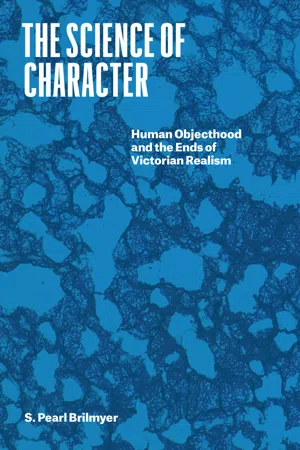
The Science of Character
Human Objecthood and the Ends of Victorian Realism
- English
- ePUB (mobile friendly)
- Available on iOS & Android
eBook - ePub
About this book
Trusted by 375,005 students
Access to over 1.5 million titles for a fair monthly price.
Study more efficiently using our study tools.
Information
Publisher
University of Chicago PressYear
2022Print ISBN
9780226815787
9780226815770
eBook ISBN
9780226815794
[ CHAPTER ONE ]
Plasticity, Form, and the Physics of Character in Eliot’s Middlemarch
. . . the way in which your life presses on others, and their life on yours . . .
George Eliot, Daniel Deronda
George Eliot’s novel Middlemarch is famously said to both thematize and foster intersubjectivity through its psychologically rich and detailed portrait of human life.1 However, to elide the distinction between subjectivity and what I have been referring to as its dynamic material substrate—character—risks overlooking the extent to which human life in Middlemarch is presented as taking shape not only through intentions, thought, or speech, but through physical actions and reactions as well. Deidre Lynch has shown how the protocols of interiority attributed to the novelistic modes of characterization were not endemic to the novel genre but rather emerged in attempts to “validate and naturalize a concept of character as representational” (3). Building on the work of Lynch, Catherine Gallagher, and other character historians and theorists, this chapter shows how Middlemarch engages Victorian materialist science to produce not only sympathetic and real-seeming minds but also lively and reactive characterological bodies, cultivating an ethological approach to the human that models the dynamic, material processes through which character takes shape.
Closer attention to the representation of character in Eliot’s novel troubles the suggestion that as the nineteenth century progressed, the representation of character became increasingly inward-oriented and psychologized. Narrating “how it came to be that novels, to be good novels, had to be about character,” Lynch suggests that as the nineteenth century turned, character cleaved from the body and its materiality, transforming character from an “outer” to an “inner” quality (29). In Middlemarch, however, character appears not as a hidden or buried kernel of personhood but instead as an empirically observable, materially determined figuration produced through shifts in the boundaries between the body’s inside and outside. As we will see, even the most notoriously “brainy” of Victorian novels—on the level of its descriptions—resist a too-easy alignment of its characters with the individual human personality.2
The characterological bodies that form the focus of my analysis are not verisimilitudinous human anatomies, with faces and limbs. Where Eliot certainly describes her characters with regard to their phenomenal appearances—Dorothea has “dark-brown hair” (81); Celia is “amiable and innocent looking” (9)—the more ontological characterology I elucidate in what follows presents characters less in terms of particular, observable traits than with regard to general states of matter, drawing upon knowledge of how materials in different physical states respond differently under different circumstances. So doing constitutes an example of what in the introduction to this book I referred to as “weak theory”—theory that immanently unfolds through close attention to situational particularities, straddling the descriptive and the theoretical.
Consider, as an initial example, the narrator’s description of Rosamond Vincy’s persistence as that which “enables a white soft living substance to make its way in spite of opposing rock” (Middlemarch 324). This description of Rosamond’s tenacity relies on the reader’s corporeal awareness of the general properties of matter—in this case, soft matter, which has the capacity to envelop harder bodies thanks to its looser molecular structure. The descriptive force of the figure inheres in the lively materiality of this “white soft living substance”—its soft texture, plastic form, and unexplained animacy. Notice also how the figure presents Rosamond’s ability to overpower her father not in terms of an individual or conscious intention but rather as a nonintentional affordance of the materiality of her character. Much later in the novel, the narrator describes Rosamond’s behavior with a maxim that harkens back to her plastic quality:
We cannot be sure that any natures, however inflexible or peculiar, will resist this effect from a more massive being than their own. They may be taken by storm and for the moment converted, becoming part of the soul which enwraps them in the ardor of its movement. (714)
As we will see, few natures in Middlemarch are so inflexible; most are like Rosamond in their affinity to a soft, plastic substance. Arthur Brooke, for example, is described as “glutinously indefinite” (8). He is “a very good fellow, but pulpy; he will run into any mould, but he won’t keep shape” (65). Sir James Chettam, likewise, is made of a kind of “human dough”; he has but the “limpest personality,” furnished “with a little gum or starch in the form of tradition” (20). Taken separately, such descriptors might read as metaphors for particular personality traits (Brooke is fickle; Chettam, lacking in substance). Taken together, however, they develop a vocabulary for the plasticity of character that—while certainly figural in nature—exceeds the metaphorical in its consistent explanation of characterological traits and behaviors with reference to fundamental physical laws.
A metaphor sets up a comparison between two distinct concepts or objects, highlighting similarities between two apparently unrelated things; Eliot’s character descriptions, however, often assume no categorical difference between the “stuff” of human character and that of nonhuman physical things. Both are presented as the product of what J. S. Mill, A. F. Shand, and other Victorian ethologists called “circumstances”—interactions between bodies that lend shape to their being. To return to my initial example, notice that Rosamond is not compared to a “white soft living substance . . . mak[ing] its way in spite of opposing rock.” Rather, she is said to derive her forcibility from the very same quality that allows this plastic substance to envelop rigid structures. To quote the passage in full: “The circumstance called Rosamond was particularly forcible by means of that mild persistence which, as we know, enables a white soft living substance to make its way in spite of opposing rock” (324, emphasis mine).
In revealing the characterological link between the behavior of these two beings—one nonhuman, one human—Eliot might be said to produce what the feminist science studies scholar Donna Haraway calls a figure. “Figures,” Haraway writes, “are not representations or didactic illustrations, but rather material-semiotic nodes or knots in which diverse bodies and meanings coshape one another” (When Species 135). “For me,” she continues, “figures have always been where the biological and literary or artistic come together with all of the force of lived reality. My body itself is just such a figure, literally” (135). Haraway’s body is a figure in the same way that Eliot’s “white soft living substance” is: both signify meaning to those who encounter them. Rather than understand this “white soft living substance” as a metaphor “for” Rosamond, then, we might follow Haraway in considering how “the circumstance called Rosamond” and this imaginary substance “coshape one another” via the node that is their “mild persistence.”
It is one of the driving arguments of this book that late Victorian realist fiction offers special insight into the workings of character. This story begins with Eliot, whose 1870s fiction laid the conceptual and formal groundwork for the later realists I analyze. Her fiction did so by shifting the reader’s attention from human subjecthood toward what I have called human objecthood—physical aspects of existence that humans share with nonhuman animals and things. The objecthood of the human is rendered in Eliot’s novel through figural, descriptive language that pushes past the metaphorical to generate theories about how character emerges, physically and relationally, across scales.
Elucidating what I call Eliot’s physics of character—a figural characterology that represents human life in terms of its physical limitations and potentials—this chapter tests two hypotheses in two sections. The first hypothesis is that the plasticity of Eliot’s characters in Middlemarch records the capacity of bodies for relation and thus for change as well. The second hypothesis is that throughout Middlemarch, rigidity signals the apparent autonomy of character, the phenomenal experience of characters as stable, individuated entities that remain consistent throughout time. Phrased differently, I will argue that where soft matter for Eliot embodies the interactivity and transformability of character as an impersonal substrate that takes form only through its relations, solids emerge as figures in the production of fictional worlds populated by individual persons with self-possessed natures. While the fictional world of the realist novel might be imaginary, as I go on to suggest in tracing Eliot’s historical ties to the English philosophical tradition known as emergentism, its apparent reality is no mere illusion but rather an emergent property of the matter of fiction: language. Aiding me in making this argument will be a diverse set of thinkers—from nineteenth-century scientists such as Robert Brown, Michael Faraday, and William James to present-day feminist materialist philosophers, including Catherine Malabou and Elizabeth Grosz. My analysis will focus on how Eliot exploits certain formal elements of descriptive language and realist world-building in order to explore the limits and potential of characterological change and to theorize the role of character in mediating fiction and reality.
Plastic Forms
“Character,” the narrator of Middlemarch explains, is “a process and an unfolding” (140). This process is one of neither passive imprintation nor heroic self-formation but rather one that emerges from the plasticity of matter itself.3 Incorporating nineteenth-century research into the activity of matter into her weak-theoretical descriptions of characters, Eliot develops a physics of character in which matter both figures and participates in characterological transformation.
In the nineteenth century, the extent to which the matter of character could be intentionally transformed was a subject of great debate. Where pseudosciences like phrenology and physiognomy understood character to be biologically inherent, if also manipulable, many political and educational theorists by contrast held that character, even if materially conditioned, was a direct product of the will—a thing crafted through individual practices and man-made social institutions. In the introduction, I noted that scholarship in Victorian studies has tended to focus on the overlapping binaries of the predetermined and the chosen, the biological and the social, as well as the typological and the individual. Athena Vrettos, for example, has tracked anxieties about the “potential rigidification of human character” in Victorian psychological discourse, showing how “biologically based theories of the mind” often called into question the possibility of “individual reformation, spiritual growth, or free will” (400, 404). Where Vrettos paints a portrait of rigid, mechanized minds, “driven to repetitive, automatic behaviors in order to conserve energy for more difficult or novel tasks” (400), Sara Ahmed, writing from a different critical perspective, describes the simultaneously occurring liberal dream of self-transformation in which character was thought by Mill and other Victorians to be “amenable to [the] will” (Mill, William Hamilton 466). As she remarks, in the nineteenth century, character was often presented as a pliable substance given shape by either individuals or social institutions like schools. “If a character can be thought of as a will product,” Ahmed writes in reference to this liberal political tradition, “then character might even be the material, or provide the material, that is given form through will, in the sense of given an end, shape, or purpose” (234).
Eliot’s novel circumvents the binary in Victorian characterological thinking elucidated by Vrettos and Ahmed (as well as by Amanda Anderson, elsewhere), refusing both the discourse of biological fixity and that of willed flexibility.4 In so doing, she cultivates what I have been describing as a dynamic materialist approach to character. While for some Victorians, materialism entailed a mechanism whereby the actions of all physical things were thought to obey a simple set of causal laws, for Eliot, along with New Realist authors that followed in her footsteps, the dynamic forces that act in and on matter were understood to be no less predictable and determined than the human will. In the dynamic materialist characterology that emerges in Middlemarch—and which this book tracks forward across the turn of the century through the late fiction of Thomas Hardy to the New Woman novel—character traits and behaviors arise neither through the unfolding of a preformed nature nor through the expression of the individual mind, but circumstantially as a result of material affordances like the dynamic responsiveness of organic tissue to outside force. Borrowing a term from recent new materialist philosophy and tracking its use back to contemporaries of Eliot such as William James, I suggest that character for Eliot is fundamentally plastic.
In contemporary philosophy, the term plasticity has recently resurfaced as a keyword in theories of the brain and body. Such philosophies have aimed, broadly speaking, to conceive of bodily matter as more than a precultural given, a fixed constant that is “inscribed” or passively molded by culture or society.5 As Catherine Malabou has pointed out, the word plasticity implies an active principle. Its etymology can be traced to the Greek plassein (πλάσσειν), which “means at once the capacity to receive form (clay is called ‘plastic,’ for example) and the capacity to give form (as in the plastic arts or plastic surgery)” (What Should We Do 5).6 Plasticity theory is an expression of dynamic materialism insofar as it understands matter broadly to be an active producer of form rather than merely its passive recipient. This is because, as Malabou underlines, plasticity connotes the active potential of transformation—the idea that a thing is simultaneously susceptible to and can cause change. It does not mean that something is infinitely modifiable but rather that impressions and forces that act on a body from the outside are consolidated and transformed to produce intentions, desires, and thoughts that sometimes appear to originate solely from within.
For Malabou, such actions and reactions are not governed by the same causal laws that apply to the inorganic world. Far more complex in structure, life is defined by the potential for discontinuity between action and reaction. Put otherwise, the plasticity of life consists in the ability of an organism to introduce spontaneous delays and shifts into nexuses of force. (This definitional distinction between life, which is plastic, and nonlife, which is not, will be called into question by Eliot, as we will see in the second part of this chapter, as well as in the coda.) The turn to plasticity in cultural studies and critical theory, which is initiated largely through the innovations of feminist science studies, though now unfolding outside this arena, has afforded thinkers new ways of conceiving of identity formation. Rather than perceiving matter as the passive background to social formations, critics have increasingly come to understand matter, as well as nature, as an active force at work in the production of culture, identity, and agency.7 Contemporary plasticity theory thus emerges as a particular instantiation of the dynamic materialism that this book traces to the work of nineteenth-century novelists, philosophers, and scientists such as William James and Eliot.
In line with present-day theorists of plasticity such as Malabou, these nineteenth-century thinkers challenge our tendency to understand character solely as the product of human forces, be they individual wills or sociocultural norms. They challenge this tendency not from the present, of course, but from their historical moment, a moment in which the assumptions that matter was static and reactive, and the human mind, dynamic and active, were increasingly being called into question. In The Outward Mind, Benjamin Morgan argues that “a nineteenth-century fascination with matter occasioned new speculation about the agencies of physical things that had previously seemed still and inert” (6). A watershed moment in this history was the Irish physicist John Tyndall’s 1874 address to the British Association for the Advancement of Science at Belfast, which drew on a long history of materialist philosophy and science to argue that movement and power were immanent to matter....
Table of contents
- Cover
- Title Page
- Copyright Page
- Contents
- list of figures
- introduction • Ethology, or the Science of Character
- chapter 1 • Plasticity, Form, and the Physics of Character in Eliot’s Middlemarch
- chapter 2 • Sensing Character in Impressions of Theophrastus Such
- chapter 3 • The Racialization of Surface in Hardy’s Sketch of Temperament and Hereditary Science
- chapter 4 • Schopenhauer and the Determination of Women’s Character
- chapter 5 • The Intimate Pulse of Reality; or, Schreiner’s Ethological Realism
- coda • Spontaneous Generations of Character between Realism and Modernism
- Acknowledgments
- Bibliography
- Index
- Footnotes
Frequently asked questions
Yes, you can cancel anytime from the Subscription tab in your account settings on the Perlego website. Your subscription will stay active until the end of your current billing period. Learn how to cancel your subscription
No, books cannot be downloaded as external files, such as PDFs, for use outside of Perlego. However, you can download books within the Perlego app for offline reading on mobile or tablet. Learn how to download books offline
Perlego offers two plans: Essential and Complete
- Essential is ideal for learners and professionals who enjoy exploring a wide range of subjects. Access the Essential Library with 800,000+ trusted titles and best-sellers across business, personal growth, and the humanities. Includes unlimited reading time and Standard Read Aloud voice.
- Complete: Perfect for advanced learners and researchers needing full, unrestricted access. Unlock 1.5M+ books across hundreds of subjects, including academic and specialized titles. The Complete Plan also includes advanced features like Premium Read Aloud and Research Assistant.
We are an online textbook subscription service, where you can get access to an entire online library for less than the price of a single book per month. With over 1.5 million books across 990+ topics, we’ve got you covered! Learn about our mission
Look out for the read-aloud symbol on your next book to see if you can listen to it. The read-aloud tool reads text aloud for you, highlighting the text as it is being read. You can pause it, speed it up and slow it down. Learn more about Read Aloud
Yes! You can use the Perlego app on both iOS and Android devices to read anytime, anywhere — even offline. Perfect for commutes or when you’re on the go.
Please note we cannot support devices running on iOS 13 and Android 7 or earlier. Learn more about using the app
Please note we cannot support devices running on iOS 13 and Android 7 or earlier. Learn more about using the app
Yes, you can access The Science of Character by S. Pearl Brilmyer in PDF and/or ePUB format, as well as other popular books in Literature & Modern British History. We have over 1.5 million books available in our catalogue for you to explore.