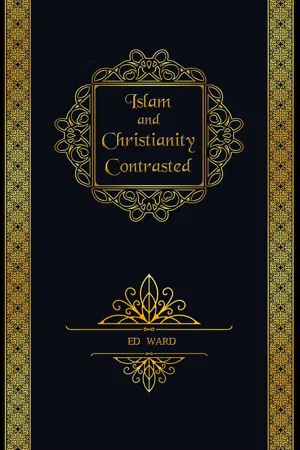
Islam and Christianity Contrasted
eBook - ePub
Available until 23 Dec |Learn more

Islam and Christianity Contrasted

  1. English
  2. ePUB (mobile friendly)
  3. Available on iOS & Android
eBook - ePub
Available until 23 Dec |Learn more

Islam and Christianity Contrasted

About this book

My first exposure to Muslims was in 2005 in Morocco. I enjoyed my visit and was surprised by the Berbers' hospitality. I was fascinated by the eagerness of Muslims to discuss God. While sharing personal stories was important, our conversations always concluded with talking about God. Discussions about our faiths was the foremost topic of my conversations with Muslims. Over the years, I have compared the teachings of Islam with the Christian Scriptures. I have found the narratives differing in detail and concepts conflicting in perspective. These theological differences confirm that Islam and Christianity do not worship the same God. For example, the Quran teaches that Allah commanded angels to bow down to Adam at creation. Satan refused, and Allah banished him to the earth (Qu.7: 11-13). According to the Bible, Yhwh would never command angels to bow down to man, for only Yhwh is worthy of worship. For an angel to bow down to man is idolatry. I have observed many debates between Muslims and Christians. Muslim debaters seldom stay on the agreed topic. Instead, they divert from the subject to ridicule and debase Christianity as foolishness. I have found that while Muslims ask difficult questions of Christianity, they never ask the same questions of Islam. Islam and Christianity Contrasted will seek answers to those questions from the early Islamic sources and compare them with the teachings of the Bible. The Quran, early hadiths, Islamic history, and four established translations of the Bible will be consulted. I hope that through Islam and Christianity Contrasted, both Muslims and Christians will have a deeper understanding of one another's faith.

Islam, Christianity, God, Allah, Muslims, Christians, Paradise, Heaven, Quran, Injil, Trinity, Tawhid

Frequently asked questions

Yes, you can cancel anytime from the Subscription tab in your account settings on the Perlego website. Your subscription will stay active until the end of your current billing period. Learn how to cancel your subscription.
No, books cannot be downloaded as external files, such as PDFs, for use outside of Perlego. However, you can download books within the Perlego app for offline reading on mobile or tablet. Learn more here.
Perlego offers two plans: Essential and Complete
  • Essential is ideal for learners and professionals who enjoy exploring a wide range of subjects. Access the Essential Library with 800,000+ trusted titles and best-sellers across business, personal growth, and the humanities. Includes unlimited reading time and Standard Read Aloud voice.
  • Complete: Perfect for advanced learners and researchers needing full, unrestricted access. Unlock 1.4M+ books across hundreds of subjects, including academic and specialized titles. The Complete Plan also includes advanced features like Premium Read Aloud and Research Assistant.
Both plans are available with monthly, semester, or annual billing cycles.
We are an online textbook subscription service, where you can get access to an entire online library for less than the price of a single book per month. With over 1 million books across 1000+ topics, we’ve got you covered! Learn more here.
Look out for the read-aloud symbol on your next book to see if you can listen to it. The read-aloud tool reads text aloud for you, highlighting the text as it is being read. You can pause it, speed it up and slow it down. Learn more here.
Yes! You can use the Perlego app on both iOS or Android devices to read anytime, anywhere — even offline. Perfect for commutes or when you’re on the go.
Please note we cannot support devices running on iOS 13 and Android 7 or earlier. Learn more about using the app.
Yes, you can access Islam and Christianity Contrasted by Ed Ward in PDF and/or ePUB format, as well as other popular books in Theology & Religion & Biblical Commentary. We have over one million books available in our catalogue for you to explore.
Chapter 3
The Injil

Holy Books of Islam

Muslims believe that Allah gave the Jewish Taurat (Torah) and the Zabur (Psalms), the Christian Injil (New Testament), and the Quran. The Quran teaches that Muslims are to accept all four books as truth:
Any who denieth Allah, His Angels, His Books, His Apostles, and the Day of Judgment, hath gone far, far astray. (Qu.4:136 Y Ali)
The Quran states that all four books are equal, and one is not given prominence over the other:
We believe in God and what was revealed to us; and what was revealed to Abraham, Ishmael, Isaac, Jacob, and their descendants, and what was given to Moses and Jesus and what was given to the [other] prophets by their Lord. We make no distinction between any of them. It is to Him that we surrender ourselves. (Qu.2:136 Khan; 3:3-4)
The Quran teaches that Allah will keep his word from being corrupted--all four books:
There is good news in this life and in the Hereafter: the Word of God shall never change. That is the supreme triumph. (Qu.10:64 Khan, 18:27; 6:34 )
The Quran commands Christians to live according to their Gospel:
Therefore, let those who follow the Gospel judge according to what God has revealed in it. Those who do not judge by what God has sent down are rebellious. (Qu.5:47 Khan)
Furthermore, the Quran teaches that Muslims who have questions about the Quran are to seek out Christians for answers from the Injil. Islam's acceptance of the Injil supports its authenticity:
If you are in any doubt concerning what We have sent down to you, then question those who have read the Book before you: the Truth has come to you from your Lord, so do not be one of the doubter.
(Qu.10:94 Khan)
From these ayat, there is no doubt that Mohammed held the Injil as a source of the true knowledge of God:
The Messenger believeth in what hath been revealed to him from his Lord, as do the men of faith. Each one (of them) believeth in Allah, His angels, His books, and His messengers. "We make no distinction (they say) between one and another of His messengers." (Qu.2:285 Y Ali)
Therefore, the Quran places great confidence in the Christian Gospel as a source of truth and authority for a Christian's life.

The Taurat

Modern Muslims believe that the Quran cannot become corrupted because Allah promises to keep it safe:
We have, without doubt, sent down the Message; and We will assuredly guard it from corruption. (Qu.15:9 Y Ali)
However, Muslims are taught that the former books from Allah have been corrupted. If Allah could not keep the Torah and the Injil from corruption, how can he keep the Quran from corruption? The Quran considers both the Torah and the Injil as the books of Allah:
He has sent down the Book to you with truth, which fulfils the predictions in the Scriptures that preceded it: He sent down the Torah and the Gospel. (Qu.3:3 Khan)
According to Islam, in the same manner that the Quran came to Muslims, the Torah came through Moses. Allah had total confidence that the Torah was intact during the lifetime of Mohammad because the Quran uses the phrase "Book…that is with you":
O People of the Book, believe in what We have sent down, fulfilling [the predictions] that is with you… (Qu.4:47 Khan)
The Quran repeatedly declares that the Torah was unchanged. Consider the ayat in surah 2. The Quran states that the Jews had the authentic Scriptures when Mohammad was alive:
Children of Israel… And believe in the message I have sent down which fulfils that [predictions about the last prophet in their Scripture] which you already possess and do not be foremost among those who deny its truth. Do not sell My revelations for a paltry price; fear Me alone. Do not mix truth with falsehood, or hide the truth when you know it.
(Qu.2:40-42 Khan)
The Quran warns about misinterpreting the Scriptures. Two ayat later, the Jews were sited reading the Torah:
Do you admonish others to do good and forget this yourselves? Yet you read the Book. Will you not then understand? (Qu.2:44 Khan)
The Jews had to have had the Torah to read the Torah. Consider what was written later in the same surah:
And when there came to them (the Jews), a Book (this Quran) from Allah confirming what is with them (the Taurat {Torah} and the Injeel {Gospel}). (Qu.2:89 Hilali/Khan)
The Quran confirms that the authentic Torah and the Injil were with the Jews when Mohammad recited this ayah. All these ayat are in surah 2, recognizing that the Jews still had an authentic Torah when Mohammad founded Islam:
When they are told, Believe in what God has revealed, they say, We believe in what was revealed to us, while they deny the truth in what has been sent down after that, even though it is the Truth, confirming that which they already have. Say, Why did you kill God's prophets in the past, if you were true believers. (Qu.2:91 Khan)
Surah 2 confirms that the Jews had their Scriptures during the life of Mohammad, and yet, the Quran warns that some of the Jews discarded the Torah:
And when a messenger came to them from at God confirming to what (is) with them, a group from those who were given The Book , discarded/ rejected God's Book behind their backs, as if they do not know.
(Qu.2:101 M/S Ahmed)
Muslims should correct others who say that the Torah was corrupted, for Surah 2 is redundant that both the Jews and Christians had their authentic Scriptures when...

Table of contents

  1. Contents
  2. Preface
  3. The Traditional Record
  4. Mohammad
  5. Mohammad and Moses
  6. The Line of God
  7. Mohammad's Calling
  8. Mohammad's Deception
  9. A Year of Delusion
  10. Can Mohammad Be Trusted
  11. The Unlettered Prophet
  12. The Test of a Prophet
  13. Conclusion
  14. The Quran
  15. Basic Information on the Quran
  16. The Forgotten Ayat
  17. The Lost Surahs
  18. The Quran Was Edited
  19. Plagiarism
  20. Contradictions
  21. Abrogation
  22. Fabricated Ayat
  23. Conclusion
  24. Holy Books of Islam
  25. The Taurat
  26. Mohammad's View of the Scriptures
  27. The Hadiths
  28. The Corruption of the Injil
  29. Mohammad Endorsed the Injil
  30. A Final Word on the Authenticity of the Injil
  31. The Christian Defense: Textual Criticism
  32. The Destruction of Manuscripts
  33. Textual Criticism of the Quran
  34. Sana'a Manuscript DAM 0 1-27.1
  35. Birmingham Mingana 1572a
  36. Textual Criticism of the Injil
  37. Defense of the Injil
  38. The Expanse of the Church
  39. The Early Church Fathers
  40. Different Translations
  41. Paul the Apostle
  42. Conclusion
  43. Man is Born Good
  44. Allah Controls Everything
  45. Why Do Good Men Sin?
  46. Is Allah Holy?
  47. Allah Does Not Love Humanity
  48. Allah the Deceiver
  49. The Christian View
  50. Yhwh is Good
  51. Different Approaches
  52. Tolerance or Intolerance
  53. No Compulsion in Religion
  54. Christians Share
  55. Good News
  56. Backsliders
  57. Conclusion
  58. Justice
  59. Good Deeds
  60. Ignorance Negates Justice
  61. Religious Rituals
  62. Allah’s Mercy
  63. Mercy in Hell
  64. The Sirat
  65. The Christian View of Justice
  66. Yhwh is Just
  67. Yhwh is Love and is Thereby Merciful
  68. God Saves Us from His Wrath
  69. Conclusion
  70. Jesus’ Death
  71. One Ayah
  72. Muslim Commentaries—Tafsir
  73. The Historicity of Christ’s Death
  74. Modern Non-Christian Historians
  75. Jesus was a Prophet
  76. Jesus’ Enemies Were Satisfied
  77. Jesus’ Actions Proved He Died
  78. People’s Actions After His Death
  79. Conclusion
  80. A Common Problem
  81. Denial of the Trinity
  82. Mary Also Became Deity
  83. The Conception of Jesus
  84. The Spirit of Allah
  85. The Christian Concept
  86. The Old Testament
  87. God Reveals Himself in the Plural
  88. Moses’ Relationship with God
  89. A Triune God
  90. Abraham’s Experience with God
  91. The Possibility of the Trinity
  92. Conclusion
  93. Mohammad
  94. Mohammad Worship
  95. Maligning Mohammad
  96. Consider Jesus
  97. The Messiah
  98. Jesus Accepted Worship
  99. Was the Worship of Jesus Shirk
  100. Testimonies Concerning Jesus
  101. Conclusion
  102. God’s Death
  103. The Islamic Concept of Death
  104. The Christian View of Death
  105. Physical Death
  106. Jesus’ Death
  107. Jesus’ Experience After Death
  108. The Cleansing of the Cross
  109. Islamic Substitution
  110. Resurrected for Death
  111. Life In the Eternal
  112. Resurrected Bodies
  113. The Glimpse of a New Earth
  114. Conclusion
  115. Fear
  116. Islam’s Spiritual Paradigm
  117. Jinn
  118. Muslims Fear Jinn
  119. The Worship of Jinn
  120. Satan
  121. The Christian View
  122. The Fall of a Cherub
  123. The Fall of Mankind
  124. Banished
  125. Responding to Spiritual Aggression
  126. Conclusion
  127. Five Pillars of Islam
  128. Pillar 1: Shahada—How to Become a Muslim
  129. Yhwh’s Covenants
  130. Repentance
  131. Baptism
  132. Pillar 2: Salat--The Call to Prayer
  133. Pillar 3: Saum--Fasting
  134. Pillar 4: Zakat--The Giving of Alms
  135. The Christian’s View of Giving
  136. Pillar 5: Hajj--The Pilgrimage
  137. Conclusion
  138. Historicity
  139. Archaeology
  140. Al Aqsa Mosque
  141. Changing the Qibla
  142. Solving a True Mystery
  143. The Mystery of Mecca
  144. The Hajj
  145. The Holy House
  146. Science and Jerusalem
  147. The Kaaba
  148. Deception
  149. The Winds of Change
  150. Conclusion