Vitamins are heterogenous bioactive substances required by the human body for its healthy functioning. Vitamins are required through a diet as they are normally not produced by the body. Their deficiency may lead to the development of diseases like scurvy, rickets, pellagra, beri-beri and many others. Vitamins have also been produced synthetically and used in supplements. However, they may induce hypersensitivity reactions, ranging from an allergic contact dermatitis to, urticaria as well as life-threatening anaphylaxis. Hypersensitivity to Vitamins summarizes knowledge from case reports, studies and investigations on hypersensitivity reactions to all types of vitamins (A, B, C, D, E and K). Chapters explain the identification, diagnosis and management of hypersensitivity reactions to vitamins. Key Features: - Provides a general introduction to vitamin allergies - Covers the major vitamin types: water soluble (B and C) and fat soluble (A, D, E and K) with chapters dedicated to each type - Provides information about identification, diagnosis and management of the specific hypersensitivity reactions in a clear and concise manner - Includes a chapter on unusual aspects of vitamin hypersensitivity Hypersensitivity to Vitamins is an essential handbook for clinicians, nutritionists and pharmacists who want to quickly access information about vitamin allergies. Students of clinical immunology and pharmacology will also be able to learn about the subject.
- English
- ePUB (mobile friendly)
- Available on iOS & Android
eBook - ePub
Hypersensitivity to Vitamins
About this book
Information
Topic
MedicineSubtopic
Nutrition, Dietics & BariatricsVitamin K (Phytomenadione)
Gianfranco Calogiuri
Abstract
Vitamin K is a fat soluble vitamin used to treat or prevent certain coagulation disorders, because it is strongly required by the human organism for the production of the coagulation factors II, VII and X, and the dietary intake of the daily doses are strongly recommended to avoid the onset of bleeding and haemostasis disorders. However, Vitamin K is surely the vitamin for which majority of hypersensitivity reactions have been described for, either immediate or delayed-type, and sometimes the clinical manifestations do not allow the certain identification of the immune pathomechanism. Furthermore, the excipient like Cremophor EL i.e., polyoxyl 35-hydrogenated castor oil, plays a role in eliciting immediate type reactions, which can be pseudo allergic or IgE mediated even. Crempopor EL is in fact used as a suspending agent in many hydrophobic drugs like cyclosporine, tacrolimus, paclitaxel, teniposide and many others. On the other hand, vitamin K-induced delayed type reactions exhibit a wide range of morphological clinical pictures, mainly cutaneous. Patch tests and intradermal tests are very useful in delayed type reactions to diagnose such a hypersensitivity, while immediate reading skin tests have resulted doubtful or poorly helpful in the diagnosis of the immediate type reactions.
Keywords: Allergic Contact Dermatitis, Anaphylaxis, Cremophor EL, Delayed Type Reactions, Eczema, Immediate-type Reactions, Patch Tests, Phylloquinone, Phytonadione, Preservative Scleroderma, Skin Tests, Texier Disease, Urticaria, Vitamin K, Vitamin K1, Vitamin K3.
Introduction
Vitamin K [from the Danish word “Koagulation”] was isolated in 1930 by the Danish Dam and it is an essential factor required for post-translational modification of coagulation factors II, VII, IX, and X; thus the term Vitamin K is used to indicate some compounds which possess a common 2-methyl-1,4 naftoquinone core, called menadione, and a phytyl chain ide at the 3-position. That side chain is an isoprenoid structure, varying in lengths and degrees of saturation and exhibiting anti-hemorrhagic properties [1].
There are seven molecules which have been designated as vitamin K as shown in Table 1.
Table 1 The seven forms of vitamin K by Fiore et al. [3] (modified).
| Vitamin K1 | 2-methyl-3-phythyl-1,4-naphthoquinone | Phylloquinone – phytonadione - phytomenadione |
| Vitamin K2 | 2-methyl-3-difarneasyl-1,4-naphthoquinone | menaquinone –menatetrenone |
| Vitamin K3 | 2-methyl-1,4-naphthoquinone | menadione – menadione Na-bisulfite |
| Vitamin K4 | 2-methyl-naphthalene-1,4-diol | menadiol and its esters (diacetate, dibutyrate) |
| Vitamin K5 | 4-amino-2-methyl-1-naphthol | - |
| Vitamin K6 | 2-methyl-1,4-2-naphthaelendiamine | - |
| Vitamin K7 | 4-amino-3-methyl-1-naphthol | - |
Vitamin K occurs naturally in two forms only, i.e., vitamin K1 and K2, whereas vitamins K3 to K7 are synthetic compounds. Vitamin K1 can be found in plants and vitamin K2 is synthesized by Gram positive, above all anaerobic Bacterioides species, found in normal flora of the large intestine [1]. Vitamin K1 is also known as phylloquinone and vitamin K2 is also designated as menaquinone [1]. The chemical structure of vitamin K1 consists of a basal 2-methyl-1,4-naphthoquinone molecule, indicated as menadione in which the two methyl groups are functionally important, and an isoprenoid side chain containing 20-30 carbon atoms at the C3 position [1]. That side chain may change in length and degree of saturation. Vitamin K1 is the predominant form of vitamin K present in the diet and it is also the most widely used preparation for intravenous administration, although vitamin K1 (phytonadione) is a fat-soluble synthetic derivative identical to the naturally occurring vitamin K1.
Moreover, synthetically prepared vitamins K1, K3, K4, and K5 have been used in clinical practice, and vitamins K3 and K4 are available as water-soluble salts [1]. However, vitamin K1 remains the preferred molecule being the K vitamer available for oral, intramuscular, subcutaneous, and intravenous administration, although oral preparations are not well absorbed [2]. Vitamin K1 is used as an antidote to contrast warfarin overdose [1].
Interestingly, vitamin K1 molecule has two geometrical isomers (cis-trans or (Z)-(E)-isomers) plus two asymmetric carbon atoms (C7 and C11), each generating two enantiomers (R or S). Thus, there are eight diastereoisomers (four in the trans- and four in the cis- configuration). For that reason, in truth, Vitamin K1 is a mixture of 2-methyl-3-[(2E)-(7R,11R)-3,7,11,15-tetramethylhexadec-2-enyl] naphthalene-1,4-dione (trans-phytomenadione), 2-methyl-3-[(2Z)-(7R,11R)-3, 7,11,15-tetra-methylhexadec-2-enyl]naphthalene-1,4-dione [cis-phytomenadione], and 2,3-epoxy-2-methyl-3-[[2E]-[7R,11R]-3,7,11,15-tetramethylhexadec-2-enyl]- 2,3-di hydronaphthalene-1,4-dione (trans-epoxy-phyto-menadione), where, the name Vitamin K1 and its pharmacological properties fits appropriately only for the 2'-Trans-7R, 11R-stereoisomer (the others are not vitamins because the cis-isomer is inactive) [2], and the 2'-Trans-7R, 11R-stereoisomer represents the 75-90% of the mixture, whose chemical formula is shown in Fig. (1).


The vitamin K vitamers and the main derivatives.
The liver is the site of synthesis of vitamin K dependent coagulation factors, but the concentration of vitamin K in the hepatic tissue is extremely variable [1]. Furthermore, phylloquinone is a minor component of hepatic vitamin K, being only 10%, whereas menaquinones represent 90% of the liver storage [1] and, although the liver is reputed to be the main catchment area of vitamin K, other tissues as kidney, lung, bone and skin work like reservoire for vitamin K [2]
Vitamin K1 has a molecular weight of 450.68 g/mol and it looks like a clear or golden yellow viscous liquid, insoluble in water, slightly soluble in ethanol, and freely soluble in ether and oils, slowly degraded by oxygen and enough stable to warmth, but strongly light-sensitive. Vitamin K1 in fact, is slowly degraded by atmospheric oxygen, but is relatively rapidly degraded by light [1]. Vitamin K in the organism is oxidized to its inactive metabolite, Vitamin K1 epoxide, i.e., vitamin K1 oxide, as shown in Fig. (1) [1].
Leafy green vegetables like spinach are the main source of vitamin K1, but it is present in broccoli, turnip, soybean, asparagus and carrot juice too [2], and an adequate intake of vitamin K is 90 micrograms for females and 120 micrograms for males daily [1].
Beyond gastrointestinal and liver diseases, some drugs may interfere with vitamin K absorption as illustrated in Table 2.
Table 2 Medications causing vitamin K deficiency*.
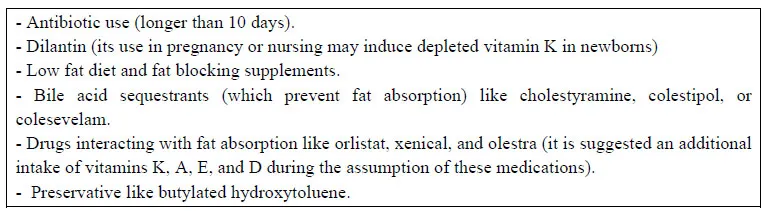 |
*Source: http://umm.edu/health/medical/altmed/supplementinteraction/possible-interactions-with-vitamin-k.
The major use of vitamin K is in the animal farms and it is added to animal feed, above all t...
Table of contents
- Welcome
- Table of Content
- Title
- BENTHAM SCIENCE PUBLISHERS LTD.
- FOREWORD
- PREFACE
- BIOGRAPHY
- Hypersensitivity to Vitamins: General Considerations
- Vitamin B1 (Thiamine)
- Vitamin B2 (Riboflavin)
- Vitamin B3 (Niacin)
- Vitamin B5 (Pantothenic Acid)
- Vitamin B6 (Pyridoxine)
- Vitamin B7 or H (Biotin)
- Vitamin B9 (Folate)
- Vitamin B12 (Cobalamin)
- Vitamin C (Ascorbic Acid)
- Vitamin A (Retinoids)
- Vitamin D (Ergocalciferol/ Cholecalciferol)
- Vitamin E (Tocopherols)
- Vitamin K (Phytomenadione)
- Unusual Clinical Aspects of Vitamin Hypersensitivity
- Conclusion
Trusted by 375,005 students
Access to over 1.5 million titles for a fair monthly price.
Study more efficiently using our study tools.
Frequently asked questions
Yes, you can cancel anytime from the Subscription tab in your account settings on the Perlego website. Your subscription will stay active until the end of your current billing period. Learn how to cancel your subscription
No, books cannot be downloaded as external files, such as PDFs, for use outside of Perlego. However, you can download books within the Perlego app for offline reading on mobile or tablet. Learn how to download books offline
Perlego offers two plans: Essential and Complete
- Essential is ideal for learners and professionals who enjoy exploring a wide range of subjects. Access the Essential Library with 800,000+ trusted titles and best-sellers across business, personal growth, and the humanities. Includes unlimited reading time and Standard Read Aloud voice.
- Complete: Perfect for advanced learners and researchers needing full, unrestricted access. Unlock 1.5M+ books across hundreds of subjects, including academic and specialized titles. The Complete Plan also includes advanced features like Premium Read Aloud and Research Assistant.
We are an online textbook subscription service, where you can get access to an entire online library for less than the price of a single book per month. With over 1.5 million books across 990+ topics, we’ve got you covered! Learn about our mission
Look out for the read-aloud symbol on your next book to see if you can listen to it. The read-aloud tool reads text aloud for you, highlighting the text as it is being read. You can pause it, speed it up and slow it down. Learn more about Read Aloud
Yes! You can use the Perlego app on both iOS and Android devices to read anytime, anywhere — even offline. Perfect for commutes or when you’re on the go.
Please note we cannot support devices running on iOS 13 and Android 7 or earlier. Learn more about using the app
Please note we cannot support devices running on iOS 13 and Android 7 or earlier. Learn more about using the app
Yes, you can access Hypersensitivity to Vitamins by Gianfranco Calogiuri in PDF and/or ePUB format, as well as other popular books in Medicine & Nutrition, Dietics & Bariatrics. We have over 1.5 million books available in our catalogue for you to explore.