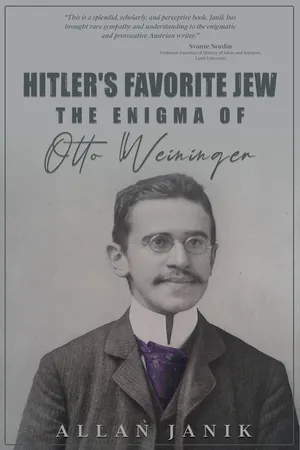
Otto Weininger (1880-1903) is the most controversial figure to emerge from fin de siècle Vienna. The son of a Jewish goldsmith, he studied philosophy and psychology at the University of Vienna and spoke six languages by the time he was 21. After receiving his Ph.D. in 1902, he converted to Christianity and, in 1903, he published his book Sex and Character—a groundbreaking and highly provocative study that would come to influence Adolf Hitler, Ludwig Wittgenstein, and James Joyce, among others. As troubled as he was brilliant, Weininger took his own life on October 3, 1903, leaving behind a small number of works, an array of challenging ideas, and many unanswered questions.
In Hitler's Favorite Jew, Professor Allan Janik draws upon a half-century of research to explore the life and legacy of Otto Weininger, and to illuminate his outsized impact on some of the greatest thinkers and the greatest monster of the twentieth century. Janik explains how Weininger came to write his bizarre book featuring outrageous claims about women and Jews, and argues that, contrary to the received wisdom, Weininger's true goal was progressive and humanistic.
With its deep insights into both Weininger the man and Viennese intellectual life at the turn of the century, Hitler's Favorite Jew offers a rich and multifaceted portrait that challenges our ideas about sexuality, the nature of anti-Semitism, and the puzzle of human identity.