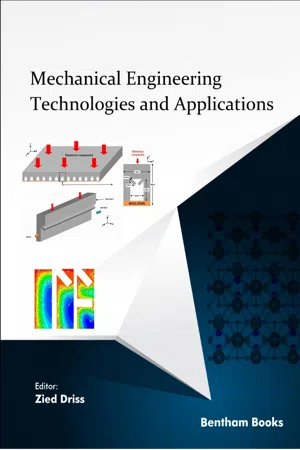
This book focuses on cases and studies of interest to mechanical engineers and industrial technicians. The considered applications in this volume are widely used in several industrial fields particularly in the automotive and aviation industries. Readers will understand the theory and techniques which are used in each application covered in each chapter. The book contents include the following topics: Numerical analysis of hydrokinetic turbines Computational fluid dynamics of a CuO based nanofluid in mini-channel cross-sections Orthodontic biomechanics of a NiTi arch wires Reynold's number effects on fluid flow through Savonius rotors Effect of operating parameters on Zn-Mn alloys deposited from additive-free chloride bath Optical properties and stability of a blue-emitting phosphor (Sr2P2O7: Eu2+) Under UV and VUV excitation Numerical study of the influence of nanofluid type on thermal improvement in a three dimensional mini channel Electrochemical studies and characterization of Zn-Mn coatings deposited in the presence of novel organic additives Prediction of fire and smoke propagation under a range of external conditions Structural design of a 10 kW H-Darrieus wind turbine The presented case studies and development approaches aim to provide the readers, such as graduate students, PhD candidates and professionals with basic and applied information broadly related to mechanical engineering and technology.
- English
- ePUB (mobile friendly)
- Available on iOS & Android
eBook - ePub
Mechanical Engineering Technologies and Applications
About this book
Information
Topic
Scienze fisicheSubtopic
EnergiaElectrochemical Studies and Characterization of Zn-Mn Coatings deposited in the presence of Novel Organic Additives
Nouha Loukil1, *, Mongi Feki2
1 Laboratory of Material Engineering and Environment, ENIS-Tunisia, University of Sfax, Sfax, Tunisia
2 Laboratory of Material Engineering and Environment, ENIS-Tunisia, University of Sfax, Sfax, Tunisia
Abstract
A novel additive based on alkylphenol ethoxylate sulphite was investigated in Zn-Mn electrodeposition on steel from a chloride bath. Electrochemical study via cyclic voltammetry showed that the tested additive increases the over-potential of the Zn deposition, resulting from strong adsorption of molecules additives on the cathode surface. Thus, Mn-rich alloy containing 16.3% of Mn is successfully co-deposited. The morphology and crystallographic structure of Zn-Mn co-deposits were analyzed using Scanning Electron Microscopy (SEM) and X-Ray Diffraction (XRD), respectively. SEM micrographs showed that Zn-16.3% Mn alloy obtained in the presence of the tested additive displays hexagonal pyramid morphology. XRD analysis exhibited that Zn-16.3% Mn alloy is monophasic with hexagonal close-packed ε-Zn-Mn phase.
Keywords: Additive, Electrodeposition, Morphology, Structure, Zn-Mn alloy.
* Corresponding author Nouha Loukil: Laboratory of Material Engineering and Environment, ENIS-Tunisia, University of Sfax, Sfax, Tunisia; E-mail: [email protected]
INTRODUCTION
Numerous zinc-based coatings Zn-X (X= Fe, Co, Ni, Mn…) have been electrodeposited on steel to improve the corrosion resistance of conventional pure zinc [1]. Currently, fundamental researches have been made to assess the corrosion resistance of these binary alloys into automotive applications [2-5]. Among Zn binary alloys, there is a growing interest in Zn-Mn coatings owing to the highest anticorrosive properties in the saline environment [4-7]. Indeed, Zn-Mn alloys show sacrificial corrosion protection for both Zn and steel components. Boshkov et al. reported that the alloying element Mn has been proposed due to its dual protective role [8, 9]. Mn is anodic to Zn and primarily dissolves [8, 9].
Accordingly, pH locally increases and promotes the formation of Zn5(OH)8Cl2.H2O (ZHC) and Zn5(OH)6SO4xH2O (ZHS) protective layers in chloride and sulfate aggressive media, respectively [8, 9]. These protective layers are thick, compact, uniform, and with low solubility [8-13]. This is recognised by the homogeneous distribution of Mn in the coatings [14].
Several existing reports investigated the effect of the Mn content on the corrosion behavior of Zn-Mn coatings. Zn-11% Mn shows the highest anticorrosive resistance [10, 11]. Muller et al. proved that 10 to 40% of Mn substantially affords better corrosion resistance [11]. It is well documented that low Mn content ranging from 0.3 to 2.5% provides suitable mechanical properties for automotive applications and good plastic deformability [7], weldability and paintability. However, Zn-Mn co-deposition from aqueous solutions is a complex process in view of the large gap between the deposition potentials of Zn (E° (Zn2+/Zn) = - 0.76 V/HSE and Mn (E° (Mn2+/Mn) = -1.18 V/HSE). These two potentials are more negative than that of hydrogen evolution, which is a concurrent reaction.
According to Brenner [15], Zn and Mn co-deposition is a normal co-deposition, implying that Mn-rich coatings require high current densities to be electrodeposited [1, 13, 14, 16]. This occurrence leads to (i) low current efficiency [13, 14, 16] and (ii) burned and non-adherent Zn-Mn deposits [13, 14, 16]. These drawbacks result from the intensive hydrogen evolution reaction at high cathodic potentials required to reduce Mn2+ ions.
Zn-Mn coatings deposited from aqueous solution have comprehensively been reported in the literature. Main electrolytic baths being used are, chloride-based [1, 6, 17-19], pyrophosphate-based [6, 18] or citrate-based electrolytes [18, 20].
One way to partially overcome the drawbacks of Zn-Mn co-deposition is the use of additives. Using a strong organic complexing agent for Zn2+ ions is the common way to reduce the gap between Zn and Mn deposition potentials [2, 6, 7, 11, 13, 15]. This is ascribed to the high relative formation constant of the complex formed with Zn2+ ions [11]. Meanwhile, they must be avoided due to environmental problems related to effluent treatment.
Few alternative organic additives are reported in the literature, which generally fall into two classes: the carrier additive and the brightener. Commonly, the carrier additive permits the (i) minimization of the potential gap between Zn and Mn co-deposition and/or hydrogen evolution [1, 17] and (ii) the grain refinement [17, 19], while the brightener additive has a complementary effect to obtain bright deposits [17, 21].
The present study deals with the development of a suitable formulation for Zn-Mn bath, including a proprietary additive. The additive formulation includes two parts: a carrier and a brightener, which are alkylphenol ethoxylate sulphite and Benzenlideneacetone (BDA), respectively. This formulation has not been explored before. The aim of the present work was to study the influence of the retained additive on Zn2+ and Mn2+ ions reduction from chloride acidic bath through cyclic voltammetry (CV). Morphological and structural characterizations of Zn-Mn coatings will also be discussed.
EXPERIMENTAL DETAILS
The electrodeposition tests were performed using an acidic chloride electrolyte. Blank expe...
Table of contents
- Welcome
- Table of Content
- Title
- BENTHAM SCIENCE PUBLISHERS LTD.
- PREFACE
- List of Contributors
- Numerical Study of a Hydrokinetic Turbine
- CFD Simulation of the Heat Transfer using a Cuo-water Nano-fluid in Different Cross-sections of Mini-channels
- Influence of the Force Delivery of Orthodontic NiTi Arch Wire on its Tribological Behavior
- Reynolds Number Effects on the Flow through a Savonius Wind Rotor
- Effect of Operating Parameters on Zn-Mn Alloys Deposited from Additive-free Chloride Bath
- Optical Properties and Stability of a Blue-Emitting Phosphor Sr2P2O7:Eu2+ Under UV and VUV Excitation
- Numerical Study of the Influence of Nano-fluid Type on Thermal Improvement in a Three Dimensional Mini Channel
- Electrochemical Studies and Characterization of Zn-Mn Coatings deposited in the presence of Novel Organic Additives
- Prediction of Fire and Smoke Propagation under a Range of External Conditions
- Structural Design of a 10 kW H-Darrieus Wind Turbine
Trusted by 375,005 students
Access to over 1.5 million titles for a fair monthly price.
Study more efficiently using our study tools.
Frequently asked questions
Yes, you can cancel anytime from the Subscription tab in your account settings on the Perlego website. Your subscription will stay active until the end of your current billing period. Learn how to cancel your subscription
No, books cannot be downloaded as external files, such as PDFs, for use outside of Perlego. However, you can download books within the Perlego app for offline reading on mobile or tablet. Learn how to download books offline
Perlego offers two plans: Essential and Complete
- Essential is ideal for learners and professionals who enjoy exploring a wide range of subjects. Access the Essential Library with 800,000+ trusted titles and best-sellers across business, personal growth, and the humanities. Includes unlimited reading time and Standard Read Aloud voice.
- Complete: Perfect for advanced learners and researchers needing full, unrestricted access. Unlock 1.5M+ books across hundreds of subjects, including academic and specialized titles. The Complete Plan also includes advanced features like Premium Read Aloud and Research Assistant.
We are an online textbook subscription service, where you can get access to an entire online library for less than the price of a single book per month. With over 1.5 million books across 990+ topics, we’ve got you covered! Learn about our mission
Look out for the read-aloud symbol on your next book to see if you can listen to it. The read-aloud tool reads text aloud for you, highlighting the text as it is being read. You can pause it, speed it up and slow it down. Learn more about Read Aloud
Yes! You can use the Perlego app on both iOS and Android devices to read anytime, anywhere — even offline. Perfect for commutes or when you’re on the go.
Please note we cannot support devices running on iOS 13 and Android 7 or earlier. Learn more about using the app
Please note we cannot support devices running on iOS 13 and Android 7 or earlier. Learn more about using the app
Yes, you can access Mechanical Engineering Technologies and Applications by Zied Driss in PDF and/or ePUB format, as well as other popular books in Scienze fisiche & Energia. We have over 1.5 million books available in our catalogue for you to explore.