Lean Management Solutions for Contemporary Manufacturing Operations: Applications in the automotive industry covers recent techniques aimed at improving manufacturing activities in automotive factories in the time of the fourth industrial revolution. The book informs the reader about some improvements in hard skills (such as technical concepts, new tools, processes, and applied designs), as well as soft skills (strategic planning and the psychology of motivating human resources in manufacturing setups). The book also presents insight for managers who are working with a niche of employees with disabilities with respect to the automotive industry. Topics in the book include: Application of Graph Theory in Workplace Design Applied Design Disability and the 4th Industrial Revolution People Development, Motivation & Results Low Cost Logistics Solutions Agile Methodologies in Manufacturing Projects This book is a concise, informative reference which updates the reader on recent strategies to maximize productivity in the auto manufacturing sector.
eBook - ePub
Lean Management Solutions for Contemporary Manufacturing Operations: Applications in the Automotive Industry
- English
- ePUB (mobile friendly)
- Available on iOS & Android
eBook - ePub
Lean Management Solutions for Contemporary Manufacturing Operations: Applications in the Automotive Industry
About this book
Information
People Development, Motivation & Results
Gustavo R. Mena1, *
1 Department of Psychology, Universidad Nacional de la Rioja, La Rioja, Argentina
Abstract
The influence of strategic planning can be a link or obstacle to the good performance of the company and can be a factor of distinction in the commitment of those who are part of it.
Strategic planning allows diagnosing, analyzing, reflecting, and making collective decisions regarding current tasks and the path that organizations must explore in the future to adapt to the changes and requests imposed by the environment to achieve their viability.
Strategic planning must be understood as a participatory process, which will not solve all uncertainties, but must draw a line of those affected to act accordingly.
Keywords: Behavior, Commitment, Goals, Motivation, Planning, Roles, Satisfaction, Skills, Strategic, SWOT, Work.
* Corresponding author Gustavo R. Mena: Department of Psychology, Universidad Nacional de La Rioja., La Rioja, Argentina; Cell.: +54 9 351 5184993; E-mail: [email protected]
INTRODUCTION
Strategic planning facilitates the possibility of thinking about the future, visualizing new opportunities and threats, focusing on the organization's mission, and effectively guiding its course, facilitating direction and leadership. It also allows facing problems such as the allocation of human and financial resources. In relation to classic forms of management, strategic planning introduces a modern methodology.
This modern form of management requires deep knowledge of the organization, greater participation, improving communication and coordination between different levels, and improving management skills, among others.
For the reasons mentioned above, the investigation raises the following question.
How does strategic planning influence employees' job performance?
Nowadays, due to the changes and the new technologies that appear in the market that determine the development of more abilities, skills, and knowledge, organizations find themselves with the need to implement changes in their labor strategy when facing the challenges presented to them.
It is necessary for companies to develop new techniques for production, market, distribution, service, and customer service, for which human capital is needed, and thus assume the organizational challenges.
Within this context, the productivity and management of human capital in organizations will become key elements of survival; therefore, coordination, direction, motivation, and staff satisfaction are increasingly important aspects of the administrative process [1,2].
PLANNING
Planning is the process by which the company's executive bodies continually design the desirable future and select how to make it feasible; It is based on advanced decision-making that, in a systematic and complex way, is oriented to ensure the highest probability of achieving previously designed desired futures.
The planning process works as a global system, considering that all the functions and organizational levels of the company must be planned simultaneously and interdependently, using the methodology of systemic reasoning since the global system works through the joint interaction of its components. Planning is usually classified as strategic and tactical.
Technical planning aims to optimize the allocation of resources to the maximum consequence of compatible company objectives. It is known as programming and is linked to the third stage of budgeting, which refers to the specific time frame in which the accepted programs must be executed. Within the integral perspective of the planning process, budgets are the formalized quantitative and qualitative expression of the partial or global quota of the programs that must be executed in each period.
Three classes are distinguished:
- Optimal, which follows policies of maximization or minimization of the variables.
- Satisfactory, which refers to the level of objectives that, by consensus, satisfy the overall organization of the company.
- Adaptive, which emphasizes the planning process itself, highlighting its value for training and continuous learning.
The plan represents the set of explicit and coherent decisions to allocate resources to pre-established ends.
Planning represents the exercise (the concrete application) of the plan linked to the theoretical instrumentation required to transform the economy or society; for this reason, it is the concept of planning that will be taken during the investigation.
Strategic planning is nothing more than the process of relating the goals of an organization, determining the policies and programs necessary to achieve specific objectives on the way to those goals, and establishing the necessary methods to ensure that the policies and programs are executed, that is, is a formulated long-term planning process that is used to define and achieve organizational goals [3].
Its characteristics are:
- It is conducted or executed by high hierarchical levels.
- Establish a framework for the entire organization.
- It faces higher levels of uncertainty with respect to other types of planning.
- Generally, it covers long periods. The longer the period, the more irreversible the effect of a more strategic plan will be.
- Its parameter is efficiency.
The central objective of strategic planning is to get the most out of internal resources by selecting the environment where they are to be deployed and their deployment strategy. For example, it is about finding a market niche that the company can serve better than potential competitors; therefore, the application of resources is more beneficial than in other circumstances.
It is the antithesis of improvisation and a management style that reacts instead of making decisions based on a plan. Due to its characteristics, it allows the manager to grasp the future of his organization as it commits him to follow previously defined lines of action.
The intensity of planning will depend on different factors such as the anticipation with which a decision must be made, the difficulty of coordination in decision-making, the magnitude of deviations and the consequent changes to be introduced. Available resources cannot be ruled out.
The limits are defined according to the type of organization, the behavior of resources, and the type of activity in question. The short, medium, and long terms can be distinguished.
The long term encompasses items subject to planning such as products, profits, return on investment, cash flow, development, and staff training plans.
The medium term is the period in which the long-term plans are expressed in more detail: the plans for profits, sales, production, inventories, expenses, purchases and financial statements.
In the short term, in terms of planning, maximum detail is reached in everything related to planning: level of installed capacity, fixed costs, variable costs and others.
Problems due to lack of planning can be:
Ignorance of the company's progress, lack of control, only works in the short term, today there are no guidelines for action. There are no clear criteria for decision making and it is not possible to project the future of the organization, and critical situations get out of control.
To define any planning, organizations must first be clear about their mission and vision.
The Mission will be the raison d'être of the company and the Vision is the projection that gives orientation and strategic sense to the decisions, plans, projects, etc.
Another very important point during strategic planning is to carry out an analysis that allows to know those internal and external factors that can help or hinder the organization's operation.
A recommended tool for detecting and classifying the types of opportunities and threats is the “SWOT” analysis (Fig. 1).
Strengths: These are the characteristics of the company that favor the achievement of its objective.
Weaknesses: They are those characteristics that constitute an internal obstacle to achieving the objectives.
Opportunities: These are those situations in the environment that would favor the achievement of the objectives.
Threats: Situations that arise in the company's environment that could negatively affect the possibilities of achieving the objectives.
Strategy selection can have several approaches, according to a traditional approach is the determination of the basic long-term goals and objectives in a company, together with the adoption of action plans and the allocation of resources necessary to achieve these purposes, always considering the boundary conditions or context. The basis of this approach is that a strategy is a means and an objective will be an outcome.
The implementation of the strategy should consider 4 components.
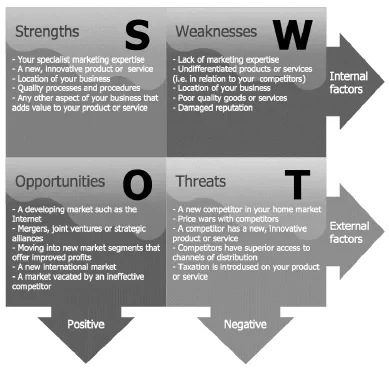
SWOT Analysis - created in the 1960s by Albert Humphrey at the Stanford Research Institute.
- Designing an organizational structure: the organization, in order to achieve the functioning of a strategy, needs to adopt the right structure, this implies assigning responsibilities for tasks and authority for decision making, analyzing the best way to do it (dividing the organization into subunits, distributing authority, distributing authority among different hierarchical levels, achieving integration among subunits).
- Design of control systems: the organization must decide on the best way to evaluate performance and control the actions of the sub-units, from market and production controls to bureaucratic and control alternatives through organizational culture, it also implies deciding on the type of compensation and incentive systems to establish for its employees.
- Matching strategy, structure and controls: Because different strategies and environments place different demands on an organization, they require different responses and structural control systems. If the company wants to be successful, it must find a balance between its strategy, structure and controls.
- Managing conflict, politics, and change: Organizational politics plays a key role, is endemic to organizations and different subgroups have their own agendas and conflicts, such as competing for a greater share of the organization's finite resources. organization. These conflicts can be resolved through the relative distribution of power among subunits or through a rational assessment of relative need.
Power struggles and coalition building are the major consequences of these conflicts and are, in fact, part of strategic management.
Strategic change tends to highlight these struggles, since any change causes an alteration in the distribution of power within an organization.
Once the strategy has been implemented, its execution must be monitored to determine the extent to which the strategic objectives are being achieved. This information is fed back to the corporate level through feedback loops, which provide the next phase of strategy implementation and formulation, serving to reaffirm existing corporate objectives and strategies or to suggest changes.
The combination of strengths and opportunities gives rise to potentials, which indicate the most promising lines of action for the organization and make it possible to detect and generate a competitive advantage.
A company is said to have a competitive advantage when its profit ratio is higher than the average for its industry.
The profit rate is usually defined as a given index and the fundamental determinant of a company's profit is its gross profit margin (GPM), which corresponds to the difference between total revenues (TI) and total costs (TC), divided by total costs: GPM = (TI-TC) / TC.
For a gross profit margin to be higher than the industry average, one of the following must occur:
- The company's unit price must be higher than that of the average company and its ...
Table of contents
- Welcome
- Table of Content
- Title
- BENTHAM SCIENCE PUBLISHERS LTD.
- FOREWORD
- PREFACE
- List of Contributors
- Application of Graph Theory in Workplace Design
- Applied Design – Efficiency & Added Value
- Disability and the 4th Industrial Revolution
- People Development, Motivation & Results
- Low Cost Logistics Solutions
- Agile Methodologies in Manufacturing Projects
- APPENDIX
- Glossary
Trusted by 375,005 students
Access to over 1.5 million titles for a fair monthly price.
Study more efficiently using our study tools.
Frequently asked questions
Yes, you can cancel anytime from the Subscription tab in your account settings on the Perlego website. Your subscription will stay active until the end of your current billing period. Learn how to cancel your subscription
No, books cannot be downloaded as external files, such as PDFs, for use outside of Perlego. However, you can download books within the Perlego app for offline reading on mobile or tablet. Learn how to download books offline
Perlego offers two plans: Essential and Complete
- Essential is ideal for learners and professionals who enjoy exploring a wide range of subjects. Access the Essential Library with 800,000+ trusted titles and best-sellers across business, personal growth, and the humanities. Includes unlimited reading time and Standard Read Aloud voice.
- Complete: Perfect for advanced learners and researchers needing full, unrestricted access. Unlock 1.5M+ books across hundreds of subjects, including academic and specialized titles. The Complete Plan also includes advanced features like Premium Read Aloud and Research Assistant.
We are an online textbook subscription service, where you can get access to an entire online library for less than the price of a single book per month. With over 1.5 million books across 990+ topics, we’ve got you covered! Learn about our mission
Look out for the read-aloud symbol on your next book to see if you can listen to it. The read-aloud tool reads text aloud for you, highlighting the text as it is being read. You can pause it, speed it up and slow it down. Learn more about Read Aloud
Yes! You can use the Perlego app on both iOS and Android devices to read anytime, anywhere — even offline. Perfect for commutes or when you’re on the go.
Please note we cannot support devices running on iOS 13 and Android 7 or earlier. Learn more about using the app
Please note we cannot support devices running on iOS 13 and Android 7 or earlier. Learn more about using the app
Yes, you can access Lean Management Solutions for Contemporary Manufacturing Operations: Applications in the Automotive Industry by Gonzalo Taboada in PDF and/or ePUB format, as well as other popular books in Technology & Engineering & Automotive Transportation & Engineering. We have over 1.5 million books available in our catalogue for you to explore.