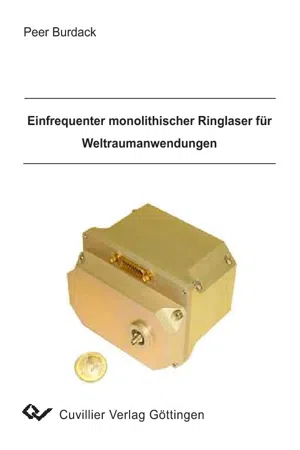
Durch den Einsatz von Kommunikationssatelliten können im Vergleich zur herkömmlichen Übertragungstechnik mit Glasfaserkabeln auch schwer zugängliche Gebiete erreicht und globale, mobile Kommunikationsverbindungen ermöglicht werden. Optische, kohärente Intersatellitenverbindungen sind geplant, um den zukünftigen Bedarf an hohen Datenübertragungsgeschwindigkeiten von ? 1 GBit/s abzudecken. Für diese innovative Satellitentechnik werden weltraumqualifizierte Master-Verstärker-Lasersysteme und Laser zur kohärenten Detektion Lokaloszillator (LO) benötigt, die zu Beginn dieser Dissertation nicht zur Verfügung standen. Wesentliche funktionelle Voraussetzungen sind eine zuverlässige, einfrequente, frequenzstabile und einfach abstimmbare Laserstrahlquelle und eine Ausgangsleistung von ? 50 mW für den Masterlaser und von ? 10 mW für den LO-Laser.Auf Basis eines Laserdioden-gepumpten monolithischen, nichtplanaren Nd: YAG-Ringoszillators (kurz NPRO) wurde eine geeignete weltraumqualifizierbare Laserstrahlquelle entwickelt und ein einfacher, neuartiger Frequenzstandard zur Lasercharakterisierung demonstriert. Ein Schwerpunkt der Laserentwicklung war die Realisierung eines kompakten und stabilen Designs unter Berücksichtigung der Umgebungsbedingungen beimWeltraumeinsatz. Der realisierte und charakterisierte Laser, mit dem die Gewichtsanforderung von 1 kg um 16 % unterschritten wurde, erfüllte im Vakuum die funktionellen Anforderungen und zeigte vergleichbare oder bessere Frequenzstabilitäten als herkömmliche NPROs. Die Langzeitfrequenzstabilität war bis zu einem Faktor sieben besser und betrug ?8 MHz/h. Zur kohärenten Kommunikation wird mit einer Modulationsbandbreite von1 GHz ein gemeinsamer modensprungfreier Abstimmbereich zwischen Master- und LO-Laser von ? 4 GHz benötigt. Im Vergleich zu bisherigen NPROs wurde der modensprungfreie Abstimmbereich um einen Faktor 1, 8 vergrößert und ein Abstimmbereich von 15, 7 GHz erreicht. Für zwei identische Lasersysteme wurde ein gemeinsamer modensprungfreier Abstimmbereich von 12, 4 GHz realisiert; entsprechend wurden die Anforderungen bezüglich der Frequenzabstimmbarkeit weit übertroffen, so dass prinzipiell höhere Übertragungsraten erreicht werden können.Zur Laserqualifizierung wurden Thermal-Vakuum-Tests erfolgreich durchgeführt, bei denen keine Funktionsbeeinträchtigungen beobachtet wurden. Die benötigte Ausgangsleistung wurde nach den Tests nahezu um einen Faktor zwei übertroffen, wodurch bei einer Degradierung der Pumpquelle eine viel höhere Systemlebensdauer erreicht werden kann. Eine Leistungssteigerung des Lasers von ca. 100 mW auf 250 mW wurde mit einer faseroptischen Pumplichtzuführung demonstriert. Zur vollständigen Weltraumtauglichkeit müssen noch weiterführende Qualifizierungstests (z., B. Vibrationstests) durchgeführt werden. Aufgrund der erzielten Ergebnisse sollte der Laser als Master- und LO-Laser für die optische Intersatellitenkommunikation geeignet sein und eine vollständige Weltraumqualifizierung erreicht werden können.Zur Lasercharakterisierung wurde ein neuartiger, einfacher und kompakter Frequenzstandard mit molekularem Jod als Referenz realisiert. Erstmals wurde die Frequenzstabilisierung eines NPROs auf eine Hyperfeinstruktur von molekularem Jod mit einem modulations- und dopplerfreien Zwei-Farben-Interferometer demonstriert. Die erreichten Frequenzstabilitäten waren ausreichend hoch für die Charakterisierung eines freilaufenden NPROs und ein bis zwei Größenordnungen höher als das unstabilisierte Lasersystem. Diese Stabilisierungsmethode ermöglicht mit weiteren Optimierungen einen einfachen Frequenzstandard der auch im Bereich der industriellen Lasercharakterisierung eingesetzt werden kann.Communication satellites can access remote regions that are hard to access for standard fiber-based communication links, thus enabling global mobile communication links. Coherent optical inter-satellite links are planned to meet future needs for high-capacity data communication links of ? 1GBit/s. For this innovative satellite technology, space-qualified master-power-laser systems and lasers for coherent detection (local oscillator) are required, which were not available at the beginning of this work. The main functional requirements are a reliable, single-frequency, frequency-stable and tunable laser source with an output power of ? 50mW for the master laser and ? 10mW for the local oscillator laser. A space-qualifiable laser based on a laser diode-pumped monolithic Nd: YAG ring oscillator (NPRO) has been developed, and a simple, novel frequency standard for laser characterization has been demonstrated. Laser development focussed on the realization of a compact and robust design considering the effects of the space environment. The laser realized and characterized was 16% lower than the mass requirements of 1 kg, it fulfilled all functional requirements in a vacuum and showed a similar or better frequency stability compared with conventional NPRO's. The long-term frequency stability was up to seven times better, and reached ±8MHz/h. For coherent communication with a modulation bandwidth of 1GHz, the common-mode tuning range for master laser and local oscillator has to be at least 4GHz. Compared with conventional NPRO's, the mode-hop-free tuning range was increased by a factor of 1.8 and a mode-hop free tuning range of 15.7GHz was demonstrated. A common-mode tuning range of 12.4 GHz was realized for two identical laser systems, and is more than the requirements call for, and thus higher data rates can be achieved, in principal. Successful thermal-vacuum-cycling-tests have been performed as part of the laser qualification process, which showed no functional damage. After thermal cycling, the output power was almost twice the required power. Thus, a higher system life time can be achieved if pump source degradation occurs. An increase in output power from approximately 100mW to 250mW was demonstrated with a fiber optical pump light source. To achieve a fully space-qualified laser, further space qualification tests (e. g. vibration tests) have to be made. On the basis of the achieved results, the laser system should be well-suited for optical inter-satellite communication as master laser and local oscillator, and for achieving complete space qualification. For laser characterization, a novel, simple and compact frequency standard was realized using a molecular iodine reference. For the first time, frequency stabilization of a NPRO to an iodine hyperfine component was demonstrated, with a modulation-free and sub-Doppler, two-color interferometer. The frequency stability achieved was high enough for characterization of a free-running NPRO, and one to two orders of magnitude better than the stability of the unstabilized laser system. With further optimization, this stabilization method can be used as a simple frequency standard, which can be applied for industrial laser characterization.
- 142 pages
- English
- PDF
- Available on iOS & Android
eBook - PDF
About this book
Information
Print ISBN
9783865372659
Edition
1Table of contents
Trusted by 375,005 students
Access to over 1.5 million titles for a fair monthly price.
Study more efficiently using our study tools.