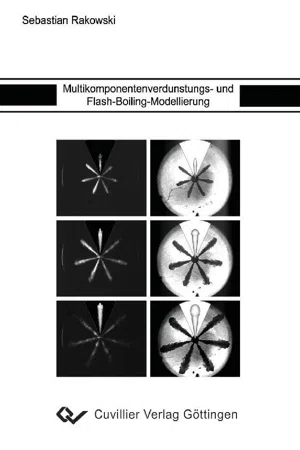
Kurzfassung Trotz eines stetig steigenden Anteils von Diesel-Motor angetriebenen PKW auf zur Zeit über 40%, ist der Ottomotor immer noch die am weitesten verbreitete Antriebsquelle im PKW-Segment. Im Gegensatz zum Diesel-Motor, weist der Otto-Motor aufgrund des Drei-Wege-Katalysators nur ein geringe Emissionsproblematik auf, und der Fokus in der Entwicklung richtet sich vermehrt auf den Verbrauch. Mit neu entwickelten Einspritztechnologien können enorme Einsparpotenziale erschlossen werden, jedoch steigen mit den erworbenen Freiheitsgraden die Komplexität und damit auch die Systemkosten an. Die CFD-Simulation bietet hier die Möglichkeit kostenaufwändige und langwierige Prüfstandsläufe einzusparen, in dem mittels geeigneter Ansätze (z.B. DOE) die Anzahl der Variationen gesenkt werden kann. Voraussetzung für zuverlässige Ergebnisse ist jedoch eine möglichst genaue Kenntnis der während der Einspritzung ablaufenden Vorgänge. Im Rahmen dieser Arbeit wurde deshalb ein erweitertes Multikomponenten-Modell entwickelt, welches im Gegensatz zu herkömmlichen Modellen nicht einen einkomponentigen Ersatzbrennstoff benutzt, sondern das reale Brennstoffgemisch mittels einer statistischen Verteilungsfunktion beschreibt. Zudem wird dieser Ansatz mit einer diskreten aromatischen Spezies überlagert, um den Einfluss von aromatischen Anteilen im Brennstoff auf den Verdunstungsvorgang aufzuzeigen. Auf Basis des MK-Modells wird ebenfalls ein Flash-Boiling-Modell vorgestellt, welches den intensivierten Phasenübergang aufgrund der Überhitzung des Brennstoffes in der Düse abbildet. Beide Modelle werden in den CFD-Code KIVA-3V implementiert und mittels Mie-Schlieren-Untersuchungen an der schnellen Kompressionsmaschine sowie LIF-Untersuchungen in der Druckkammer validiert. Schlüsselwörter: Benzin -Direkteinspritzung -Verdunstung -Flash-Boiling -CFD Abstract In spite of a steady increasing fraction of diesel engine driven cars, the gasoline engine is still the most popular drivetrain concept in passenger cars. In contrast to the diesel engine, the gasoline engine shows only small emission promblems due to the 3way catalytic converter. In this case the development efforts are focused on the fuel consumption. New developed injection systems offer a high fuel reduction potential, but more degrees of freedom also rise the system's complexity and costs. CFDsimulation offers the opportunity to reduce cost intensive experiments by reducing the number of variations with appropriate approaches (e.g. DOE). The prerequisite for reliable results is a detailed knowledge of the proceeding processes during injection. Within this work an extended multicomponent evaporation model (MCmodel) was developed, which uses a statistically based approach to describe commercial fuel mixtures with a distribution function, instead of describing it with a single component surrogate fuel. In this model the distribution function is superposed with a single aromatic species, in order to examine the influence of aromatic compounds on the evaporation process. Furthermore a flashboiling model was developed, to describe the intensified phase change due to superheating inside the nozzle, also based on the MCmodel. Both models are implemented into the CFDcode KIVA3V and validated with MieScatterand Schliereninvestigations in a rapid compression machine and with LIFexperiments in a pressure chamber. Keywords: Gasoline direct injection evaporation flashboiling CFD
- 119 pages
- English
- PDF
- Available on iOS & Android
eBook - PDF
About this book
Information
Print ISBN
9783865379429
Edition
1Table of contents
Trusted by 375,005 students
Access to over 1.5 million titles for a fair monthly price.
Study more efficiently using our study tools.