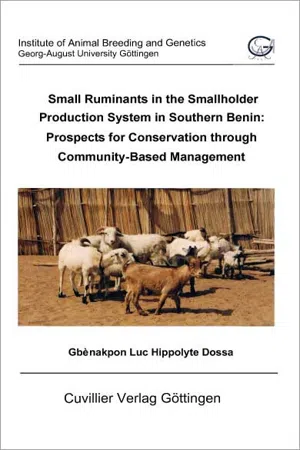
The main objective of this study was to develop a framework for community-based management (CBM) actions aiming to better utilize and to conserve the local small ruminants genetic resources in southern Benin. Hence, the study was designed in such a way as to: i) understand the livelihood contribution of each species of small ruminant to smallholders and identify a priority species (sheep or goats) for CBM activities, ii) collect and collate existing information on phenotypes and conduct surveys to map the phenotype structure of local populations of the targeted species, iii) record and understand farmers' traditional breeding strategies and practices and iv) analyse the opportunities and constraints for CBM.In the study area in southern Benin, the majority (78%) of rural households were keeping small ruminants. This confirms the important role of goats and sheep in the livelihood strategies of rural families. The ownership of goats was higher (91%) than sheep (35%) because goats are not affected by any ethnic or cultural restrictions. Goats are also perceived to be a less risky to invest into compared to sheep. Women represented 71% of the keepers of goats. Owners of small ruminants are less likely to be involved in off-farm activities and would often have no access to credit facilities. These findings highlight the financing and insurance roles that small ruminants particularly goats, are playing in the study area. These results of the phenotypic characterization provided supporting evidence for spatial variation in population of goats in Benin. Four populations of goat were characterized as distinct and may be referred to as ecotypes. The significant morphological variability recorded infers a considerable genetic variability that needs to be maintained for further genetic improvement and to respond to changes in climate, disease and market conditions. Two rural communities were selected for in-depth studies. The results showed that goats are mainly kept for sale whenever cash is needed. Traits related to reproduction, to behavior, to health and to meat production were considered equally important and were ranked very high by goat keepers. Increased net income per flock through increased number of marketable animals was the derived breeding objective from the trait analysis. Poor management practices (poor disease control, poor housing and nutrition, uncontrolled mating) were identified as keys obstacles to improved smallholder's goat production. Farmers were found more focused on immediate short-term benefits. Therefore, it was concluded that the overriding priority towards improvement was to develop initiatives to address the management constraints, and that the most effective way to achieve this is to bring farmers together in a participatory action planning process. Additional information on the communities and on their sources of livelihoods were collected through participatory village resource mapping and wealth ranking exercises, transect walks and focus group discussions and used to plan with the communities for community-led strategies towards better management and conservation of the local goat genetic resources. In general, the results of the CBM process outlined in this thesis have shown that because of the important role that play goats in their welfare and because they were offered the relevant information and technical support, people in the targeted communities organized themselves effectively and took appropriate actions to better manage and conserve the local goat resources. Given some time for consolidation and continual institutional and technical support, these newly created CBM groups are most likely to become self-reliant, socially and economically viable. The interactive nature of the CBM approach developed in this study allows its rapid adjustment to different local conditions and thus its replication elsewhere.
- 181 pages
- English
- PDF
- Available on iOS & Android
eBook - PDF
About this book
Information
Print ISBN
9783867273442
Edition
1Table of contents
- Dossa1.jpg
- Dossa.pdf
Trusted by 375,005 students
Access to over 1.5 million titles for a fair monthly price.
Study more efficiently using our study tools.