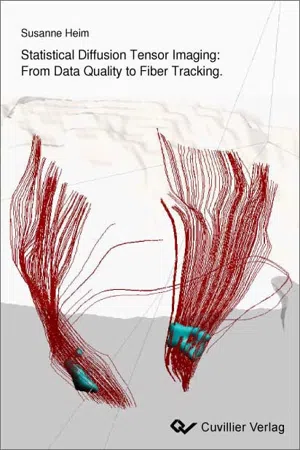
Magnetic resonance diffusion tensor imaging (DTI) allows to infere the ultrastructure of living tissue. In brain mapping, neural fiber trajectories can be identified by exploiting the anisotropy of diffusion processes. Manifold statistical methods may be linked into the comprehensive processing chain that is spanned between DTI raw images and the reliable visualization of fibers. In this work, a space varying coefficients model (SVCM) using penalized B-splines was developed to integrate diffusion tensor estimation, regularization and interpolation into a unified framework. The implementation challenges originating in multiple 3d space varying coefficient surfaces and the large dimensions of realistic datasets were met by incorporating matrix sparsity and efficient model approximation. Superiority of B-spline based SVCM to the standard approach was demonstrable from simulation studies in terms of the precision and accuracy of the individual tensor elements. The integration with a probabilistic fiber tractography algorithm and application on real brain data revealed that the unified approach is at least equivalent to the serial application of voxelwise estimation, smoothing and interpolation. From the error analysis using boxplots and visual inspection the conclusion was drawn that both the standard approach and the B-spline based SVCM may suffer from low local adaptivity. Therefore, wavelet basis functions were employed for filtering diffusion tensor fields. While excellent local smoothing was indeed achieved by combining voxelwise tensor estimation with wavelet filtering, no immediate improvement was gained for fiber tracking. However, the thresholding strategy needs to be refined and the proposed model of an incorporation of wavelets into an SVCM needs to be implemented to finally assess their utility for DTI data processing. In summary, an SVCM with specific consideration of the demands of human brain DTI data was developed and implemented, eventually representing a unified postprocessing framework. This represents an experimental and statistical platform to further improve the reliability of tractography.The reader might find Chapters 1 and 4 particularly useful for a concise introduction to magnetic resonance imaging and to wavelet theory. The SVCM model was implemented in R and is available online as package of the same name.
- 20 pages
- English
- PDF
- Available on iOS & Android
eBook - PDF
About this book
Trusted by 375,005 students
Access to over 1 million titles for a fair monthly price.
Study more efficiently using our study tools.
Information
eBook ISBN
9783736923263Edition
1Table of contents
- Heim.jpg
- Heim.pdf