Virtuelle Akustik
eBook - PDF

Virtuelle Akustik

KĂŒnstliche Raumimpulsantworten, Effiziente Faltung

,
  1. 116 pages
  2. English
  3. PDF
  4. Available on iOS & Android
eBook - PDF

Virtuelle Akustik

KĂŒnstliche Raumimpulsantworten, Effiziente Faltung

,

About this book

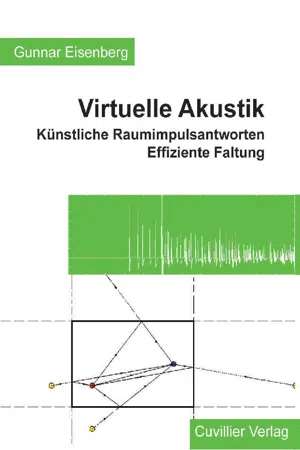
Die virtuelle Akustik oder Auralisation bezeichnet die akustische Simulation von RĂ€umen. Dies bedeutet, dass Audiosignale so verĂ€ndert werden, dass sie fĂŒr einen Hörer klingen, als hörte er sie in dem simulierten Raum aus Lautsprechern. Das Ergebnis der Simulation wird hierbei durch die Geometrie bzw. die Beschaffenheit des Raums sowie die Positionen der Lautsprecher und des durch Mikrofone ersetzten Hörers bestimmt. Methoden der Auralisation finden unter anderem in EffektgerĂ€ten der Musikelektronik, sowie im Zusammenhang mit der Simulation von Freisprecheinrichtungen Anwendung.In diesem Buch wird eine stereophone Raumsimulation nach dem von Allen und Berkley vorgestellten Spiegelquellenmodell beschrieben. Hierzu werden die nötigen Grundlagen der technischen Akustik sowie der Elektroakustik vermittelt, aus denen das Spiegelquellenmodell hergeleitet wird. Weiterhin wird die fĂŒr die Raumsimulation benötigte Filtertheorie im Zusammenhang mit Methoden der effizienten Implementierung von FIR-Filtern erklĂ€rt.Dieses Buch versteht sich als Praxisseminar, das dem Leser die nötige Theorie und Praxis zur virtuellen Akustik vermitteln will, um ihn so in die Lage zu versetzen, eigene Algorithmen entwerfen und implementieren zu können. HierfĂŒr werden Kenntnisse der Signalverarbeitung und der höheren Mathematik, sowie Kenntnisse in MATLAB und C/C++ vorausgesetzt. Sowohl bei der Implementierung in MATLAB als auch in C/C++ wurde in diesem Zusammenhang bewusst die Verwendung von Fremdbibliotheken auf ein Minimum beschrĂ€nkt, um so den Umfang der geforderten Vorkenntnisse möglichst gering halten zu können.
Frequently asked questions

Yes, you can cancel anytime from the Subscription tab in your account settings on the Perlego website. Your subscription will stay active until the end of your current billing period. Learn how to cancel your subscription.
No, books cannot be downloaded as external files, such as PDFs, for use outside of Perlego. However, you can download books within the Perlego app for offline reading on mobile or tablet. Learn more here.
Perlego offers two plans: Essential and Complete
  • Essential is ideal for learners and professionals who enjoy exploring a wide range of subjects. Access the Essential Library with 800,000+ trusted titles and best-sellers across business, personal growth, and the humanities. Includes unlimited reading time and Standard Read Aloud voice.
  • Complete: Perfect for advanced learners and researchers needing full, unrestricted access. Unlock 1.4M+ books across hundreds of subjects, including academic and specialized titles. The Complete Plan also includes advanced features like Premium Read Aloud and Research Assistant.
Both plans are available with monthly, semester, or annual billing cycles.
We are an online textbook subscription service, where you can get access to an entire online library for less than the price of a single book per month. With over 1 million books across 1000+ topics, we’ve got you covered! Learn more here.
Look out for the read-aloud symbol on your next book to see if you can listen to it. The read-aloud tool reads text aloud for you, highlighting the text as it is being read. You can pause it, speed it up and slow it down. Learn more here.
Yes! You can use the Perlego app on both iOS or Android devices to read anytime, anywhere — even offline. Perfect for commutes or when you’re on the go.
Please note we cannot support devices running on iOS 13 and Android 7 or earlier. Learn more about using the app.
Yes, you can access Virtuelle Akustik by in PDF and/or ePUB format. We have over one million books available in our catalogue for you to explore.

Information

Year
2011
Print ISBN
9783869556390
eBook ISBN
9783736936393
Edition
1

Table of contents

  1. Inhaltsverzeichnis
  2. Abbildungsverzeichnis
  3. 1. Einleitung
  4. 2. Akustische Grundlagen
  5. 3. Spiegelquellenmodell
  6. 4. Partitionierte Faltung
  7. 5. Rechenlastoptimierte Faltung
  8. 6. Implementierung in MATLAB
  9. 7. Implementierung in C/C++
  10. 8. Auswertung
  11. 9. Literaturverzeichnis
  12. 10. Anhang