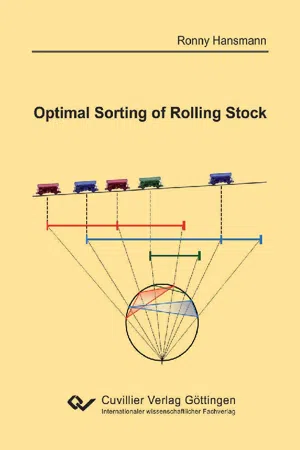
This thesis is concerned with the problem of optimally rearranging objects, in particular, railcars in a rail yard. The work is motivated by a research project of the Institute of Mathematical Optimization at Technische Universität Braunschweig, together with our project partner BASF, The Chemical Company, in Ludwigshafen. For many variants of such rearrangement problems - including the real-world application at BASF - we state the computational complexity by exploiting their equivalence to particular graph coloring, scheduling, and bin packing problems. We present mathematical optimization methods for determining schedules that are either optimal or close to optimal, and computational results are discussed from both a theoretical and practical point of view. In addition to the railway industry, there are other fields of application in which efficiently rearranging, sorting, or stacking is an important issue. For instance, the results obtained in this thesis could also be applied to solving certain piling problems in warehouses or container terminals.
eBook - PDF
About this book
Information
Print ISBN
9783869556598
Edition
1Table of contents
- Zusammenfassung
- Acknowledgements
- Contents
- Introduction
- Preliminaries
- Mathematical Formulations and Relations
- Computational Complexity
- Coloring Polygon-Circle Graphs
- Computational Results
- Online Versions
- Conclusion
- Bibliography
- Name Index
- Subject Index
- Nomenclature
- List of Figures
- List of Algorithms
- List of Tables
- Lebenslauf
Trusted by 375,005 students
Access to over 1.5 million titles for a fair monthly price.
Study more efficiently using our study tools.