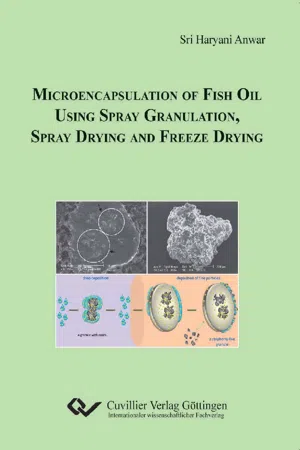
The stability of microencapsulated fish oil prepared using various drying methods isinvestigated. In the preliminary study, two production processes, i.e., spray granulation(SG) and SG followed by film coating (SG-FC) are examined and compared. First, threetypes of fish oil (10/50, 33/22, and 18/12) based on the ratios of eicosapentaenoic acid(EPA) and docosahexaenoic acid (DHA) are used in the SG process. Each type of fish oilwas emulsified with soybean soluble polysaccharide (SSPS) and maltodextrin to produce25% oil powders. Second, a 15% film coating of hydroxypropyl betacyclodextrin(HPBCD) is applied to the SG granules. The powder stability against oxidation isexamined by measurement of peroxide values (PV) and GC-headspace propanal after 6-week's storage at room temperature (± 21 ºC) and at 3 - 4 ºC. The results show that thecoated powders have lower stability than uncoated powders and this indicates that thefilm coating by HPBCD ineffectively protected the fish oil as the coating process mighthave induced further oxidation.In the main research, emulsions of 33/22 fish oil are prepared with four combinations ofmatrices and microcapsules are produced by SG, spray drying (SD), and freeze drying(FD). The objective is to identify the most critical factors which determine powderstability and to further examine the superiority of the SG process compared to otherdrying processes. Oxidation parameters and analytical methods remain the same as in thepreliminary study, but the storage time is extended to 8 weeks.The best matrices are a combination of 10% (w/w) SSPS and 65% (w/w) OSA-starch.Microencapsulation of 620 mg/g fish oil with these coating materials then dried by SG isable to produce fish oil powder having a very low propanal content and with a shelf lifeof five weeks at ± 21 ºC. The ability of SSPS to form thick membranes at the oil/waterinterface and the role of both matrices to stabilize emulsion by steric repulsion arecritical to prevent early formation of peroxides. The results of the present researchindicate that instead of layering a single concentrated core, microcapsule formation bythe SG process is actually started by agglomeration of seed particles. The seed particlesare then covered by the growth of droplet deposition and the granule surface is coated byfine particles. This assumption is supported by scanning electron microscope (SEM)examinations which verify the raspberry-like microstructure of the final granules.Therefore, it can be assumed that the SG process produces "multiple encapsulations"granules and provides maximum protection to the oil droplets.Comparison of the SG, SG-FC, SD, and FD processes confirms that combination ofmatrices, drying temperature, microcapsule morphology, and processing time are amongthe most critical factors governing the stability. Exposure to high drying temperature orheat is proved to be a limiting factor for drying unstable emulsion. If a process does notapply high drying temperature, the particle morphology becomes a determining factor forproduct stability.The main contribution of this study is to provide in-depth evaluation of four differentdrying processes with comprehensive information on the drying mechanisms in relationto how they affect the stability of microcapsules. The amount of polyunsaturated fattyacids (PUFAs), fish oil quality, type of matrix, and their physicochemical characteristicsare also discussed in this study.
- 210 pages
- English
- PDF
- Available on iOS & Android
eBook - PDF
About this book
Information
Print ISBN
9783869557175
Edition
1Table of contents
- Table of Content
- Introduction
- Theoretical background
- Objectives
- Material and methods
- Results
- Discussion
- Conclusion
- References
Trusted by 375,005 students
Access to over 1.5 million titles for a fair monthly price.
Study more efficiently using our study tools.