Gasphasenepitaxie und Eigenschaften von nicht- und semipolaren GaN
eBook - PDF

Gasphasenepitaxie und Eigenschaften von nicht- und semipolaren GaN

,
  1. 188 pages
  2. English
  3. PDF
  4. Available on iOS & Android
eBook - PDF

Gasphasenepitaxie und Eigenschaften von nicht- und semipolaren GaN

,

About this book

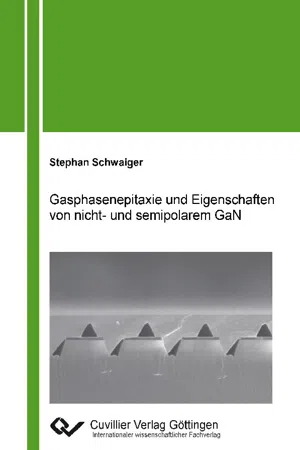
Licht emittierende Dioden (LEDs) werden heutzutage in immer mehr Bereichen des tĂ€glichen Lebens eingesetzt. Die Verwendung in der Unterhaltungselektronik z.B. bei Flachbildschirmen oder in der Automobilindustrie z.B. als Frontscheinwerfer sind nur wenige Beispiele dafĂŒr. Die GaN-basierten LEDs emittieren typischerweise im blauen oder nahen ultravioletten Spektralbereich. FĂŒr lĂ€ngere EmissionswellenlĂ€ngen – also grĂŒn emittierende LEDs – nimmt die Effizienz jedoch stark ab. Man geht davon aus, dass dafĂŒr hauptsĂ€chlich starke piezoelektrische Felder in den Bauelementen verantwortlich sind. Diese lassen sich bei den bisher verwendeten, konventionellen Herstellungsmethoden nicht vermeiden.Die vorliegende Arbeit behandelt das Wachstum sogenannter semi- und nichtpolarer Galliumnitridschichten. Diese werden mittels metallorganischer (MOVPE) und Hydrid-Gasphasenepitaxie (HVPE) abgeschieden. Es wird unter anderem eine neu entwickelte Methode vorgestellt, wie semipolares Galliumnitrid verschiedenster Orientierung auf strukturierten Saphirsubstraten epitaxiert werden kann. Dieser Ansatz kombiniert den Vorteil eines gĂŒnstigen Substrates mit der Möglichkeit einer planaren Abscheidung, sowie einem reduzierten piezoelektrischen Feld in den aktiven Zonen der spĂ€teren Bauelemente. Dadurch wird eine theoretisch deutlich höhere Effizienz der LEDs ermöglicht.
Frequently asked questions

Yes, you can cancel anytime from the Subscription tab in your account settings on the Perlego website. Your subscription will stay active until the end of your current billing period. Learn how to cancel your subscription.
No, books cannot be downloaded as external files, such as PDFs, for use outside of Perlego. However, you can download books within the Perlego app for offline reading on mobile or tablet. Learn more here.
Perlego offers two plans: Essential and Complete
  • Essential is ideal for learners and professionals who enjoy exploring a wide range of subjects. Access the Essential Library with 800,000+ trusted titles and best-sellers across business, personal growth, and the humanities. Includes unlimited reading time and Standard Read Aloud voice.
  • Complete: Perfect for advanced learners and researchers needing full, unrestricted access. Unlock 1.4M+ books across hundreds of subjects, including academic and specialized titles. The Complete Plan also includes advanced features like Premium Read Aloud and Research Assistant.
Both plans are available with monthly, semester, or annual billing cycles.
We are an online textbook subscription service, where you can get access to an entire online library for less than the price of a single book per month. With over 1 million books across 1000+ topics, we’ve got you covered! Learn more here.
Look out for the read-aloud symbol on your next book to see if you can listen to it. The read-aloud tool reads text aloud for you, highlighting the text as it is being read. You can pause it, speed it up and slow it down. Learn more here.
Yes! You can use the Perlego app on both iOS or Android devices to read anytime, anywhere — even offline. Perfect for commutes or when you’re on the go.
Please note we cannot support devices running on iOS 13 and Android 7 or earlier. Learn more about using the app.
Yes, you can access Gasphasenepitaxie und Eigenschaften von nicht- und semipolaren GaN by in PDF and/or ePUB format. We have over one million books available in our catalogue for you to explore.

Information

Year
2011
Print ISBN
9783869557571
eBook ISBN
9783736937574
Edition
1

Table of contents

  1. Einleitung
  2. Gruppe-III-Nitride: Grundlagen
  3. Epitaxie
  4. Nichtpolares GaN
  5. Semipolares GaN
  6. Zusammenfassung
  7. Summary
  8. Abbildungsverzeichnis
  9. Tabellenverzeichnis
  10. AbkĂŒrzungsverzeichnis
  11. Anhang
  12. Literaturverzeichnis
  13. Publikationsliste
  14. Danksagung