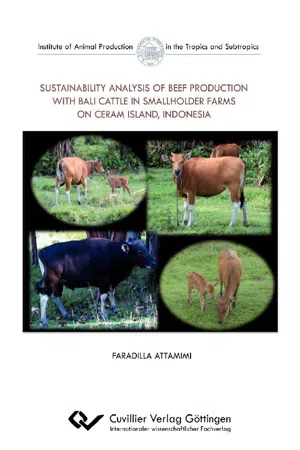
Even though being a region composed by islands and rich in water resources, beef production gains in importance on Ceram Island, Indonesia. A beef boom triggered the over-proportional selling of productive animals, threatening the sustainability of beef production in two farmer groups in the island, namely indigenous farmers who live as crop farmers, livestock keepers and fishermen and transmigrant farmers who came from other provinces in Indonesia, settled on the Island and live as food crop farmers, mainly producing rice and later becoming cattle keepers. The aim of the study was to contribute to the knowledge base needed for the design of sustainable beef production systems by analysing the sustainability of farms on Ceram Island, Indonesia. The Island was chosen by the provincial government as a centre of agricultural production in Maluku Province. The general hypothesis of this study was: farm resources and productive and reproductive performance of beef production in the mixed farming systems on Ceram Island differ according to the migratory status of farmers, leading to different economic efficiencies. Therefore, different strategies and interventions are needed to improve the systems. The study focused on districts with agriculture as the main economic activity, namely West Ceram and Kairatu districts in the west, and Bula district in the east. The study was carried out in three stages. The preliminary study was done to identify the production patterns and key features for further study planning in a diagnostic survey (33 households and 154 cattle) between June and September 2008. A comprehensive data collection was realised in the second stage, covering the areas of cattle distribution and performance, forage availability and quality, farm characteristics, production pattern, household socio-economic conditions and indicators used for sustainability analysis (88 households and 325 cattle). A closing data collection was performed with farmers in October 2010 in order to present, discuss and re-rank indicators in the sustainability analysis. The data was collected using household interviews, key person interviews, a progeny history questionnaire, systematic observation, cattle measurements, forage sampling and laboratory analysis, time line history of both farms and external condition, seasonal calendar for crops and cattle, internal bio-resource flow, ranking and scoring of the role and function of households member, as well as for cattle, crops and contribution of them for the household, and focus group discussion. After performing descriptive statistics, analytical analysis included general linear models and cluster analysis. IMPACT software was employed for annual economic balances, the households' food security status and labour allocation. Results of the study showed that performance of Bali cattle in farms managed by indigenous versus transmigrant farmers were not significantly different in terms of bull age at first mating, cow age at first calving, weaning age, calving interval and mortalities. The body weights showed a non-significant tendency towards heavier cattle in transmigrant farms. The overall productive performance of Bali cattle on Ceram Island was comparable with previous studies conducted in other parts of Indonesia and in other countries such as Malaysia, Australia and the Philippine. Forage production in the rainy season was 6.9 ton dry matter per ha, with 4 to 6% crude protein, 34 to 38% crude fiber, and 13.1 MJ per ton dry matter, which is relatively low compared to the western part of Indonesia and other islands in the Pacific like Samoa.
- 164 pages
- English
- PDF
- Available on iOS & Android
eBook - PDF
About this book
Information
Print ISBN
9783869556963
Edition
1Table of contents
- Acknowledgements
- Table of contents
- List of tables
- List of figures
- List of abbreviations
- 1 INTRODUCTION
- 2 LITERATURE REVIEW
- 3 MATERIALS AND METHODS
- 4 RESULTS
- 5 DISCUSSION
- 7 REFERENCES
- 8 Curriculum Vitae
- 9 Erklärung
Trusted by 375,005 students
Access to over 1.5 million titles for a fair monthly price.
Study more efficiently using our study tools.