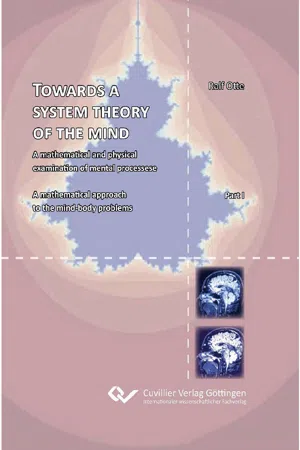
A system theory of the mind? It sounds like cybernetics, chaos theory, autopoiesis, or the theory of mind (TOM). This monograph, however, aims to break new ground. Leafing through this book, one notices formulae and unusual characters which seem to join forces and walk across the pages like centipedes. This book is more than challenging for readers who do not come into contact with mathematics regularly. And this is how the author believes he can explain what nobody has thus far been able to explain – how can the mind be understood and how can its state variables be calculated? He draws on quantum physics, a field that is oft en not understood even by its own practitioners. How can such a book expect to reach readers and how can the views included here expect to find adherents? Even scientists who devote themselves to research on the mind are likely to eschew the imaginary and complex numbers, Fourier transformations and quaternions presented here in favour of more established and conventional approaches. Once one has started reading, it soon becomes apparent that it might not be wise – or even possible – to ignore the ideas presented here for long. Prof. Dr. Gerald Wolf (from the foreword) A very interesting book. Explaining mental processes with mathematic formulae seems to be adventurous. However, it is a promising approach! Prof. Dr. Pauen, Humboldt-University Berlin
- 93 pages
- English
- PDF
- Available on iOS & Android
eBook - PDF
About this book
Information
Print ISBN
9783954040636
Edition
1Table of contents
- Foreword
- Author’s Preface
- Acknowledgements
- Table of Contents
- 1. Preliminary considerations and an introduction to the topic
- 2. Philosophical reflections on the mind body problem
- 3. Fundamental mathematical and theoretical reflections
- 4. An approach to formalising the description of cognitive and neural states
- 5. Suggestion for describing the brain within the framework of system theory
- 6. Summary and Preview of Part II and Part III
- 7. List of References
Trusted by 375,005 students
Access to over 1.5 million titles for a fair monthly price.
Study more efficiently using our study tools.