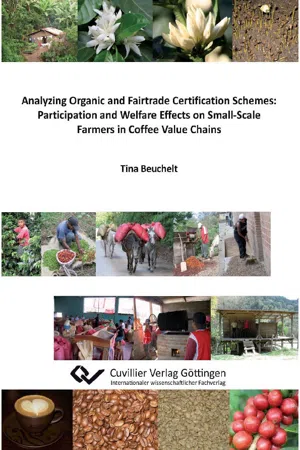
Organic and Fairtrade certified coffees have become very popular among socially, environmentally and health conscious consumers in recent years. As consumers pay higher prices for these certified coffees, it is commonly assumed that, compared to conventional coffee, better producer prices are paid and that higher shares of the added value in consuming countries trickle down to the producers. Coffee certifications are thus supposed to benefit the coffee producers. Coffee is an important export good for many developing countries. The majority of global coffee production comes from around 20-25 million smallholder families in developing countries. As individual certifications are too expensive smallholders have to participate in farmer organizations, e.g. cooperatives, in order to access cheaper group certification. Governments and international donors support coffee certification schemes and assume that these link farmers to high-value markets, increase producers' incomes, change power and information asymmetries in value chains, and contribute to poverty reduction. Yet, there is only weak empirical evidence that justifies this support. There are few quantitative studies which applied random sampling techniques, and analyzed the effects of certification schemes in regard of gross margins, profits, income shares and poverty levels of certified smallholder coffee producers. The role of cooperatives for the success of certification schemes has been neglected by research. The available studies have methodological limitations, for example they are based on qualitative methods only, include no more than one cooperative or one certification standard, or cooperatives are non-randomly sampled.This research seeks to fill the identified knowledge and methodological gaps. Through a combination of qualitative and quantitative research, the production and marketing strategies of small-scale coffee producers in northern Nicaragua are compared based on producers that are organized in conventional, organic, and Organic-Fairtrade certified cooperatives. The analysis addresses (i) the smallholders' household level and (ii) the organizational and institutional level with regard of the cooperatives and respective coffee value chains. The study aims at, first, identifying the socio-economic costs and benefits of participation in organic and Organic-Fairtrade certified coffee chains with respect to level of coffee and household incomes as well as household poverty. Second, it is examined which role the farmer organizations, their respective business models and upgrading strategies, play for the success or failure of certification schemes. Third, the integration of coffee farmers and their cooperatives into the coffee value chain, the structure and functioning of the value chains and the value adding effect of certification is examined.The survey was conducted in the northern Nicaragua departments Madriz, Nueva Segovia, and Matagalpa on coffee farms situated between 900m and 1300m a.s.l. The coffee of all farmers was classified as 'Strictly High Grown'; the species is Coffea Arabica. The sample design ensured that the research region was homogeneous with respect to living conditions, socio-economic level, as well as coffee growing characteristics driving performance of coffee farmers. After having randomly selected the cooperatives, 327 coffee producing households were also randomly selected and surveyed with a structured questionnaire. Qualitative data collection consisted in total of 58 key-person interviews, 67 semi-structured farmer interviews and 24 focus group discussions with coffee farmers. The primary data was collected during two research stays in 2007 and 2008.This research analyzes gross margins, accounting and economic profits of coffee production. The household income is measured and a poverty headcount index elaborated. Principal component analysis is used to determine current relative poverty levels and the development of relative poverty over time. A SWOT analysis identifies the strengths, weaknesses, opportunities, and threats of cooperatives. Through a value chain analysis information on the actors, power and information flows as well as price shares is gained. For identifying the farmers' experiences with coffee certification schemes, a thematic analysis is applied to the qualitative data by developing an individual code system for datareduction.In the research region, the coffee yields of conventional and certified coffee smallholders are usually 40% to 50% lower than national average due to limited maintenance activities and inadequately managed coffee plantations. Highest yields (on average around 480kg/ha) are achieved by organic producers but yield levels vary, like for conventional and Organic-Fairtrade certified producers, between the cooperatives (ranging from 293kg/ha to 516kg/ha). In comparison to conventional prices, Organic-Fairtrade certified coffee achieved on average 11% and organic coffee 8% higher farm-gate prices; price differences between cooperatives also exist. Organic production processes require fewer purchased inputs but are more laborious. Due to constrained availability of family labor, additional labor has to be hired which offsets saved input costs. The higher prices of certified coffees compensate for production costs but fail to increase per hectare gross margins and profits in the case of Organic-Fairtrade farmers compared to conventional produces. Due to higher yield levels, organic producers experience an increase in per hectare gross margins and profits. They have with 328US$/ha a significantly higher economic profit than Organic-Fairtrade farmers (147US$/ha) and conventional farmers (191US$/ha). Yet, as they tend to have smaller coffee areas and larger family sizes, the increase in gross margins does not result in improved per capita net coffee incomes for organic certified producers compared to the other groups. Also Organic-Fairtrade certified producers do not have higher per capita net coffee incomes than conventional producers.Among organic and Organic-Fairtrade certified producers, a higher share of households is grouped below the extreme poverty line than among conventional producers (45% compared to 30%) – which means that they cannot cover their food requirements. Between 60% and 70% of conventional and certified coffee producers are below the national poverty line. Using principal component analysis to investigate several dimensions of poverty and their development over time, it was found that over a period of ten years, organic certified producers became relatively poorer. In the year 1997, all groups had similar relative poverty levels. The Organic-Fairtrade certified producers first improved their relative poverty status during the coffee crisis (in 2002) and were relatively better off than conventional producers. Since then, the relative poverty levels of Organic-Fairtrade producers deteriorated compared to conventional producers.Irrespective of whether farmers were certified or not, Nicaragua's coffee smallholders face two to three months of food shortages per year during which they seek off-farm employment, and apply for formal and informal credits. In many cases the credit is used for immediate consumption needs, like food or medicine, and only partially invested in the farm. Consequently, harvested yields stay low, leading to low incomes and new credit requirements. When farmers are financially illiterate or requested higher credits than their payment capacity, they are likely to enter a vicious cycle of indebtedness.Each cooperative has a unique business model; they differ, for example, in member size, functions and services, internal organization, and financial characteristics. Despite their different business models the cooperatives often choose the same upgrading strategies as other cooperatives mainly certification, quality, and own processing. The analysis of strengths, weaknesses, opportunities, and threats (SWOTs) showed that the cooperatives have certain SWOTs in common but there are also cooperative specific SWOTs. The common strength of the cooperatives is the quality potential of the region. The common weaknesses relate to the lack of credit access, a weak extension system, and weak rural infrastructure. The common threats of the cooperatives are high competition among national coffee buyers and cooperatives, corruption and mismanagement, and, according to the qualitative interviews, increasing microclimatic variations and unreliable rainfall patterns. The common opportunities range from more horizontal coordination to reduce transaction costs to share certificates acknowledging the members' possessions in the cooperative and increased transparency about deductions on payments. Qualitative evaluation indicated no obvious association between the coffee certification strategy of farmers/their cooperative and the coffee gross margins farmers obtained. The upgrading strategies of cooperatives, the strengths and weaknesses as well as the amount of coffee-related services, which the cooperative offers to producers, tend to be more related to coffee gross margins than the organic or Organic-Fairtrade certification.Farmers are found to have no bargaining power over prices irrespective of the value chain, while certified cooperatives have limited bargaining power towards their buyers compared to cooperatives in the conventional chain. Power is unequally distributed between buyers and sellers of coffee in all chains. The quantity and quality of information flows depends on the cooperative and value chain model. Information asymmetries are fewer in certified chains; yet this also depends on the cooperative. Organic-Fairtrade certified value chains tend to have more and smaller-sized actors, especially in consuming countries, compared to the conventional chain. This increases transaction costs in the certified value chains and thus leads to substantially lower
- 235 pages
- English
- PDF
- Available on iOS & Android
eBook - PDF
About this book
Information
Print ISBN
9783954041190
Edition
1Table of contents
- Contents
- List of Figures
- List of Tables
- Abbreviations
- Executive Summary
- Zusammenfassung
- Resumen Ejecutivo
- Acknowledgements
- — Chapter 1 —Introduction
- — Chapter 2 —The Certification Standards and the ConceptualFramework
- — Chapter 3 —Research Area and Research Design
- — Chapter 4 —Profits and Poverty: Certification’s Troubled Link forNicaragua’s Organic and Fairtrade Coffee Producers
- — Chapter 5 —Justified Hopes or Utopian Thinking? The Suitabilityof Coffee Certification Schemes to Increase FoodSecurity for Small-Scale Producers
- — Chapter 6 —Organic and Fairtrade Coffee Production: The Role ofCooperative Business Models for the Success ofSmallholder Coffee Certification in Nicaragua
- — Chapter 7 —The Added Value of Social and EnvironmentalStandards for Smallholder Producers – A Case study ofNicaragua’s Coffee Value Chains
- — Chapter 8 —Summarizing Discussion and Conclusions
- — Chapter 9 —Bibliography
- — Appendix A —Household Questionnaire
- — Appendix B —Cooperative Questionnaire
- — Appendix C —Guiding Questions for Semi-Structured FarmerInterviews
- — Appendix D —Topics for Focus Group Sessions
Trusted by 375,005 students
Access to over 1.5 million titles for a fair monthly price.
Study more efficiently using our study tools.