SummaryIn Israel, more than half of the national sheep flock is kept by Bedouin in the Negev desert.Extensive production systems co-exist besides semi-intensive systems with varying economicsuccess. There is a constant regional demand for sheep meat, but the local supply is not ableto cover it. The wide gap between the performance potential of the commonly used andenvironmentally adapted local Awassi and improved sheep breeds suggests an increase ineconomic efficiency by intensification of breeding. The choice of a suitable breed for aspecific system is seen as key factor for the farm success and requires the knowledge of theanimals' adaptation. Information on the performance of Bedouin sheep flocks under the givenharsh production conditions are, however, missing. The purpose of the study was thus acharacterization of current production systems, the assessment of the aggregated performanceof the different Awassi lines kept in those systems and the impact of socio-economic andproduction factors on the efficiency of Bedouin sheep production. Also breeding objectives ofBedouin sheep farmers were investigated. The role of new breeding technologies in theongoing process of intensification of sheep farming systems was analyzed and discussed.Data collection was step-wise with repeated field surveys from January 2007 till March 2009, lasting 6 months altogether. In a first diagnostic survey 30 Bedouin households in the Negevdesert, located in two different climatic zones, arid and semi-arid, and keeping a minimumflock size of 50 animals, were visited. Households were grouped into 4 tribe groups accordingto location and ethnical background. In a second step, 21 households of the previous samplewere visited again and grouped according to the breed composition of their flocks and by theiruse of hormonal synchronization and/or artificial insemination. Semi-structured interviewsand participative observation yielded information about the socio-economic situation of thehousehold, function of flocks, the livestock husbandry, sheep management and production.Sheep market surveys, key person interviews and secondary data were used for verification ofdata. Detailed information on sheep was obtained through on-farm performance recording runin 16 sheep farms, including a total of 2420 breeding ewes. Sheep of different ImprovedAwassi lines were present in those experimental flocks, including the Afec Awassi, carryingthe Booroola gene (BB/B+), which has a major impact on prolificacy, and the Assaf breed. Ina last step, 56 sheep farmers from different parts of the Negev were asked about theirselection criteria for replacement. Trait preferences were derived by a consecutive rankingtechnique. The data analysis incorporated descriptive statistics, general linear models andnon-parametric tests performed with SAS 9.1 and SAS 9.2 software.The diagnostic survey revealed that functions of sheep flocks differed significantly betweentribes: in the semi-arid area with a main focus on generating income, and in tribes of the aridzone with a higher importance of subsistence related and social purposes. The primarypurpose was meat production. The dual purpose of meat and milk was still found in 57% ofthe farms, yet only 13% of the farms were selling milk products. The missing market accesswas the main reason for a strong decline in the use of milk, wool and manure during the lastdecade. Lamb meat, providing the main output of all farms, ranged from 13 to 58 kg ofmarketable live weight per ewe and year (LME). Classified according to their LME, 30% ofthe investigated farms followed an extensive, 47% a semi-extensive and 23% a semi-intensivemanagement. Significant differences in meat output were found for the factors tribe group, breed composition of flocks and selling age of lambs. The gross margin per ewe and yearvaried between -27 € and 54 € and the net benefit per flock and year (NB) between -7, 020 €and 20, 993 €. Both economic parameters were positively related to the meat output. NegativeNB's were realized by 43% of the farms, belonging foremost to traditional Bedouin tribes, oriented towards subsistence and living in remote areas. Only 27% of economically successfulfarms generated an income comparable to that of a part-time off-farm job. These farmersregularly used veterinary services to introduce improved breeds and modern breedingtechnology. Their good market access facilitated a strong market-oriented production, integrating lamb fattening, which had the highest impact on the production success.During the two years of research a severe drought occurred in the study region, causing adecline in LME, due to lower lambing rates and higher mortalities. To adapt to changingconditions, farms keeping the pure local Awassi breed reduced their flock sizes stronger thanfarms keeping also crossbreds. Consequently, the LME and the NB decreased stronger inflocks of pure local Awassi, compared to flocks with crossbreds. The decline in the NB was14 times lower in flocks with use of hormonal synchronization and/or artificial inseminationthan in flocks with the local breed kept under traditional management. The lowest decline inthe NB and the benefit cost ratio (BCR) were found in flocks with more than 50% crossbreds.Yet, a high variation in performance among flocks with different degrees of crossbreedingwas detected.Data analysis of flocks with permanent performance recording revealed that prolificacy wassignificantly affected by breed, besides farm and parity. Afec Awassi (B+) ewes had asignificantly (p<0.05) higher number of lambs born alive per ewe lambing (1.57 LBA/EL), than Assaf ewes (1.24 LBA/EL), Assaf crossbred ewes (1.17 LBA/EL) and local Awassi ewes(1.08 LBA/EL). Litter weight of lambs at weaning (LWW) showed also significantdifferences (p<0.05) between Afec Awassi (B+) (31 kg/ewe) and local Awassi ewes (18kg/ewe). The mortality rate of lambs at birth ranged by farm from 1.3% to 17.2% and frombirth to weaning from 5% to 23.3%, but did not differ significantly between breeds. Highestprolificacies and lowest lamb mortalities at birth were found in farms with good feeding andhigh labour input. As the lamb mortality at birth increased in litters larger than two, post-natalcare of lambs was essential for the success of the Afec Awassi line.Farmers of tribes, located in the two different climatic zones, expressed different selectioncriteria for replacement. Those of the arid zone ranked feed efficiency (good body conditionof the sheep with the available feed) highest, whereas farmers of the semi-arid zone gavepreference to fertility traits, ranking prolificacy first. The introgression of the Afec Awassi(BB/B+), leading to higher prolificacy, corresponds with trait preferences of market-orientedfarmers of the semi-arid zone in the Negev.The Afec Awassi line was the most profitable under good management. The setup of aheterozygote (B+) breeding stock can thus be recommended for the semi-intensive and semi-extensive Bedouin sheep farms in the Negev with improved management. A prolificacyhigher than 2.0 LBA/EL is not advisable due to higher lamb mortalities after birth withlimitations in management. The Afec Awassi line does not match the trait preferences andresource endowment of sheep farmers from the arid zone, following an extensive, subsistence-oriented system. There, the local Awassi is still providing the most suitablecombination of traits of adaptation and performance, however, without avoiding losses fromsheep production.ZusammenfassungÜber die Hälfte aller Schafe in Israel werden von Bedouinen in der Negev Wüste gehalten.Extensive Schafhaltungssysteme bestehen dort neben semi-intensiven Systemen, mit großenUnterschieden im Betriebserfolg. Die Nachfrage nach Schaffleisch ist hoch, aber das lokaleAngebot kann den regionalen Bedarf nicht decken. Die Reproduktionsleistung der gut an dasWüstenklima angepassten lokalen Awassi Rasse liegt weit hinter dem leistungsstärkererSchafrassen zurück. Eine Intensivierung in der Zucht könnte die ökonomische Effizienz derSchafhaltung verbessern. So haben Bedouinen in den letzten Jahren zunehmend fruchtbarereRassen in ihre Herden eingekreuzt, ohne dass gesicherte Erkenntnisse über deren Anpassungan die örtlichen Gegebenheiten vorhanden sind. Die Wahl der geeigneten Rasse für einbestehendes Produktionssystem ist jedoch ausschlaggebend für den Betriebserfolg. Bishergibt es keine detaillierten Informationen über die Leistung von Bedouinen Schafherden unterden harschen Produktionsbedingungen der Wüste. Ziel der vorliegenden Arbeit war esdeshalb zuerst die aktuellen Produktionssysteme zu beschreiben und die Produktivität derlokalen Rasse und von Kreuzungsgruppen unter den jeweiligen Haltungsbedingungen zubestimmen. Zudem sollte der Einfluss der Wahl der Rasse auf die ökonomische Effizienz derSchafproduktion ermittelt werden. Gleichzeitig wurde die Rolle neuer Züchtungstechnologienbei der Umsetzung der züchterischen Intensivierung untersucht und deren Akzeptanz bei denFarmern diskutiert, wobei auch Merkmalspräferenzen der Bauern für ihre Schafrassenermittelt wurden.Die Datenerhebung erfolgte schrittweise mit wiederholten Felduntersuchungen von Januar2007 bis März 2009 bei einer Untersuchungszeit von insgesamt 6 Monaten. Im Negev wurdendazu in einer ersten Bestandsaufnahme 30 Bedouinen-Haushalte mit unterschiedlicherEntfernung zur nächsten größeren Stadt, Beer Sheva, in unterschiedlichen Klimazonen (aridund semi-arid) und mit einer Herdengröße von über 50 Tieren besucht. Die Haushalte wurdenanhand ihrer geographischen Lage und ihrer Stammeszugehörigkeit 4 Gruppen zugeordnet. Ineiner zweiten Umfragerunde wurden nochmals 21 Haushalte aus der ersten Stichprobebesucht und sowohl nach der Rassenzusammensetzung ihrer Herden, als auch nach demEinsatz von neuen Reproduktionstechniken gruppiert. Halbstrukturierte Interviews undteilnehmende Beobachtungen erbrachten Informationen über die sozio-ökonomische Situationder Haus
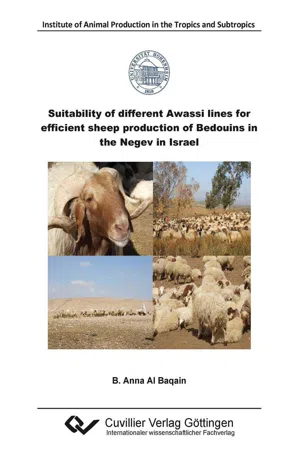
- 167 pages
- English
- PDF
- Available on iOS & Android
eBook - PDF
About this book
Information
Print ISBN
9783954041558
Edition
1Table of contents
- Acknowledgement
- Table of contents
- List of tables
- List of figures
- List of abbreviation
- 1 Introduction
- 2 Literature review
- 3 Materials and Methods
- 4 Results and discussion
- 5 General Discussion
- 6 Summary
- 7 Zusammenfassung
- 8 References
- 9 Curriculum Vitae
- 10 Erklärung
Trusted by 375,005 students
Access to over 1.5 million titles for a fair monthly price.
Study more efficiently using our study tools.