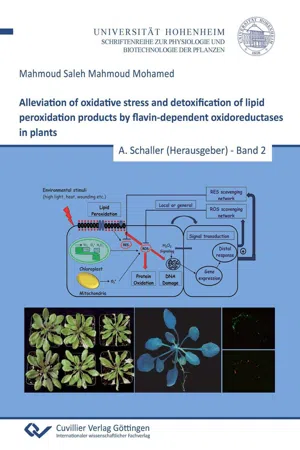
KurzbeschreibungDie mehrfach ungesättigten Fettsäuren der Membranlipide werden leicht durch reaktive Sauerstoff Spezies (ROS) oxidiert. Dadurch entstehen als Lipidperoxidationsprodukte Aldehyde und Ketone, deren Akkumulation die Pflanzenzelle stark schädigen. In dieser Arbeit werden zwei Vertreter einer Enzymfamilie untersucht, die möglicherweise maßgeblich an der Entgiftung der reaktiven Carbonylgruppe dieser Oxidationsprodukte beteiligt sind und als 12-Oxophytodiensäure Reduktasen (OPRs) bezeichnet werden. Die Mitglieder dieser kleinen Enzymfamilie sind flavinabhängige Oxidoreduktasen, welche Homologe des Old Yellow Enzyme der Hefe sind, mit sechs Vertretern in A. thaliana. Der Name ist abgeleitet von OPR3, das die Reduktion der Oxophytodiensäure katalysiert, welches ein zentraler Schritt in der Biosynthese der Jasmonsäure ist. Es ist jedoch wenig über die physiologische Bedeutung der anderen OPR Enzyme bekannt. Die Charakterisierung von "Loss-of-function"-Mutanten von AtOPR1, 2 und 4 zeigte eine verminderte Toleranz gegen photooxidativen Stress. Diese Enzyme scheinen eine Schutzfunktion durch Entgiftung von Lipidperoxidationsprodukten zu haben. Die AtOPR5 und AtOPR6 Mutanten zeigten jedoch keinen Phänotyp, was darauf zurückzuführen sein könnte, dass die beiden Gene in Promotor und kodierender Region identisch sind und identische Transkripte liefern.Um die Funktion der AtOPR5/6 Gene in pflanzlichen Stress-Antworten zu untersuchen, wurde als Strategie die RNA-Interferenz gewählt, um beide Gene gemeinsam herunterzuregulieren. Die AtOPR5/6-RNAi-Pflanzen zeigten eine starke Intoleranz gegenüber Starklichstress, was sich in einer reduzierten Effizienz der Photochemie am Photosystem II und Photoinhibierung äußerte. Dieser Phänotyp ist vergleichbar mit Pflanzen, die einen Defekt in der Entgiftung reaktiver Carbonyle aufweisen und stellt damit einen Hinweis auf eine ähnliche Funktion für OPR5/6 dar. Darüber hinaus wird diese Rolle durch eine gesteigerte Empfindlichkeit gegenüber Methylvinylketon (MVK), einem Lipidperoxidationsprodukt, unterstützt. Die MVK behandelten opr1 und opr2 Mutanten, sowie die AtOPR5/6-RNAi-Pflanzen zeigten einen signifikant verstärkten Zelltod im Vergleich zum Wildtyp.Um den Entgiftungsprozess genauer zu untersuchen, musste AtOPR5/6 in ausreichenden Mengen aufgereinigt werden. Die Bedingungen zur Expression und Aufreinigung wurden optimiert, da AtOPR5/6 zur Aggregation tendierte und in unlöslicher Form als "inclusion bodies" akkumulierte. Schließlich erwies sich die Denaturierung und spätere Rückfaltung als effizienteste Strategie, um eine ausreichende Menge an stabilem und löslichem OPR5/6 Protein zu generieren. Allerdings konnte für AtOPR5/6 keine katalytische Aktivität gezeigt werden. Dies könnte durch eine besondere Substratspezifität oder eine inaktive Proteinkonformation zu erklären sein.Die ähnlichen Starklicht-empfindlichen Phänotypen von opr1, 2, und 4 Einzelmutanten und AtOPR5/6-RNAi-Pflanzen deuten darauf hin, dass diese Gene auf nicht redundante Weise zur Stressakklimation beitragen. Frühere Studien wiesen unterschiedliche gewebespezifische Expressionsmuster für AtOPR1, 2, und 4 nach, worauf ihre nicht redundante Wirkung zurückzuführen sein mag. In dieser Arbeit wurden transgene Pflanzen untersucht, die das ?-Glucuronidase (GUS) Reportergen unter der Kontrolle des AtOPR5/6 Promotors exprimieren. Die AtOPR5/6 Promotoraktivität unterschied sich von der anderer AtOPRs und war besonders hoch im Hypokotyl und den ausgewachsenen Blättern der Rosette, nicht aber in etiolierten Keimlingen, den Reproduktionsorganen und der Wurzel. Weiterhin zeigte eine Untersuchung der subzellulären Lokalisation von AtOPR5/6 eine Lokalisation im Golgi Apparat. Diese Ergebnisse lassen vermuten, dass die unterschiedlichen OPRs eine sich gegenseitig ergänzende Rolle im Entgiftungsprozess spielen, um die zelluläre Homöostase von Stressmetaboliten in verschiedenen Pflanzengeweben und verschiedenen subzellulären Kompartimenten zu kontrollieren.DescriptionThe accumulation of lipid peroxide-derived aldehydes and ketones generated by the oxidation of polyunsaturated fatty acids of membrane lipids by reactive oxygen species (ROS) can significantly damage plant cells. In this study, an enzyme family possibly involved in the detoxification of these reactive carbonyls in plants was investigated. The members of this small enzyme family are flavin-dependent oxidoreductases and are related to Yeast Old Yellow enzyme. In A. thaliana they are represented by six members designated as 12-oxophytodienoate reductases (OPRs). This name is derived from OPR3 which catalyzes the reduction of oxophytodienoic acid, a key step in the jasmonic acid biosynthetic pathway. However, little is known about the physiological significance of the remaining OPR isoenzymes. The characterization of A. thaliana loss-of-function mutants for AtOPR1, 2 and 4 indicates a role for OPR isozymes in the alleviation of (photo)oxidative stress by detoxification of lipid peroxidation products. The single lossof-function mutants of AtOPR5 and AtOPR6, on the other hand, show no phenotype, most likely because the two genes are identical in the promoter and coding regions and yield identical transcripts.In order to explore AtOPR5/6 gene function in plant stress responses and to overcome their functional redundancy, RNA interference was employed to silence both genes. AtOPR5/6 RNAi-silenced plants exhibited high sensitivity toward (photo)oxidative stress, resulting in a decrease in the efficiency of photosystem II photochemistry and photoinhibition. The increased high-light sensitivity in AtOPR5/6 RNAi-silenced plants is reminiscent of plants impaired in the detoxification of reactive carbonyls suggesting that OPR5/6 may serve a similar function in vivo. Such a role is further supported by the increased susceptibility to the electrophilic lipid derivative methyl vinyl ketone (MVK). MVK-induced cell death events were significantly higher in opr1 and opr2 mutants and AtOPR5/6 RNAi-silenced plants as compared to MVK-treated wild type.In order to study the detoxification process in more detail, AtOPR5/6 had to be purified in sufficient quantities. Conditions of AtOPR5/6 expression and purification were optimized, since the enzyme tended to aggregate and accumulate in insoluble form as inclusion bodies. Denaturation and refolding turned out to be the most effective way to generate considerable amounts of stable and soluble OPR5/6. However, no activity was detected for AtOPR5/6, possibly because of a unique substrate specificity, or else, because of an inactive conformation of the protein.Similar high-light sensitive phenotypes of the opr1, 2, and 4 single mutants and AtOPR5/6 RNAi-silenced plants indicated that the genes act non-redundantly in stress acclimation. Previous findings showed different tissue-specific expression patterns of AtOPR1, 2 and 4, which may account for apparently non-redundant function of the AtOPRs. Here, the expression analysis was extended to the AtOPR5 promoter. Transgenic plants expressing the ?-glucuronidase (GUS) reporter gene driven by the AtOPR5/6 gene promoter were analyzed. AtOPR5/6 promoter activity differed from that of other AtOPRs, being high in hypocotyls and in the fully expanded rosette leaves but not in etiolated dark grown seedlings, reproductive organs and roots. Furthermore, sub-cellular localization experiments revealed that AtOPR5/6 is targeted to the Golgi apparatus. These finding suggest that the different OPRs play complementary roles in the detoxification process to control the cellular homeostasis of stress metabolites in different plant tissues and in different subcellular compartments.
- 187 pages
- English
- PDF
- Available on iOS & Android
eBook - PDF
About this book
Information
Print ISBN
9783954043385
Edition
1Table of contents
- Table of Contents
- List of Figures
- List of Tables
- Abbreviations
- 1. Introduction
- 2. Materials and methods
- 3. Results
- 4. Discussion
- 5. Summary
- 6. Zusammenfassung
- 7. References
- 8. Acknowledgements
- 9. Curriculum Vitae
Trusted by 375,005 students
Access to over 1.5 million titles for a fair monthly price.
Study more efficiently using our study tools.