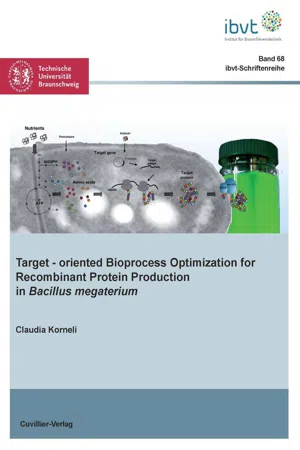
The aim of this project was the development and targeted optimization of recombinant protein production with Bacillus megaterium. Based on a genetically defined model strain with plasmid based production of the gene for the green fluorescent protein (GFP), at first, the optimization of the basic culture parameters pH-value, temperature and dissolved oxygen concentration was performed. Further empirical analysis included an evaluation of different carbon sources and vitamin requirements. The use of GFP hereby enabled fast and simple detection of the production performance. Subsequently, recombinant protein production was also assessed on the cellular level – using system wide transcriptome and proteome analysis. Then, this was transferred to production processes at industrial scale, investigating limiting effects occurring in large scale bioreactors, i.e. heterogeneities in oxygen and substrate supply. Initially, a two compartment scale-down plant was developed for this purpose. Suboptimal feeding of the substrate induced extensive substrate- and oxygen gradients which had a negative effect on the GFP yield. With the help of advanced scale-down experiments, the metabolic origin of this detrimental production was investigated. In highly resolved time intervals the availability of free intracellular amino acids in B. megaterium was analyzed. Five strongly limiting amino acids were identified. In a subsequent large scale production the addition of these amino acids to the feed solution resulted in a 100 % increased GFP yield. Finally, the results from the model strain were successfully transferred to the production of a homologous protein, the levansucrase SacB. This enzyme is an important biocatalyst in the food industry for the production of prebiotic ingredients. In high cell density cultivations, a high product level, which was significantly higher than that of any other extracellular proteins, produced so far with B. megaterium, could be obtained. Hereby, the process allowed the use of raw glycerol, a waste product from biodiesel industry, as raw material for high titer and quality of the recombinant product.
- 133 pages
- English
- PDF
- Available on iOS & Android
eBook - PDF
About this book
Information
Print ISBN
9783954042890
Edition
1Table of contents
- Vorwort
- Table of Contents
- Summary
- Zusammenfassung
- 1. Introduction
- 2. Objectives
- 3. State of Knowledge – Bacillus megaterium as Recombinant Host
- 4. Materials and Methods
- 5. Results and Discussion
- 6. Conclusions and Outlook
- 7. Abbreviations and Symbols
- 8. References
- 9. Appendix
Trusted by 375,005 students
Access to over 1.5 million titles for a fair monthly price.
Study more efficiently using our study tools.