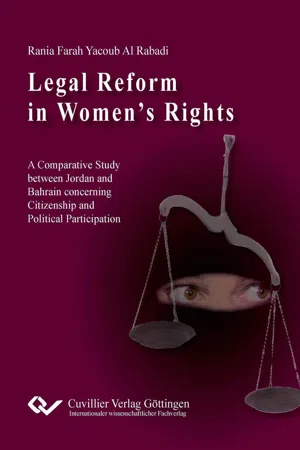
Liberal Feminism has made a strong point that women's equality with men can be achieved best through the establishment of civil and political rights through legal reform and liberal legislation. This offers a political agenda that can work in existing democratic systems and effect change from within, and as such is closer to practice and women's immediate needs than the more radical approaches of feminism. This study sets out to put the premise of liberal feminism to develop an argument about the cases I want to study because of applications need. This is first operationalised through a concept of liberal citizenship, which is then compared to the legal and real situation in two Arab countries, which have established liberal women's rights.Both, Jordan and Bahrain grant complete political and economic rights to women in their liberal constitutions. Both countries have made legislation efforts and reforms to bring women's equality in the countries' laws and to end discrimination against women as agreed to in the Convention on the Elimination of All Forms of Discrimination Against Women (CEDAW), to which both countries are party. The two countries share several political features, both are Arab countries with the political system of monarchy; both have Islam as the main religion and both endorse Shari'a law as part of the legal system. A key difference is that Bahrain has a Sunni-Shi'ite split, whereas in Jordan there are only Sunni.The research presented in this study employs the qualitative comparatives methodology by Sotirios Sarantakos. The comparison between both countries has been made according to a set of categories which based on the field study. This way the theoretical conclusions regarding the two cases are compared by identifying the similarities and differences. The primary field data comes from nine elite interviews in Jordan and seven in Bahrain; and from parliament debate records, newspaper articles, reports of organisations and other grey literature documents. All original material in Arabic has been translated to English. Research in Bahrain is rather difficult and particularly concerning women's rights. By this and also by conducting a comparative study of Arab countries the thesis fills research gaps.The core finding is that the liberalist promise of women's equality from legal rights is stopped short by the dual legal system of the countries. The liberal constitutions coexist with Shari'a interpretation control of family life. This reproduces the well known division of public and private sphere. Thus, while women have full political and economic rights on the paper, it is difficult for them to practice and exercise these rights in reality. They have the right to run for office, but are rarely elected due to bias against women. They have the right to work and education, but many graduates do not find a job and many working women cannot control the earned money but have to yield it to their husbands. The failure to wrest control of social rights from religious clergymen obsoletes many reforms aimed to empower women.Three empirical chapters present detailed analysis on specific laws and bylaws, on political processes and parliamentary procedures, on the intertwinement of societal bias and stereotypes with legal arrangements and reforms, of family and domestic power structures with political participation in the public sphere; on working conditions of women, the role of NGOs and international actors such as the UN, and finally recommendations to better women's situation in Jordan and Bahrain – based both on the content analysis of documents and on insights given by members of the political elites including members of parliament, lawyers, NGO representatives and women's activists.
- 181 pages
- English
- PDF
- Available on iOS & Android
eBook - PDF
About this book
Information
Print ISBN
9783954042678
Edition
1Table of contents
- Table of Content
- List of Acronyms
- Acknowledgements
- 1 Introduction
- 2 Theoretical Framework
- 3 Definition of Citizenship
- 4 The Methodology
- 5 Citizenship in the Jordanian Legislation and inWomen’s Practice
- 6 Citizenship in the Bahraini Legislation andin Women’s Practice in a Comparative Perspective
- 7 Conclusion
- 8 References
- Appendix A: Pilot Research in Jordan
- Appendix B: Jordan Field Research
- Appendix C: Bahrain Field Research Report 9-19/ 4/ 2010
- Appendix D: Interviews Questions
Trusted by 375,005 students
Access to over 1.5 million titles for a fair monthly price.
Study more efficiently using our study tools.