Chiral molecules exist in two geometric configurations of their atoms with mirror-image symmetry, which are called enantiomers. Many natural and organic molecules are chiral, such as peptides, enzymes, many amino acids or proteins. Despite similar physical and chemical properties, enantiomers may have very different biochemical and physiological effects being of great interest for the development of new pharmaceutically active compounds. Optical methods provide a direct means of distinguishing the enantiomers due to their differential interaction with circularly polarized light. This difference is generally referred to as Optical Activity. This book presents and evaluates new optical methods for the detection of Optical Activity in refraction, absorption and scattering. Beside different concepts for a Chiral Refractometer allowing the measurement of Optical Activity in microfluidic volumes the first realization of a VCD spectrometer based on a Quantum Cascade Laser is shown. It enables Optical Activity studies in strongly absorbing solvents like water. Finally differential scattering experiments are used for the characterization of chiral colloids, which can act as model systems for chiral molecules.
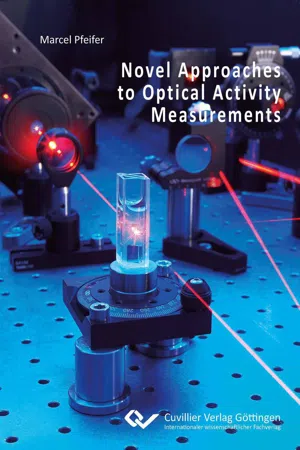
- 139 pages
- English
- PDF
- Available on iOS & Android
eBook - PDF
About this book
Information
Print ISBN
9783954046713
Edition
1Table of contents
- Erklärung der Selbstständigkeit
- Contents
- List of symbols and abbriviations
- Zusammenfassung
- Abstract
- 1 Introduction
- 2 Theory
- 3 Chiral Refractometry
- 4 MIR Laser-Based Vibrational Optical Activity
- 5 Mid-Infrared Refractometry
- 6 Chiral Scattering and Colloidal Molecules
- 7 Conclusion
- References
- Own Publications
- Danksagung
Trusted by 375,005 students
Access to over 1.5 million titles for a fair monthly price.
Study more efficiently using our study tools.