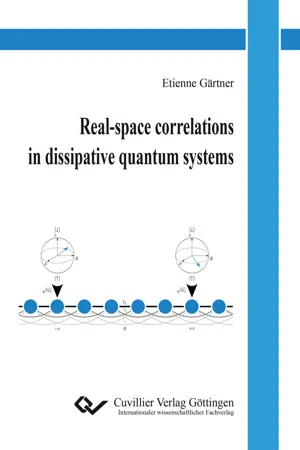
While multiple qubits in a quantum register should behave independently, their connection to a common environment may spoil that independence, as they start to influence each other via the environment. In this work two qubits, modelled by magnetic spin-1/2 impurities, are investigated which are coupled at a finite distance to the same dissipative environment. From the spin-boson model it is known that there exists a phase for weak coupling where the spin is not localised in any state and may thus explore the whole SU(2) Bloch sphere, while for strong coupling it is localised in one of two configurations, completely destroying its quantum mechanical nature.As a second spin is coupled in direct vicinity of the first, the environment mediates an effective ferromagnetic interaction between the spins, rendering them no longer independent.Within the Numerical Renormalization Group (NRG) it is investigated at which point the two spins can be treated independently as the distance between them is increased. To this end a two-channel bosonic NRG is developed that can deal with the model and its limit of two independent spin-boson models. The two-channel NRG is first tested on a model incorporating a single oscillator as an impurity. While the latter model only involves a single channel, a self-interaction of the impurity oscillator provides accessible limits, where the numerical implementation of the two-channel NRG can be tested. Furthermore signals of the different impurities are traced in the environment by means of thermal averages and their changes due to the presence of the impurities.Das Werk behandelt den Einfluss von Quantenstörstellen innerhalb einer dissipativen Umgebung sowohl aufeinander als auch auf ihre Umgebung. Die Störstellen werden hierbei entweder durch einen Oszillator oder durch zwei Qubits realisiert. Da die betrachteten Systeme für eine Vielzahl von Parametern nicht analytisch lösbar sind, wird eine Zwei-Kanal-NRG (Numerische Renormierungsgruppe) für bosonische Modelle entwickelt. Details dieser NRG und ihrer Implementierung werden in der Arbeit vorgestellt.Eine Untersuchung der Flussdiagramme der Zwei-Qubit-Systeme deutet auf einen Grundzustand hin, in dem die Quantenstörstellen effektiv ferromagnetisch gekoppelt sind.In diesem Zustand zeigen sowohl die mittlere Besetzung als auch die mittlere Auslenkung der Umgebungsorbitale eine deutliche Erhöhung direkt an den Störstellen.Die eindeutige Zuordnung einer Längenskala, auf der die betrachteten Signale abnehmen, ist derzeit nicht möglich.
- 159 pages
- English
- PDF
- Available on iOS & Android
eBook - PDF
About this book
Information
Print ISBN
9783954048502
Edition
1Table of contents
- Contents
- Abstract
- Kurzzusammenfassung
- 1. Introduction
- 2. Introduction of the models
- 3. Correlation functions
- 4. Bath spectral functions
- 5. Numerical Renormalization Group
- 6. Results
- Summary
- Outlook
- A. Impurity displacement-displacement correlation function
- B. Calculation of the ξn
- References
- Danksagungen
- Erklärung
- Lebenslauf
Trusted by 375,005 students
Access to over 1.5 million titles for a fair monthly price.
Study more efficiently using our study tools.