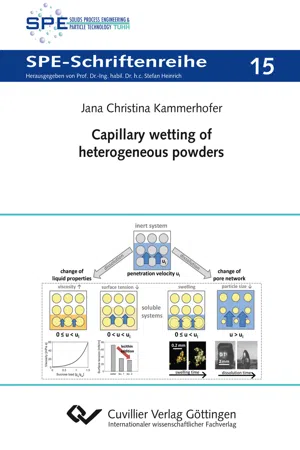
The objective of this PhD thesis is the enhancement of understanding and prediction of capillary wetting of heterogeneous, soluble food powders. Therefore, the capillary penetration is studied experimentally by increasing stepwise the complexity. Firstly, the heterogeneity in terms of contact angle and the effect of solubility during capillary wetting as the two main influencing factors are investigated separately and in a second step both factors are combined. Furthermore, a new model based on the coupling of the Washburn and the mass transfer equation is presented dealing simultaneously with capillary penetration and dissolution. It is observed that the viscosity increase is dominant during liquid penetration for the powder systems containing the most soluble component (sucrose) at a high concentration. For powder mixtures containing a less soluble component with less viscosity development (sodium chloride), the hydrophobic contact angle drives the liquid penetration.
eBook - PDF
About this book
Information
Print ISBN
9783736970823
Edition
1Table of contents
- 1. Introduction
- 2. Experimental methods
- 3. Results of materialcharacterization
- 4. Model description
- 5. Capillary wetting into inertsystems
- 6. Capillary wetting into foodsystems
- 7. Conclusion
Trusted by 375,005 students
Access to over 1.5 million titles for a fair monthly price.
Study more efficiently using our study tools.