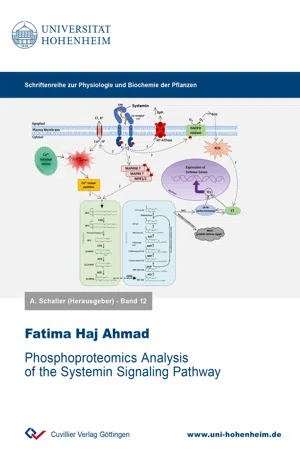
Systemin is a small peptide with important functions in plant wound response signaling. To elucidate systemin perception and signal transduction mechanisms, a phosphoproteomic profiling study was performed to reconstruct a systemin-specific kinase/phosphatase signaling network. Time course analyses revealed early events at the plasma membrane, such as dephosphorylation of H+-ATPase, and the phosphorylation of NADPH-oxidase and Ca2+-ATPase in response to systemin. Later responses included transient phosphorylation of small GTPases and vesicle trafficking proteins, as well as transcription factors. Based on a correlation analysis of systemin-induced phosphorylation profiles, substrate candidates for 44 systemin-responsive kinases and 9 phosphatases were predicted, some of which are involved in a regulatory circuit for the regulation of the plasma membrane H+-ATPase. In this regulatory model, H+-ATPase LHA1 is rapidly de-phosphorylated at its C-terminal regulatory residue T955 by phosphatase PLL5, resulting in the alkalization of the growth medium within two minutes of systemin treatment. LHA1 is re-activated by MAP-Kinase MPK2 later in the systemin response. A valuable resource of proteomic events involved in the systemin signaling cascade is provided with a focus on the prediction of substrates to early systemin-responsive kinases and phosphatases.
- 191 pages
- English
- PDF
- Available on iOS & Android
eBook - PDF
About this book
Information
Print ISBN
9783736970465
Edition
1Table of contents
- 1. Introduction
- 2. Materials and Methods
- 3. Results
- 4. Discussion
Trusted by 375,005 students
Access to over 1.5 million titles for a fair monthly price.
Study more efficiently using our study tools.