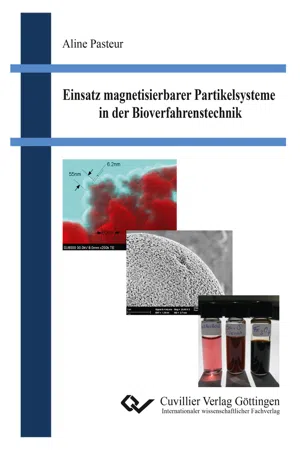
Nanopartikel sind in den letzten Jahren immer mehr in den Fokus der Forschungen gerückt. Die außergewöhnlichen physikochemischen Eigenschaften dieser Partikel eröffnen ein breites Feld von Anwendungsmöglichkeiten in verschiedenen wissenschaftlichen Bereichen. Bisher sind magnetische Partikel kaum in großtechnischen Prozessen eingesetzt. Anhand von drei Beispielen aus den Bereichen Hydrolyse, Katalyse und dem Downstream-Processing von Antibiotika werden mögliche Einsatzgebiete vorgestellt und das Potential für den Einsatz in einem bioverfahrenstechnischen Prozess diskutiert.Im ersten Beispiel werden magnetische Nanopartikel als Träger für einen Biokatalysator verwendet. Die magnetische Charakteristik ermöglicht die einfache Rückgewinnung der Partikel und somit einen wiederholten Einsatz im Prozess. Im zweiten Teil der Arbeit werden Goldnanopartikel für die trägerkatalysierte Umsetzung von Glucose zu Gluconsäure eingesetzt. Der katalytische Umsatz der Partikel ist vergleichbar mit der Fermentation, die zur großtechnischen Produktion der Säure eingesetzt wird und somit eine konkurrenzfähige Alternative für die bestehenden Prozesse. Als letztes Beispiel wurden magnetische Partikel als Adsorber in der Aufarbeitung von Lactam-Antibiotika eingesetzt, die durch den Einsatz eines auf Bioprozesse optimierten Hochgradienten-Magnetseparators die Aufarbeitungsschritte der Antibiotikagewinnung deutlich reduzieren.
- 291 pages
- English
- PDF
- Available on iOS & Android
eBook - PDF
About this book
Information
Print ISBN
9783954049004
Edition
1Table of contents
- Danksagung
- Kurzzusammenfassung
- Abstract
- Abkürzungen
- Formelzeichen
- Inhaltsverzeichnis
- 1 Einleitung und Stand der Technik
- 2 Enzymatische Hydrolyse von Cellulose
- 3 Katalytische Oxidation von Glucose zu Gluconsäure
- 4 Aufarbeitung von fermentativ gewonnenen Antibiotika
- 5 Abschließende Diskussion und Fazit
- 6 Literaturverzeichnis
- Anhang A Synthesevorschriften
- Anhang B Analytische Methoden
- Anhang C Reaktionsvorschriften
- Anhang D Simulationen
- Anhang E Verwendete Adsorber- und Partikelsysteme
- Anhang F Verwendete Geräte
- Anhang G Verwendete Chemikalien
- Anhang H Verwendete Puffer und Lösungen
- Anhang I Angaben zur Person
Trusted by 375,005 students
Access to over 1.5 million titles for a fair monthly price.
Study more efficiently using our study tools.