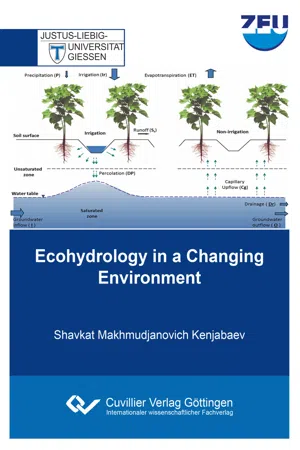
The complex of ecological problems in Central Asia, especially in Uzbekistan, is linked to rapid ongoing demographic and economic processes. However, geographical location has its own peculiarity. Aridity of the climate in Uzbekistan makes water resources as main limiting factor for sustainable economic development (Chub et al., 1998; RECCA, 2011). Annual precipitation, ranging from 80-200 mm in plain to 300-400 mm in foothills and 600-800 mm in mountain rangelands (Chub, 2007), is considerably lower than the evaporation demand of atmosphere (FAO IPTRID et al., 2004). Thus, agriculture, accounting about 90% withdrawal of total available water resources in Uzbekistan, is impossible without irrigation (Qadir et al., 2009). Moreover, agricultural production is highly vulnerable to climate change (Lioubimtseva & Henebry, 2009). High fluctuation of precipitation and temperature increase may influence land use in irrigated lands, create difficulties in water management at regional and local scales, and increase competition of scarce water resources among water users in various sectors.
eBook - PDF
About this book
Information
Print ISBN
9783954048656
Edition
1Table of contents
- ABSTRACT
- TABLE OF CONTENTS
- 1 INTRODUCTION
- 2 LITERATURE REVIEW
- 3 STUDY REGION
- 4 MATERIALS AND METHODS
- 5 RESULTS AND DISCUSSIONS
- 6 CONCLUSIONS AND FURTHER RESEARCH NEEDS
- REFERENCES
- ANNEXES
- ACKNOWLEDGEMENTS
Trusted by 375,005 students
Access to over 1.5 million titles for a fair monthly price.
Study more efficiently using our study tools.