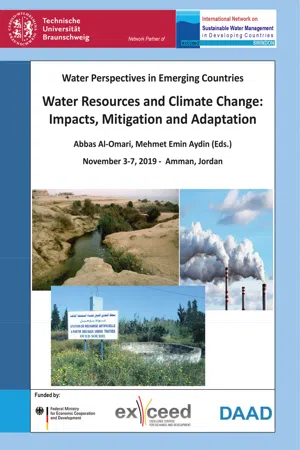
Sustainable development in the already vulnerable MENA Region faces several challenges, among which is climate change. Though the MENA Region is not a main contributor to climate change, it is predicted that several vital sectors will be negatively impacted, which is a threat to the sustainability of its socio-economic development. Water availability in the MENA Region is expected to be negatively impacted by climate change due to the predicted reduction of rainfall and increased evaporation. In addition, domestic and agricultural demands for freshwater will dramatically increase due to the expected temperature rise, which will enlarge the already existing gap between supply and demand in several MENA countries. It is important to note that the negative impacts on water resources will directly translate to other sectors due to their strong connectivity with the water sector. These sectors are food security, health, ecology, environment, economy and social. Predicted sea level rise due to melting of the poles is expected to result in land use change, which will in turn have severe social and economic consequences. Proper mitigation and adaptation options that take into consideration the multi-dimensional nature of the climate change impacts are imperative to conserve these sectors and to sustain the socio-economic development of the MENA Region. The objective of this book is to provide readers with state-of-the-art knowledge of diverse experiences related to the possible climate change impacts, mitigation and adaptation options in the MENA Region, and to identify and to deliberate upon the research needs and concepts against the background of increasing threats to ecosystems, economy and human health.
- 245 pages
- English
- PDF
- Available on iOS & Android
eBook - PDF
About this book
Information
Print ISBN
9783736971165
Edition
1Table of contents
- 1. Preface
- 2. Water Resources in Morocco as impacted by climate change
- 3. Adaption to climate change
- 4. Impacts of climate change on mouhoun river in Burkina Faso: Quantitative and Qualitative aspects
- 5. Climate Adaption governance fot agriculture sector: evidences from pakistan
- 6. Climatic change life cycle assessment of water and wastewater treatment systems: Case of morocco
- 7. Comporative study of wastewater treatment techniques for adaption to climate change
- 8. A decision making model based on ensemble flood forecasts
- 9. Bias correction of regional climate model simulations of temperature in egypt
- 10. Responses and strategic climate actions recommended in tunisia
- 11. Water management and climate change mitigation strategies along irans lake urmia basin
- 12. Climate change mitigation measures in Jordan by sustainng the soil Productivity under water stress conditions by using microbes preliminary results
- 13. Ecological wastewater treatment station for sustainable development in moroccan villages
- 14. Pesticide wastes management as a strategy for climate change mitigation in morocco
- 15. Contribution to a pre-feasibility study of aconstructed wetland systems for the treatment of the hamdoun river water, Tunisia
- 16. Boron removal from wastewater of concentrator and boric acid production
- 17. Flodd analysis of damladag River
- 18. Industrial effluent outfall in coastal region and its impacts on climate change
- 19. Impacts of drought and drought management strategies in Turkey
- 20. Agriculture Production and food security in mena countries under changing climate and water scarcity
- 21. Groundwater management in moghra region considering climate change impacts
- 22. Hydrogeophysical, Hydrogeochemical and environmental assessment of the Groundwater inal-abyad phosphate area
Trusted by 375,005 students
Access to over 1.5 million titles for a fair monthly price.
Study more efficiently using our study tools.