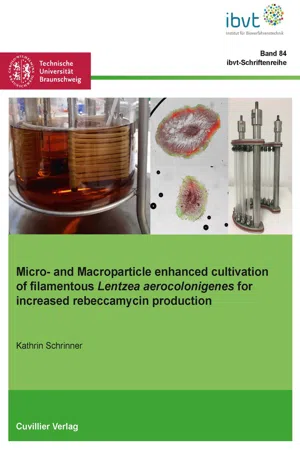
The filamentous actinomycete Lentzea aerocolonigenes produces the antitumor antibiotic rebeccamycin. However, the complex morphology of actinomycetes leads to challenges during the cultivation often accompanied by low product titers. In the recent past, the to date low rebeccamycin titers were increased by particle addition to cultivations of L. aerocolonigenes. In this thesis the addition of micro-, macro- and adsorbent particles to cultivations of L. aerocolonigenes were investigated in more detail. Furthermore, the scale-up to a bubble-free bioreactor was conducted.The addition of glass microparticles (x50 = 7.9 ?m, 10 g L-1) to shake flask cultivations increased the rebeccamycin titer up to 3.6-fold compared to an unsupplemented approach. Pellet slices showed the incorporation of microparticles. With different surface modifications of the microparticles, specific incorporation patterns of the microparticles appeared. The incorporation of microparticles causes looser and smaller pellets allowing an increased nutrient and oxygen supply in the pellet core. With addition of larger (glass) macroparticles (ø = 0.2 - 2.1 mm, 100 g L-1) mechanical stress was induced on the biopellets. The additional supplementation of 5 g L-1 soy lecithin and glass beads (ø = 969 ?m, 100 g L-1) resulted in a rebeccamycin titer of 388 mg L-1, one of the highest rebeccamycin titers ever achieved. For the scale-up of L. aerocolonigenes cultivations a bubble-free membrane aeration system was developed. The tubular membrane aeration system can additionally be pressurized to increase the oxygen transfer. First cultivations of L. aerocolonigenes successfully provided 18 mg L-1 rebeccamycin, a concentration similar to that of unsupplemented shake flask cultivations. XAD adsorbent particles were added to cultivations to facilitate rebeccamycin recovery. However, the XAD particles additionally increased the rebeccamycin titer which was likely to be caused by the adsorption of the rebeccamycin precursor tryptophan to the resins which in turn directly transferred the tryptophan to the microorganism.
- 143 pages
- English
- PDF
- Available on iOS & Android
eBook - PDF
About this book
Information
Print ISBN
9783736973503
Edition
1Table of contents
- 1 Introduction and aim of the thesis
- 2 Theoretical background
- 2.1 Lentzea aerocolonigenes and rebeccamycin
- 2.2 Morphology and productivity of filamentous microorganisms
- 2.3 Bubble–free aeration in bioreactors
- 3 Material and methods
- 3.1 Strain and cultivation medium
- 3.2 Particles
- 3.3 Cultivation methods
- 3.4 Analytical methods
- 3.5 Investigation of the pellet structure
- 4 Results and discussion
- 4.1 Microparticle enhanced cultivation
- 4.2 Macroparticle enhanced cultivation
- 4.3 Membrane aerated stirred bioreactor cultivations
- 4.4 Particle-based rebeccamycin recovery with adsorbent resins
- 5 Conclusions and future prospects
- 6 List of abbreviations and symbols
- 7 References
Trusted by 375,005 students
Access to over 1.5 million titles for a fair monthly price.
Study more efficiently using our study tools.