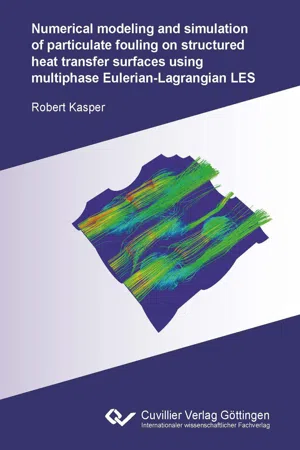
Durch die gezielte Strukturierung von wärmeübertragenden Oberflächen, wie beispielsweise durch Dellen oder Rippen, kann die örtliche Turbulenz und damit die thermische Durchmischung gesteigert werden. Dies kann die Effizienz von Wärmeübertragern oder Bauteilkühlsystemen erheblich erhöhen. Derartige Oberflächenstrukturrierungen begünstigen jedoch das Partikelfouling, daher die Ablagerung suspendierter Partikel, wie z.B. Sand, Schlamm oder Korrosionsprodukte. Gegenstand dieser Arbeit ist die Entwicklung eines universellen, numerischen CFD-Verfahrens zur Vorhersage des partikulären Foulings auf strukturierten Oberflächen, speziell Dellenoberflächen. Das entwickelte Verfahren basiert auf einer Kombination des Lagrangian-Particle-Trackings zur Beschreibung der dispersen Phase (Foulingpartikel), sowie räumlich und zeitlich aufgelöster Large-Eddy Simulation für die Berechnung der kontinuierlichen Phasen (Trägerfluid). Dieses Vorgehen ermöglicht nicht nur die Auswertung der infolge der Partikelablagerungen verminderten thermo-hydraulischen Effizienz, sondern auch die Untersuchung der Wechselwirkungen zwischen turbulenten Strömungsstrukturen und dem partikulärem Fouling. Dadurch kann gezeigt werden, dass die Verwendung von sphärischen Dellen als Oberflächenstrukturen nicht nur aus thermo-hydraulischer Sicht die optimale Wahl darstellt, sondern auch eine substantielle Verminderung des Partikelfoulings begünstigt.The application of structured heat transfer surfaces, such as dimples or ribs, increase the local turbulence and thus thermal mixing. This can improve the efficiency of heat exchangers or cooling systems significantly. However, structured surfaces are known to promote particulate fouling, hence the unwanted accumulation and deposition of suspended particles (e.g., silt, sludge or iron oxide).The scope of this work is the development of a universal numerical CFD method for the prediction of particulate fouling, especially on dimpled surfaces. The proposed approach is based on a combination of the Lagrangian point-particle tracking for the description of the disperse phase (fouling particles), and spatially and temporally resolved large-eddy simulations for the calculation of the continuous phase (carrier fluid). This approach allows not only the evaluation of the reduced thermo-hydraulic efficiency due to particle deposition, but also the investigation of the interaction between turbulent flow structures and the particulate fouling. It can be shown that the usage of spherical dimples as surface structures is not only the optimal choice from a thermo-hydraulic point of view, but also favors a substantial reduction of particulate fouling.
- 179 pages
- English
- PDF
- Available on iOS & Android
eBook - PDF
About this book
Trusted by 375,005 students
Access to over 1.5 million titles for a fair monthly price.
Study more efficiently using our study tools.
Information
Print ISBN
9783736974197
Edition
1Table of contents
- Abstract
- Preface
- List of Figures
- List of Tables
- Nomenclature
- 1 Introduction
- 1.1 Motivation
- 1.2 Fouling of heat transfer surfaces
- 1.3 Objectives and thesis outline
- 2 Description of the continuous phase
- 2.1 Governing equations of fluid motion
- 2.2 Turbulence in wall-bounded flows
- 2.3 Mathematical modeling of turbulent flows
- 2.4 Large-eddy simulation
- 3 Description of the dispersed phase
- 3.1 Characterization of dispersed multiphase flows
- 3.2 Numerical modeling of dispersed multiphase flows
- 3.3 Forces on particles
- 3.4 Phase coupling
- 3.5 Particle dispersion
- 3.6 Particle interactions
- 4 Numerical methodology
- 4.1 Spatial discretization
- 4.2 Temporal discretization
- 4.3 Pressure-velocity coupling
- 4.4 Boundary conditions
- 4.5 Numerical procedure of the applied Lagrangianparticle tracking
- 5 Modeling of particulate fouling onstructured heat transfer surfaces
- 5.1 Eulerian-Lagrangian approach
- 5.2 Multiscale modeling for the simulation of long-termfouling intervals
- 6 Validation
- 6.1 Particle-laden Taylor-Green vortex flow
- 6.2 Particle-laden turbulent backward-facing step flow
- 6.3 Particle-laden flow in a simplified combustionchamber
- 6.4 Particle-laden turbulent channel flow
- 7 Particulate fouling on dimpled heattransfer surfaces
- 7.1 Particulate fouling on a single spherical dimple
- 7.2 Particulate fouling on spherical dimples in astaggered arrangement
- 8 Conclusion
- Bibliography
- A Appendix
- A.1 High order statistical moments
- A.2 Unladen turbulent channel flow over a singlespherical dimple
- List of publications