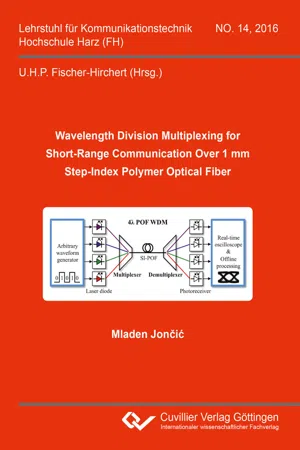
In short-range communication 1 mm step-index polymer optical fiber (SI-POF) established itself as a reasonable alternative to the traditional data communication media. The commercial systems with SI-POF use a single wavelength for data transmission. This thesis investigates the utilization of several optical carriers for parallel transmission of data channels over a single fiber, known as wavelength division multiplexing (WDM), in order to increase the capacity of SI-POF link. The focus of research is on (1) demultiplexing techniques for SI-POF, (2) high-speed WDM transmission over SI-POF and (3) channel allocation for POF WDM systems.For WDM an optical demultiplexer is a key component. The thesis concentrates on the demultiplexing techniques employing thin-film interference filters and a concave diffraction grating. A four-channel interference filter-based SI-POF demultiplexer was realized using a precisely adjustable opto-mechanical setup. It provided low IL ( 30 dB), outperforming other interference filter-based SI-POF demultiplexers reported so far. Theoretical and experimental analysis of an already realized SI-POF demultiplexer based on a concave diffraction grating was carried out. The results confirmed the wavelength separating function of the device. However, a poor grating quality due to unstable parameters of the ruling process led to high IL (> 20 dB) and low channel isolation (< 15 dB). To demonstrate experimentally the feasibility and potential of a high-speed POF WDM concept, a four-channel laser diode-based data transmission setup employing the interference filter-based demultiplexer was realized. It was shown that POF WDM with lower channel rates and simple transmission technique could provide aggregate bit rates comparable to those achieved with the single-wavelength systems that used more advanced transmission techniques but required more signal processing. In addition, the record 14.77 Gb/s and 8.26 Gb/s data rates employing the offline-processed discrete multitone modulation were demonstrated over 50 m and 100 m SI POF, respectively. Compared to the fastest single-wavelength systems, two times higher transmission capacities were achieved.Finally, the channel allocation for POF WDM systems was investigated. It was shown that the extension of ITU-T G.694.2 Coarse WDM grid into the visible spectrum, with 15 channels and 20 nm channel spacing, is best suited to support WDM applications over SI-POF.
- 149 pages
- English
- PDF
- Available on iOS & Android
eBook - PDF
About this book
Information
Print ISBN
9783736992047
Edition
1Table of contents
- Acknowledgements
- Abstract
- Table of contents
- 1 Introduction
- 2 Fundamentals of WDM for short-range communication over POF
- 3 POF demultiplexer employing thin-film interference filters
- 4 POF demultiplexer based on a concave diffraction grating
- 5 Four-channel POF WDM transmission experiments
- 6 Spectral grids in the visible spectrum for POF WDM applications
- 7 Summary and outlook
- References
- List of abbreviations
- List of publications
Trusted by 375,005 students
Access to over 1.5 million titles for a fair monthly price.
Study more efficiently using our study tools.