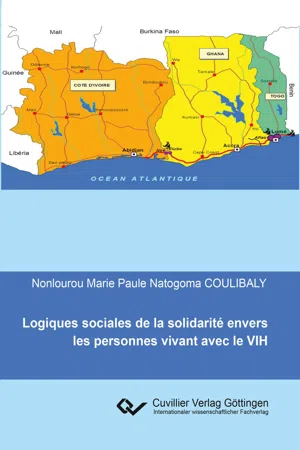
L'analyse des phénomènes sociaux qui naissent de l'articulation entre la problématique du VIH/sida et la notion de solidarité dans cette étude permettent une meilleure compréhension de la dynamique sociale. Face aux graves conséquences du VIH/sida dans ce contexte d'étude ouest-africain, où une infime partie de la population bénéficie de la sécurité sociale, il s'agit d'analyser les facteurs de variations des pratiques de la solidarité au sein de différents groupes sociaux issus de classes sociales relativement pauvres. L'enjeu est donc d'établir une typologie de la solidarité en mettant en relation la situation de vulnérabilité que vivent les personnes vivant avec le VIH (PVVIH), les pratiques de solidarité envers elles, les principes et normes de leur groupe social et les différents contextes politique, économique et social dans lesquels la solidarité a lieu. L'analyse du contenu des discours recueillis au cours des entretiens biographiques, des discussions de groupe, et des entretiens individuels a permis d'analyser les phénomènes sociaux qui induisent les pratiques de la solidarité envers les PVVIH rencontrées dans trois pays d'Afrique de l'Ouest (Côte d'Ivoire, Ghana et Togo).Dans ces contextes africains, les pratiques de la solidarité envers la PVVIH ne sont pas toujours systématiques et uniformes à tous les membres de son groupe social. De plus, la pratique de la solidarité émane autant bien d'actions raisonnées et des relations affectives. La solidarité envers la PVVIH dans ces contextes de groupes sociaux socialement défavorisés traduit une dynamique sociale dans laquelle la notion de famille se redéfinit par le fait que la solidarité entraine une reconstruction des liens familiaux basée sur l'entente, les sentiments affectifs, la confiance mutuelle et la réciprocité. The analysis of social phenomena, born from the articulation of the problem of HIV/AIDS and the notion of solidarity, helps to understand better the question of social dynamics. In the West African context, where a minority of the population benefits from social security, this study analyses the determining factors of the practices of solidarity within different groups in a relatively poor social class. What is at stake is to establish a typology of solidarity between the vulnerability of people living with HIV/AIDS (PLWHA), the practices of solidarity towards them, the principles and norms of their social group and the different political, economic and social contexts in which this solidarity takes place.The analysis of the discourses gathered from biographical interviews, group discussions and individual interviews helped to analyze the social phenomena that induce the practices of solidarity towards people living with HIV/AIDS in three West African countries (Côte d'Ivoire, Ghana and Togo).In these African contexts, the practices of solidarity towards PLWHA are not always systematic and uniform to every member of a social group. Further, the practice of solidarity derives from both reasonable actions and affective relations. In this context of marginalized social groups, the social dynamic of solidarity towards PLWHA redefines and reconstructs the concept of family based on agreement, affective feelings, mutual trust and reciprocity.
- 261 pages
- English
- PDF
- Available on iOS & Android
eBook - PDF
About this book
Information
Print ISBN
9783736991187
Edition
1Table of contents
- Remerciements
- Liste des sigles et abréviations
- Résumé
- Table des matières
- Introduction
- 1 Présentation du sujet
- 2 Revue de littérature et cadre théorique
- 3 Méthodologie de la recherche
- 4 Analyse des conditions de vie de la population à l’étude
- 5 Le VIH/sida et ses implications
- 6 La solidarité familiale
- 7 La solidarité de proximité avec les amis et les voisins
- 8 La solidarité vécue dans les associations et les prestataires de service de solidarité envers les PVVIH
- 9 Discussion
- Conclusion générale
- Références bibliographiques
- ANNEXES
- LISTE DES TABLEAUX
Trusted by 375,005 students
Access to over 1.5 million titles for a fair monthly price.
Study more efficiently using our study tools.