Hinsichtlich der Zusammensetzung von schwarzem Tee bestehen deutliche Wissenslücken. Dies lässt sich jedoch nicht auf ein mangelndes wissenschaftliches Interesse, sondern auf die hohe Komplexität der Inhaltsstoffe, konkret der sogenannten Thearubigene (TRs), zurückführen, die klassische analytische Herangehensweisen an ihre Grenzen bringt. Der Begriff Thearubigene stellt eine Sammelbezeichnung für im schwarzen Tee enthaltene Oxidationsprodukte dar, welche im Zuge der enzymatischen Oxidation bei der Teeherstellung v.?a. aus Flavanolen gebildet und auf der Basis chemischer und sensorischer Eigenschaften sowie des chromatographischen Verhaltens zusammengefasst werden. Im Rahmen dieser Arbeit sollten die Vorgänge während der Teeproduktion untersucht, etablierte Methoden zur Fraktionierung von Thearubigenen evaluiert und optimiert sowie die Lagereigenschaften eines Schwarztee-Extraktes erforscht werden. Der erste Teil der Arbeit befasst sich mit der Durchführung von Modellfermentationen mit einem polyphenolfreien Teeblattpulver, in dem die endogenen Tee-Enzyme weiterhin aktiv waren und durch die Wahl der Rahmenbedingungen selektiv im Oxidationsprozess eingesetzt werden konnten. Als Substrate wurden gezielt Kombinationen von Flavanolen verwendet, so dass sowohl die Wirkung der Enzyme Polyphenoloxidase (PPO) bzw. Peroxidase (POD) als auch der Einfluss der Flavanole untersucht werden konnte. Dabei ist es gelungen, die Bildung charakteristischer Schwarzteebestandteile mit unterschiedlichen Grundstrukturen (di- und trihydroxylierte Benzotropolone sowie Benzotropolon-Derivate; 2', 2'-Bisflavanole; verschiedene Dehydrodicatechine) nachzuweisen und anhand von HPLC-DAD-ESI-MSn-Daten Vorschläge für das Fragmentierungsverhalten mehrerer Oxidationsprodukte wie Theaflavat B, Theacitrin und Epitheaflagallin-3-gallat zu formulieren. Der B-Ring konnte als das mit Abstand reaktivste Glied der Flavanole bestätigt werden, gefolgt von der eventuell vorhandenen Galloyleinheit. Durch qualitative und quantitative Bestimmungen von Edukten und Produkten wurde gezeigt, dass die Enzyme PPO und POD offenbar dieselben Reaktionen katalysieren, sich jedoch bezüglich ihrer Präferenzen deutlich unterscheiden. Die Abläufe blieben trotz der vereinfachten Bedingungen komplex und führten neben einigen charakteristischen Primärprodukten zur Bildung einer unübersichtlichen Anzahl gering konzentrierter Verbindungen. In einem weiteren Ansatz wurde ein alternatives System unter Verwendung kommerziell erhältlicher Meerrettich-Peroxidase entwickelt und erstmalig ein für die Oxidationsvorgänge relevanter Matrixeffekt durch Teeblätter beschrieben, der sich nicht mit einer enzymatischen Aktivität erklären ließ. Der mittlere Teil der Arbeit beschäftigt sich mit einem Vergleich dreier Methoden zur Fraktionierung und Isolierung von Thearubigenen (Roberts'-Fraktionierung, Coffein-Fällung sowie ein kombinierter Einsatz von XAD-7-Säulenchromatographie und Hochgeschwindigkeits-Gegenstromverteilungschromatographie, HSCCC). Da das HSCCC-basierte Verfahren die reinsten TR-Fraktionen lieferte, wurde dieses für eine weitere Optimierung ausgewählt, wobei auch die Übertragbarkeit auf andere Technologien zur Verringerung des Zeitaufwandes bzw. zur Vergrößerung des Maßstabes demonstriert wurde. Anhand einer TR-reichen HSCCC-Fraktion wurde im abschließenden Teil die Lagerstabilität schwarzteehaltiger Lösungen untersucht. Vorbehaltlich etwaiger Matrixunterschiede scheint der Schlüssel zu einer langen Lagerfähigkeit v.?a. in der konsequenten Kühlung und dem Einstellen eines sauren pH-Wertes zu liegen.Up to today, there are wide gaps in knowledge concerning the composition of black tea. This is, however, not due to a lack of scientific interest but rather the result of the high complexity of its constituents, in particular of the thearubigins (TRs), which bring conventional analytical tools to their limits. The term thearubigins refers to a group of compounds, which are formed during black tea manufacture through an enzymatically catalysed oxidation of flavanols and possess similar chemical, sensorial and chromatographic properties.This thesis deals with the investigation of processes during tea production, the evaluation and optimisation of different methods for the fractionation of thearubigins, and the examination of storage properties of a black tea extract.In the first part of this work model fermentations using a polyphenol-free tea-leaf-powder with active endogenous enzymes were conducted. By variation of the experimental conditions it was possible to select which of the relevant enzymes (polyphenol oxidase, PPO and/or peroxidase, POD) was active during the model oxidations. Different combinations of flavanols were used as substrates. Thus, the impact of each enzyme as well as the behaviour of the flavanols could be analysed in the course of the experiments. As a result the formation of numerous characteristic black tea constituents with different structural backbones (di- and trihydroxylated benzotropolones and -derivates, 2', 2'-bisflavanols and various dehydrodicatechins) was observed. Through data obtained by HPLC-DAD-ESI-MSn several fragmentation reactions for oxidation products, such as theaflavate B, theacitrin and epitheaflagallin-3-gallate, were suggested. The results confirm the B ring to be the most reactive part of flavanols, followed by the galloyl moiety. Via qualitative and quantitative measurements of educts and products it was shown that PPO und POD catalyse the same reactions but have clearly different preferences. Despite the simplified reaction conditions the processes remained complex and led to a wide range of low-concentrated compounds. In an additional approach an oxidation system employing horseradish-POD was established and a non-enzymatic matrix effect of tea leaves was reported for the first time.The second part takes a look at three different methods for the fractionation and isolation of thearubigins (Roberts'-fractionation, precipitation with caffeine, and separation by high-speed countercurrent chromatography, HSCCC, after column chromatography with XAD-7). Based on the results the procedure using HSCCC was selected for further optimisation and the feasibility of its transfer to other techniques, namely high-performance CCC and spiral-coil CCC, was demonstrated in order to reduce the separation time or to work in a larger scale. By means of a TR-enriched solution, stability tests were carried-out in the final part of the thesis. Subject to possible differences in the matrix it was observed that the adjustment of an acidic pH value as well as continuous cooling seem to be key to maintain long storage stability.
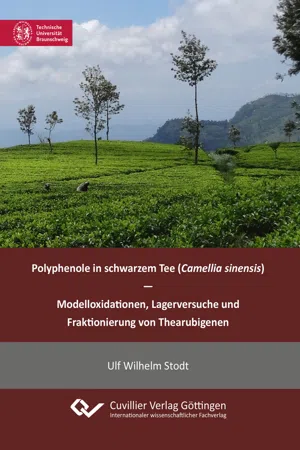
- 247 pages
- English
- PDF
- Available on iOS & Android
eBook - PDF
About this book
Information
Print ISBN
9783736991965
Edition
1Table of contents
- INHALT
- ABKÜRZUNGEN UND SYMBOLE
- 1Einleitung und Grundlagen
- 2 Zielsetzung
- 3 Ergebnisse und Diskussion
- 4 Zusammenfassung und Ausblick
- 5 Material und Methoden
- 6 Literatur
- 7 Anhang
Trusted by 375,005 students
Access to over 1.5 million titles for a fair monthly price.
Study more efficiently using our study tools.