Synthese und Charakterisierung heterobimetallischer Komplexe von Seltenerdelementen mit späten Übergangsmetallen und P-N-Liganden
eBook - PDF

Synthese und Charakterisierung heterobimetallischer Komplexe von Seltenerdelementen mit späten Übergangsmetallen und P-N-Liganden

,
  1. 138 pages
  2. English
  3. PDF
  4. Available on iOS & Android
eBook - PDF

Synthese und Charakterisierung heterobimetallischer Komplexe von Seltenerdelementen mit späten Übergangsmetallen und P-N-Liganden

,

About this book

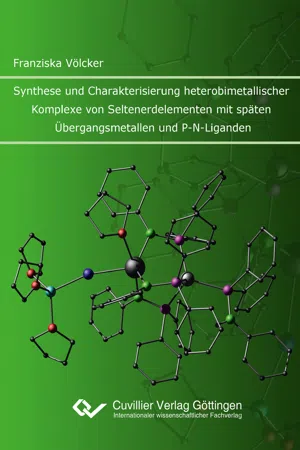
Die Entwicklung neuer Verbindungen für die homogene Katalyse und die Aktivierung kleiner Moleküle ist von großem Interesse in der aktuellen Forschung. Komplexe, die ein frühes und ein spätes Übergangsmetall beinhalten, sogenannte "Early-Late Heterobimetallic complexes", zeichnen sich durch ihr bifunktionales Reaktionszentrum aus und sind deshalb besonders interessant. Komplexe, die Seltenerdelemente in Kombination mit Rhodium, Palladium oder Platin mit einem Metall-Metall-Abstand von weniger als 3.5 Å enthalten, sind dabei bisher relativ selten. In dieser Arbeit konnte ausgehend von sowohl neuen als auch literaturbekannten monometallischen Seltenerdmetall-Komplexen eine Vielzahl an neuen heterobimetallischen Komplexen dargestellt werden. Dabei konnten Komplexe mit Phosphanamid- und Bisphosphanamid-Liganden, die Seltenerdelemente in Kombination mit späten Übergangsmetallen der Gruppe 9 und 10 beinhalten, dargestellt und deren Festkörperstruktur aufgeklärt werden. Darüber hinaus konnten in Zusammenarbeit mit anderen Arbeitsgruppen die magnetischen Eigenschaften von Dysprosium-P-N-Komplexen und die Metall-Metall-Wechselwirkung mit Hilfe von quantenchemischen Rechnungen in einem der neu erhaltenen heterobimetallischen Komplexe untersucht werden.
Frequently asked questions

Yes, you can cancel anytime from the Subscription tab in your account settings on the Perlego website. Your subscription will stay active until the end of your current billing period. Learn how to cancel your subscription.
No, books cannot be downloaded as external files, such as PDFs, for use outside of Perlego. However, you can download books within the Perlego app for offline reading on mobile or tablet. Learn more here.
Perlego offers two plans: Essential and Complete
  • Essential is ideal for learners and professionals who enjoy exploring a wide range of subjects. Access the Essential Library with 800,000+ trusted titles and best-sellers across business, personal growth, and the humanities. Includes unlimited reading time and Standard Read Aloud voice.
  • Complete: Perfect for advanced learners and researchers needing full, unrestricted access. Unlock 1.4M+ books across hundreds of subjects, including academic and specialized titles. The Complete Plan also includes advanced features like Premium Read Aloud and Research Assistant.
Both plans are available with monthly, semester, or annual billing cycles.
We are an online textbook subscription service, where you can get access to an entire online library for less than the price of a single book per month. With over 1 million books across 1000+ topics, we’ve got you covered! Learn more here.
Look out for the read-aloud symbol on your next book to see if you can listen to it. The read-aloud tool reads text aloud for you, highlighting the text as it is being read. You can pause it, speed it up and slow it down. Learn more here.
Yes! You can use the Perlego app on both iOS or Android devices to read anytime, anywhere — even offline. Perfect for commutes or when you’re on the go.
Please note we cannot support devices running on iOS 13 and Android 7 or earlier. Learn more about using the app.
Yes, you can access Synthese und Charakterisierung heterobimetallischer Komplexe von Seltenerdelementen mit späten Übergangsmetallen und P-N-Liganden by in PDF and/or ePUB format. We have over one million books available in our catalogue for you to explore.

Information

Year
2016
Print ISBN
9783736992085
eBook ISBN
9783736982086
Edition
1

Table of contents

  1. Inhaltsverzeichnis
  2. 1 Einleitung
  3. 2 Aufgabenstellung
  4. 3 Ergebnisse und Diskussion
  5. 4 Experimenteller Teil
  6. 5 Zusammenfassung/Summary
  7. 6 Literaturverzeichnis
  8. 7 Anhang