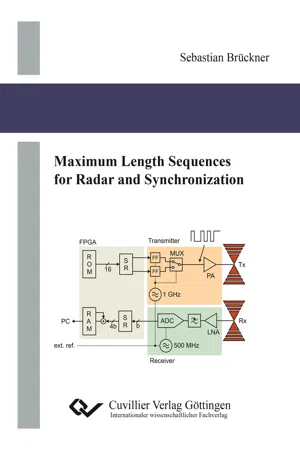
This dissertation demonstrates the implementation of ultra-wideband (UWB) radar sensors using commercial off-the-shelf electronics. The sensors are based on the correlation of binary pseudo noise sequences (M-sequences), combining low transmit power requirements with excellent noise and interference suppression. A ranging system is introduced that is able to track moving objects with a standard deviation of 1.73mm at 2m range. Subsequently, a system is developed which can synchronize itself to a reference sequence with 1.96ps RMS jitter. This synchronization system uses an analog correlating control loop (delay lock loop) to achieve tracking of the reference to 0.38% of one chip.The final application shown is a ground penetrating radar (GPR). The system is comprised of three elements: an FPGA, an output driver for the transmitter and a commercial analog-to-digital converter. Comparative measurements on buried pipes and cables prove that this system has achieved detection capability comparable to commercially available pulsed GPRs.
- 159 pages
- English
- PDF
- Available on iOS & Android
eBook - PDF
About this book
Information
Print ISBN
9783736991927
Edition
1Table of contents
- Kurzfassung
- Abstract
- Contents
- Acronyms
- Introduction
- Noise Modulated Radar
- M-Sequence Generation
- Distance Measurement
- Synchronization System
- Ground Penetrating Radar
- Conclusions and Future Work
- Bibliography
Trusted by 375,005 students
Access to over 1.5 million titles for a fair monthly price.
Study more efficiently using our study tools.