Anthocyanins and Copigments from fruits, vegetables and flowers
eBook - PDF

Anthocyanins and Copigments from fruits, vegetables and flowers

Characterization, Separation and Isolation by Membrane and Countercurrent Chromatography

,
  1. 222 pages
  2. English
  3. PDF
  4. Available on iOS & Android
eBook - PDF

Anthocyanins and Copigments from fruits, vegetables and flowers

Characterization, Separation and Isolation by Membrane and Countercurrent Chromatography

,

About this book

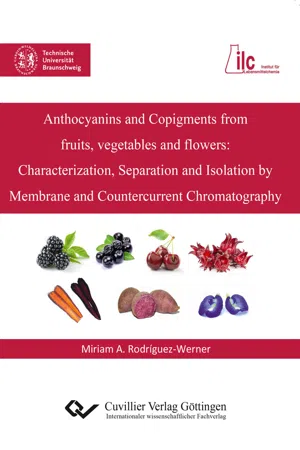
Public scandals, awareness of food safety of colorants and health promotion are factors that have prompted changes in the legislation of food additives worldwide. Furthermore, the substitution of synthetic with natural food colorants and the importance of finding new sources for natural food colorants have significantly increased. In the first part of this work, the main aim was to characterize the phenolic composition of anthocyanin-rich plant-derived extracts, especially from blackberry, black chokeberry, sour cherry, black carrots, purple sweet potatoes, roselle and butterfly pea. The chemical composition of anthocyanins-rich extracts was obtained by TLC, UV spectra, HPLC-DAD, HPLC ESI-MSn and NMR analysis. In this way, their fingerprints were established in order to be used for routine analytical purposes as well as authenticity control. In the second part, the preparative isolation of anthocyanins by membrane chromatography and countercurrent chromatography was performed. Separation of anthocyanins by both chromatographic techniques was achieved in all cases and allowed isolation of anthocyanin pigments on a large scale in high purity and quantity. On the other hand, countercurrent chromatography, especially LSRCCC, HSCCC and HPCCC provided separation of polyphenols and isolation of individual compounds on a large scale, particularly anthocyanins, chlorogenic acids, quercetin glycosides and kaempferol glycosides.
Frequently asked questions

Yes, you can cancel anytime from the Subscription tab in your account settings on the Perlego website. Your subscription will stay active until the end of your current billing period. Learn how to cancel your subscription.
No, books cannot be downloaded as external files, such as PDFs, for use outside of Perlego. However, you can download books within the Perlego app for offline reading on mobile or tablet. Learn more here.
Perlego offers two plans: Essential and Complete
  • Essential is ideal for learners and professionals who enjoy exploring a wide range of subjects. Access the Essential Library with 800,000+ trusted titles and best-sellers across business, personal growth, and the humanities. Includes unlimited reading time and Standard Read Aloud voice.
  • Complete: Perfect for advanced learners and researchers needing full, unrestricted access. Unlock 1.4M+ books across hundreds of subjects, including academic and specialized titles. The Complete Plan also includes advanced features like Premium Read Aloud and Research Assistant.
Both plans are available with monthly, semester, or annual billing cycles.
We are an online textbook subscription service, where you can get access to an entire online library for less than the price of a single book per month. With over 1 million books across 1000+ topics, we’ve got you covered! Learn more here.
Look out for the read-aloud symbol on your next book to see if you can listen to it. The read-aloud tool reads text aloud for you, highlighting the text as it is being read. You can pause it, speed it up and slow it down. Learn more here.
Yes! You can use the Perlego app on both iOS or Android devices to read anytime, anywhere — even offline. Perfect for commutes or when you’re on the go.
Please note we cannot support devices running on iOS 13 and Android 7 or earlier. Learn more about using the app.
Yes, you can access Anthocyanins and Copigments from fruits, vegetables and flowers by in PDF and/or ePUB format. We have over one million books available in our catalogue for you to explore.

Information

Year
2016
Print ISBN
9783736994263
eBook ISBN
9783736984264
Edition
1

Table of contents

  1. Content
  2. 1 Introduction and Intention
  3. 2 General
  4. 2.2 Raw materials
  5. 2.3 Preparative techniques for separation
  6. 3 Results and Discussion
  7. 3.3 Black chokeberry
  8. 3.4 Sour cherries
  9. 3.5 Black carrots
  10. 3.6 Purple sweet potato
  11. 3.7 Roselle
  12. 3.8 Butterfly pea
  13. 3.9 Authenticity and Food Adulterations
  14. 4 Material and Methods
  15. 4.1 Plant materials
  16. 4.2 Chemicals
  17. 4.3 Extraction of polyphenols
  18. 4.4 Adsorption chromatography on Amberlite XAD-7
  19. 4.5 Solvent precipitation
  20. 4.6 Device parameters
  21. 4.6.1 HPLC-DAD
  22. 4.6.2 HPLC-DAD-ESI-MSn
  23. 4.6.3 TLC
  24. 4.6.4 UV Spectrophotometer
  25. 4.6.5 Membrane chromatography
  26. 4.6.6 Countercurrent Chromatography
  27. 4.6.7 Nuclear Magnetic Resonance Spectroscopy
  28. 5 Summary and Conclusion
  29. 6 Zusammenfassung
  30. 7 References