Synthese multi- und heterometallischer Goldkomplexe mit Ferrocendithiocarboxylat und bipyridyl-funktionalisierten N-heterozyklischen-Carbenliganden
eBook - PDF

Synthese multi- und heterometallischer Goldkomplexe mit Ferrocendithiocarboxylat und bipyridyl-funktionalisierten N-heterozyklischen-Carbenliganden

,
  1. 190 pages
  2. English
  3. PDF
  4. Available on iOS & Android
eBook - PDF

Synthese multi- und heterometallischer Goldkomplexe mit Ferrocendithiocarboxylat und bipyridyl-funktionalisierten N-heterozyklischen-Carbenliganden

,

About this book

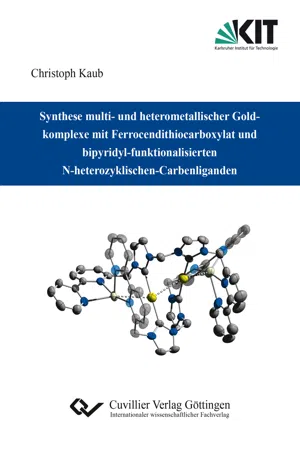
Die Arbeit beschreibt die Synthese und Charakterisierung mehrkerniger Metallkomplexe sowie ihre Untersuchung hinsichtlich metallophiler Wechselwirkungen mit dem Fokus auf dem Element Gold. Mit dem Liganden FerrocendithiocarbonsĂ€ure konnte unter Verwendung von zusĂ€tzlichen Phosphanliganden eine Reihe ein- und zweikerniger Goldkomplexe dargestellt werden, in denen teilweise intramolekulare aurophile Wechselwirkungen vorliegen. Der Schwefelligand zeigt dabei eine ausgeprĂ€gte Tendenz zur Bildung von Komplexen mit den fĂŒr Gold ungewöhnlichen Koordinationszahlen drei und vier. Im zweiten Teil der Arbeit wird die Synthese offenkettiger und zyklischer Goldkomplexe mit bipyridinsubstituierten N-heterozyklischen Carbenen behandelt. Diese Verbindungen eignen sich zur Darstellung der korrespondierenden hetero-multimetallischen Komplexe mit Kupfer, Silber, Zink und Cobalt. Mit einem symmetrischen Bis-NHC-Liganden gelang die erste Synthese eines makrozyklischen Komplexes mit einem Kern aus einer Ag-Au2-Ag-Kette, die ausschließlich von Neutralliganden koordiniert wird. Die Metall-Metall-AbstĂ€nde betragen ca. 3.0 Å und können somit als metallophile Wechselwirkung verstanden werden.
Frequently asked questions

Yes, you can cancel anytime from the Subscription tab in your account settings on the Perlego website. Your subscription will stay active until the end of your current billing period. Learn how to cancel your subscription.
No, books cannot be downloaded as external files, such as PDFs, for use outside of Perlego. However, you can download books within the Perlego app for offline reading on mobile or tablet. Learn more here.
Perlego offers two plans: Essential and Complete
  • Essential is ideal for learners and professionals who enjoy exploring a wide range of subjects. Access the Essential Library with 800,000+ trusted titles and best-sellers across business, personal growth, and the humanities. Includes unlimited reading time and Standard Read Aloud voice.
  • Complete: Perfect for advanced learners and researchers needing full, unrestricted access. Unlock 1.4M+ books across hundreds of subjects, including academic and specialized titles. The Complete Plan also includes advanced features like Premium Read Aloud and Research Assistant.
Both plans are available with monthly, semester, or annual billing cycles.
We are an online textbook subscription service, where you can get access to an entire online library for less than the price of a single book per month. With over 1 million books across 1000+ topics, we’ve got you covered! Learn more here.
Look out for the read-aloud symbol on your next book to see if you can listen to it. The read-aloud tool reads text aloud for you, highlighting the text as it is being read. You can pause it, speed it up and slow it down. Learn more here.
Yes! You can use the Perlego app on both iOS or Android devices to read anytime, anywhere — even offline. Perfect for commutes or when you’re on the go.
Please note we cannot support devices running on iOS 13 and Android 7 or earlier. Learn more about using the app.
Yes, you can access Synthese multi- und heterometallischer Goldkomplexe mit Ferrocendithiocarboxylat und bipyridyl-funktionalisierten N-heterozyklischen-Carbenliganden by in PDF and/or ePUB format. We have over one million books available in our catalogue for you to explore.

Information

Year
2016
Print ISBN
9783736993976
eBook ISBN
9783736983977
Edition
1

Table of contents

  1. Inhaltsverzeichnis
  2. 1 Einleitung
  3. 2 Aufgabenstellung
  4. 3 Ergebnisse und Diskussion
  5. 4 Experimenteller Teil
  6. 5 Zusammenfassung
  7. 6 Literatur
  8. 7 Anhang
  9. Danksagung