Bildung von nanoskopischem Calciumfluorid über die Sol-Gel-Synthese
eBook - PDF

Bildung von nanoskopischem Calciumfluorid über die Sol-Gel-Synthese

,
  1. 198 pages
  2. English
  3. PDF
  4. Available on iOS & Android
eBook - PDF

Bildung von nanoskopischem Calciumfluorid über die Sol-Gel-Synthese

,

About this book

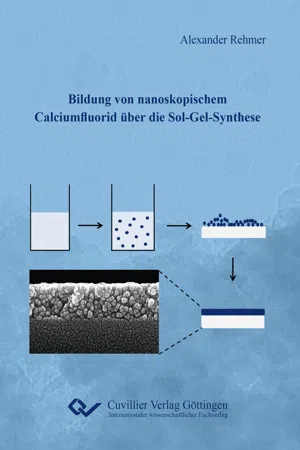
Das Ziel dieser Arbeit umfasst die Synthese von nanoskopischem Calciumfluorid über die fluorolytische Sol-Gel-Synthese. Dabei ist ein einfacher Syntheseweg über Calciumchlorid oder auch Calciumlactat möglich, der zu nanopartikulärem Calciumfluorid führt. Analytische Methoden (NMR, DLS, TEM) bestätigen die Anwesenheit von nanometergroßen CaF2-Partikeln.Anwendungen für nanopartikuläres Calciumfluorid sind überwiegend optische Applikationen wie beispielsweise die Erzeugung von antireflektiven Schichten auf Glas. Da Calciumfluorid neben Magnesiumfluorid gute optische Eigenschaften besitzt, zeigt sich weiterhin, dass CaF2-Schichten wasserbeständiger sind als im Vergleich zu MgF2-Schichten. Dies ist auf die geringere Wasserlöslichkeit von Calciumfluorid im Vergleich zu Magnesiumfluorid zurückzuführen. Auch die mechanische Abriebfestigkeit einer CaF2-Schicht aus Calciumchlorid ist wesentlich höher als bei einer MgF2-Schicht.Durch diese positiven Eigenschaften der CaF2-Schichten sowie der einfachen und kostengünstigen Synthese der CaF2-Partikel stellt Calciumfluorid eine gute Alternative zu den bisherigen antireflektiven Beschichtungsmaterialien wie z. B. poröses SiO2 oder MgF2 dar.
Frequently asked questions

Yes, you can cancel anytime from the Subscription tab in your account settings on the Perlego website. Your subscription will stay active until the end of your current billing period. Learn how to cancel your subscription.
No, books cannot be downloaded as external files, such as PDFs, for use outside of Perlego. However, you can download books within the Perlego app for offline reading on mobile or tablet. Learn more here.
Perlego offers two plans: Essential and Complete
  • Essential is ideal for learners and professionals who enjoy exploring a wide range of subjects. Access the Essential Library with 800,000+ trusted titles and best-sellers across business, personal growth, and the humanities. Includes unlimited reading time and Standard Read Aloud voice.
  • Complete: Perfect for advanced learners and researchers needing full, unrestricted access. Unlock 1.4M+ books across hundreds of subjects, including academic and specialized titles. The Complete Plan also includes advanced features like Premium Read Aloud and Research Assistant.
Both plans are available with monthly, semester, or annual billing cycles.
We are an online textbook subscription service, where you can get access to an entire online library for less than the price of a single book per month. With over 1 million books across 1000+ topics, we’ve got you covered! Learn more here.
Look out for the read-aloud symbol on your next book to see if you can listen to it. The read-aloud tool reads text aloud for you, highlighting the text as it is being read. You can pause it, speed it up and slow it down. Learn more here.
Yes! You can use the Perlego app on both iOS or Android devices to read anytime, anywhere — even offline. Perfect for commutes or when you’re on the go.
Please note we cannot support devices running on iOS 13 and Android 7 or earlier. Learn more about using the app.
Yes, you can access Bildung von nanoskopischem Calciumfluorid über die Sol-Gel-Synthese by in PDF and/or ePUB format. We have over one million books available in our catalogue for you to explore.

Information

Year
2016
Print ISBN
9783736992757
eBook ISBN
9783736982758
Edition
1

Table of contents

  1. Kurzfassung
  2. Abstract
  3. Inhaltsverzeichnis
  4. Abkürzungsverzeichnis
  5. Probenindex
  6. 1. Einleitung
  7. 2. Zielstellung
  8. 3. Grundlagen und analytische Methoden
  9. 4. Charakterisierung der Calciumfluorid-Sole und -Xerogele aus diversen Calcium-Präkursoren
  10. 5. Stabilisierung von CaF2-Partikeln im Sol
  11. 6. Herstellung der Calciumfluorid-Schichten
  12. 7. Zusammenfassung
  13. 8. Ausblick
  14. 9. Experimenteller Teil
  15. Anhang
  16. Literatur
  17. Abbildungsverzeichnis
  18. Tabellenverzeichnis
  19. Danksagung
  20. Selbstständigkeitserklärung