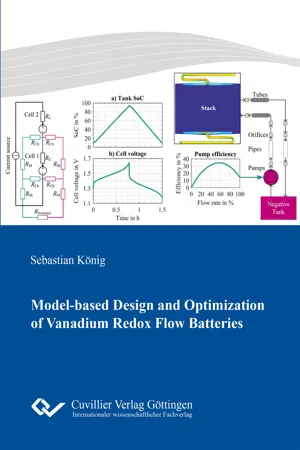
In this work, a holistic approach is used to develop a multi-physical model of the Vanadium Redox Flow Battery on a system level. The model is validated with experimental data from three flow battery manufacturers and is then deployed in an extensive parameter study for designing a flow battery cell. Using finite element analysis (FEA), twenty-four different cell designs are derived, which vary in electrode area and the design of the electrolyte inlet and outlet supply channels. The performance of the designs is then simulated in a single-stack and a three-stack string system. The presented model is also deployed in a flow rate optimization study. Here, a novel strategy involving the model-based optimization of operation-points defined by state-of-charge and charging or discharging current is presented and compared to conventional flow rate control strategies. Finally, a stack voltage controller is introduced, which prevents the violation of cell voltage limits as long as the pump capacity is not fully utilized.
- 183 pages
- English
- PDF
- Available on iOS & Android
eBook - PDF
About this book
Information
Print ISBN
9783736996151
Edition
1Table of contents
- Contents
- Zusammenfassung (German abstract)
- Introduction and motivation
- Flow battery modeling
- Definitions
- Validation of the stack voltage model
- Model-based cell design
- Evaluation of the cell designs in a single-stack system
- Evaluation of the cell designs in a three-stack system
- Flow rate optimization
- Summary and Outlook
- Appendix A
- Appendix B
- Appendix C
- Appendix D
- Appendix E
Trusted by 375,005 students
Access to over 1.5 million titles for a fair monthly price.
Study more efficiently using our study tools.