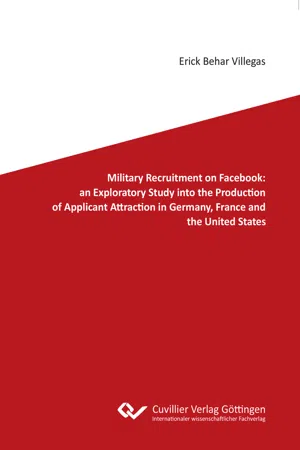
Soziale Medien wie Facebook eröffneten neue Kommunkationsmöglichkeiten für das Militär um sich im Arbeitsmarkt als attraktiver Arbeitgeber zu positionieren. Nach der Abschaffung der Wehrpflicht musste sich das Militär neu und attraktiv definieren, um Rekruten im Konkurrenzmarkt gegen den privaten Sektor anzuziehen. Diese Arbeit geht der Frage nach, wie das Militär in Deutschland, USA und Frankreich Attraktivität produziert, mit dem Ziel, die Personalgewinnung digital zu stärken. Dabei geht es um einen cyberanthropologischen Ansatz, der mit verschiedenen quantitativen und qualitativen Methoden die Perspektive von Rekruten und der Institution erfasst. Diese interdisziplinäre Annäherung auf die digitale Ebene der Kommunikation des Militärs versucht das Spektrum der Militäranthropologie und -soziologie auszuweiten, in dem Ansätze des Marketings und des Personalmanagements auch aufgefasst werden. So werden Employer-Branding Perspektiven des Militärs in einem internationalen Vergleich im jeweiligen politischen Kontext und unter mehrdisziplinären theoretischen Betrachtungen vorgestellt und analysiert. Die empirischen Ergebnisse weisen darauf hin, dass jedes Militär heterogen bleibt und jedoch kulturell und historisch geprägt wird, während es eine Attraktivitätspolitik schafft. Während die deutsche Bundeswehr sich eher mit Technik und kaum mit Geschichte befasst, setzt das französische Militär auf das zeremonielle, das design-intensive und das amerikanische Militär eher auf Werte, Patriotismus und nationalen Ikonen, die eine Identität dynamisch mitaufbauen. Social Media such as Facebook opened an array of communication potentials for the military, in order to brand itself as an attractive employer on the labor market. After the elimination of conscription, the military had to redefine itself attractively in order to lure new recruits while competing against the private sector. This work addresses the question how the Armed Forces in France, Germany and the United States produce attraction with the goal of digitally strengthening their recruitment approach. Based on cyberanthropology and using both qualitative and quantitative methods, it attempts to understand the perspectives of both recruits and the institution itself. This interdisciplinary approach to the digital realm of military communication seeks to expand the spectrum of military anthropology and sociology by using elements from marketing and recruitment studies. Employer-Branding perspectives of the military are presented and analyzed in an international comparison that takes the respective political context together with different theoretical approximations into account. Empirical results suggest that each national military remains heterogenous while being influenced both culturally and historically in the process of creating an attraction-led policy for recruitment. While the German military focuses more on technology and leaves history aside, the French Armed Forces prefer the 'ceremonial' and design-intensive, whereas the US American military highlights values, patriotism and national icons that dynamically aid in building an identity.
- 325 pages
- English
- PDF
- Available on iOS & Android
eBook - PDF
About this book
Information
Print ISBN
9783736998872
Edition
1Table of contents
- Introduction
- 1.1. Recruiutment realities
- 2.1. Historical development
- 3. Interdisciplinary
- 4. Theoretical Perspectives
- 5. Empirical study
- 6. Producing Applicant
- 7. Literature
Trusted by 375,005 students
Access to over 1.5 million titles for a fair monthly price.
Study more efficiently using our study tools.